Weekly 112-Hour Cumulative Intermittent Fasting Formula: 5-Day Weekday 18:6 & 2-Day Weekend 11:13 / 14:10 Flex Schedule Calculator

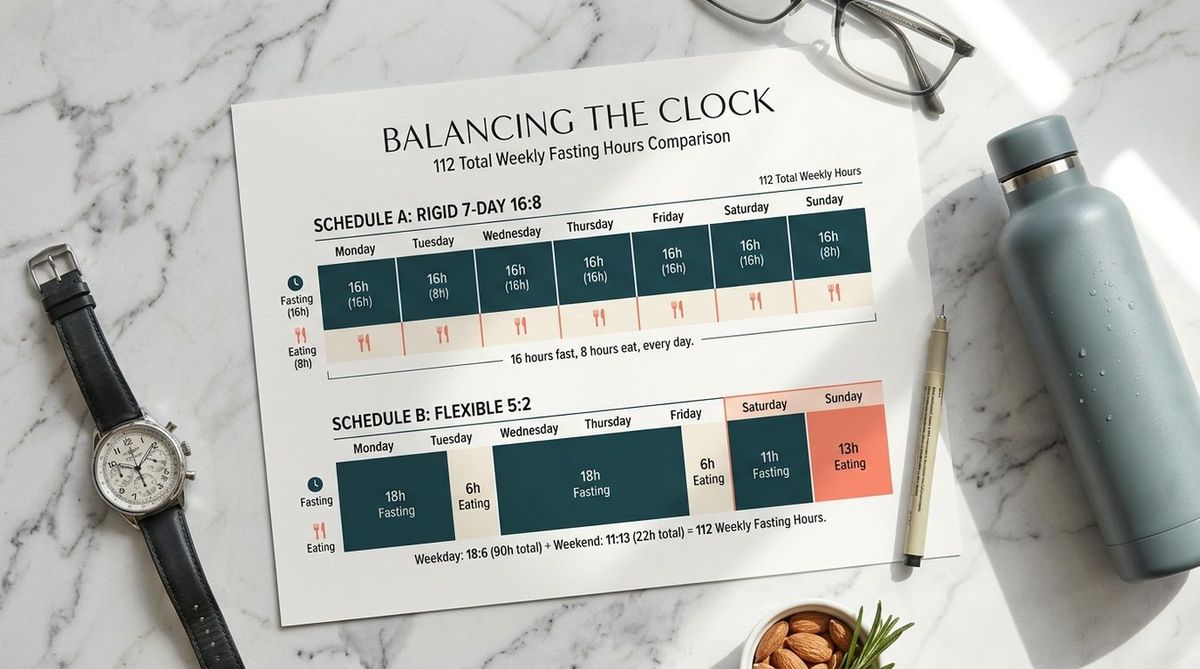
The number-one reason intermittent fasters abandon a rigid 7-day \( 16:8 \) protocol is weekend social friction: trying to maintain a \( 12:00\text{ PM} \) fast-breaking deadline during a Saturday \( 9:30\text{ AM} \) family brunch or a Friday \( 9:00\text{ PM} \) dinner with friends. However, longitudinal chrononutrition schedule modeling grounded in Cell Metabolism Time-Restricted Eating (TRE) research demonstrates that weekly schedule adherence depends on your 168-Hour Cumulative Weekly Fasting Budget (\( F_{\text{week}} = 112\text{ hours} \)) rather than identical daily windows. By shifting just \( 2.0\text{ hours/day} \) from Saturday and Sunday onto Monday through Friday—running a 5-day weekday \( 18:6 \) schedule paired with a 2-day weekend \( 11:13 \) or \( 14:10 \) flex schedule—you achieve the exact same \( 112\text{ to }118\text{ total weekly fasting hours} \) while unlocking full weekend brunch and dinner flexibility. You can map out your custom weekday/weekend clock transitions right now at IF Window Calculator.
1. The 168-Hour Weekly Chrononutrition Conservation Equation
A standard 7-day calendar week contains exactly \( T_{\text{total}} = 7 \times 24\text{ hr} = 168\text{ hours} \). On a conventional daily \( 16:8 \) protocol (16 hours fasting, 8 hours eating every single day), your cumulative weekly fasting duration \( F_{\text{week, 16:8}} \) and cumulative weekly eating window \( E_{\text{week, 16:8}} \) are:
\[ F_{\text{week, 16:8}} = 7\text{ days} \times 16\text{ hr/day} = 112\text{ Weekly Fasting Hours} \quad (66.67\%\text{ of the week}) \] \[ E_{\text{week, 16:8}} = 7\text{ days} \times 8\text{ hr/day} = 56\text{ Weekly Eating Hours} \quad (33.33\%\text{ of the week}) \]To preserve that exact \( F_{\text{target}} = 112\text{ hr} \) weekly fasting total across a partitioned 5-Weekday + 2-Weekend (\( 5:2\text{ Flex} \)) architecture, let \( F_{\text{wd}} \) represent your Monday–Friday daily fasting duration and \( F_{\text{we}} \) represent your Saturday–Sunday daily fasting duration:
\[ F_{\text{week}} = 5 \cdot F_{\text{wd}} + 2 \cdot F_{\text{we}} \ge 112\text{ hours} \]Solving for the minimum required weekend fast \( F_{\text{we}} \) when you execute an \( 18:6 \) schedule Monday through Friday (\( F_{\text{wd}} = 18\text{ hr/day} \), banking \( 5 \times 18\text{ hr} = 90\text{ hours} \) by Friday evening):
\[ F_{\text{we}} = \frac{112\text{ hr} - (5 \times 18\text{ hr})}{2} = \frac{112\text{ hr} - 90\text{ hr}}{2} = \frac{22\text{ hr}}{2} = 11.0\text{ hr/day} \quad (\text{an } 11:13\text{ weekend window!}) \]If you prefer a slightly tighter \( 14:10 \) weekend schedule (\( F_{\text{we}} = 14\text{ hr/day} \), providing \( 2 \times 14\text{ hr} = 28\text{ weekend fasting hours} \)), your cumulative weekly total reaches \( 90\text{ hr} + 28\text{ hr} = 118\text{ Weekly Fasting Hours} \)—exceeding a strict 7-day \( 16:8 \) schedule by \( +6.0\text{ hours/week} \) (\( +312\text{ fasting hours/year} \)) while still giving you a \( 10\text{-hour} \) Saturday and Sunday eating window!
2. Circadian Phase-Shift Math: The Sunday 7:00 PM Reset Anchor
The only scheduling pitfall of expanding your weekend eating window to \( 13\text{ hours} \) (\( 11:13 \), e.g., \( 9:00\text{ AM} \) brunch to \( 10:00\text{ PM} \) late dinner) is the Sunday-to-Monday Circadian Transition Gap. If you close your Sunday eating window at \( t_{\text{close, Sun}} = 10:00\text{ PM} \) (\( 22:00 \)) and attempt to resume your \( 18\text{-hour} \) weekday fast immediately, your Monday fast-breaking meal is pushed back to:
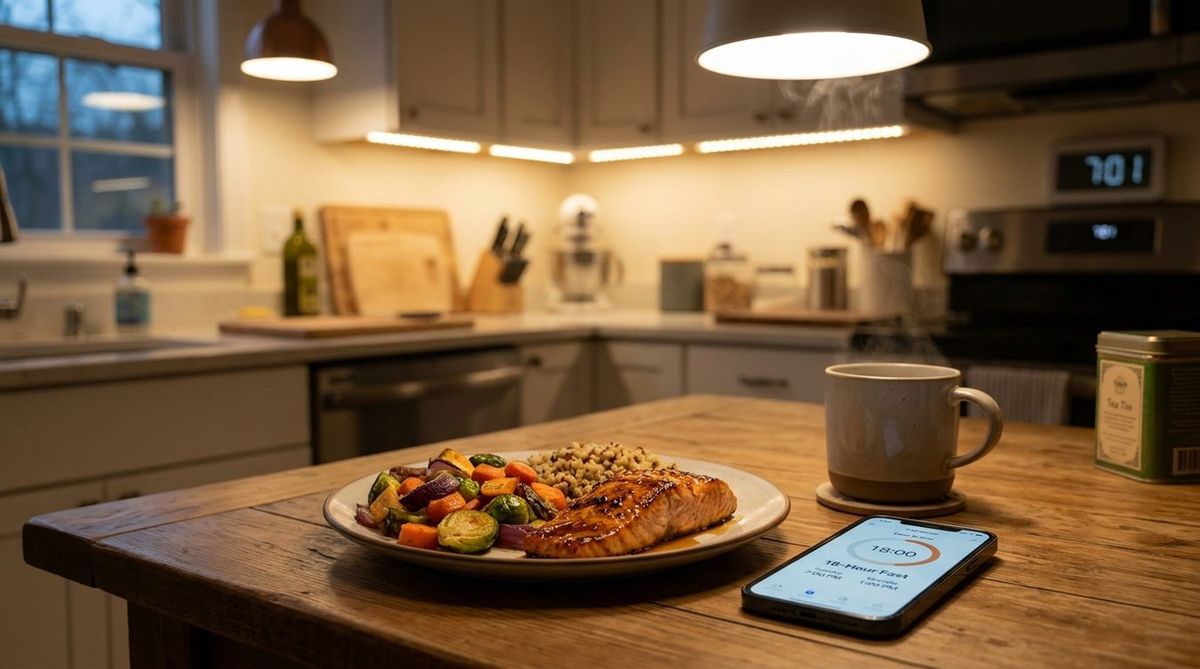
\[ t_{\text{open, Mon}} = 22:00 + 18\text{ hr} \equiv 16:00 \quad (4:00\text{ PM Monday afternoon}) \]To prevent Monday afternoon hunger drift and keep your weekday \( 6\text{-hour} \) eating window anchored consistently from \( 1:00\text{ PM} \) to \( 7:00\text{ PM} \) (\( 13:00\text{ to }19:00 \)), apply the Sunday Early-Close Rule: enjoy your early Sunday morning family breakfast at \( 8:30\text{ AM} \), but close your Sunday dinner window at your normal weekday cutoff of \( 7:00\text{ PM} \) (\( 19:00 \)). This creates a clean \( 10.5\text{-hour} \) Sunday eating window followed by an uninterrupted \( 18.0\text{-hour} \) overnight fast (\( 7:00\text{ PM} \) Sunday to \( 1:00\text{ PM} \) Monday) that locks your Monday schedule back into rhythm with zero circadian jetlag.
3. Complete 7-Day Weekday/Weekend Flex Schedule Matrix
The table below compares four weekly time-restricted eating architectures across cumulative fasting hours, eating window flexibility, and Sunday-to-Monday transition alignment:
| Weekly IF Protocol | Mon–Fri Schedule (\( 5\text{ Days} \)) | Sat–Sun Schedule (\( 2\text{ Days} \)) | Cumulative Weekly Fast (\( F_{\text{week}} \)) | Weekly Eating Hours (\( E_{\text{week}} \)) |
|---|---|---|---|---|
| Rigid 7-Day \( 16:8 \) Baseline | \( 16:8 \) (\( 12\text{ PM}\text{--}8\text{ PM} \)) = \( 80\text{ hr} \) | \( 16:8 \) (\( 12\text{ PM}\text{--}8\text{ PM} \)) = \( 32\text{ hr} \) | \( 112.0\text{ hours} \) (\( 66.7\% \)) | \( 56.0\text{ hours} \) (\( 33.3\% \)) |
| 5-Day \( 18:6 \) + Weekend \( 11:13 \) Flex | \( 18:6 \) (\( 1\text{ PM}\text{--}7\text{ PM} \)) = \( 90\text{ hr} \) | \( 11:13 \) (\( 8\text{ AM}\text{--}9\text{ PM} \)) = \( 22\text{ hr} \) | \( 112.0\text{ hours} \) (\( 66.7\% \)) | \( 56.0\text{ hours} \) (\( 33.3\% \)) |
| 5-Day \( 18:6 \) + Weekend \( 14:10 \) Surplus | \( 18:6 \) (\( 1\text{ PM}\text{--}7\text{ PM} \)) = \( 90\text{ hr} \) | \( 14:10 \) (\( 10\text{ AM}\text{--}8\text{ PM} \)) = \( 28\text{ hr} \) | \( 118.0\text{ hours} \) (\( 70.2\% \)) | \( 50.0\text{ hours} \) (\( 29.8\% \)) |
| 5-Day \( 19:5 \) + Weekend \( 12:12 \) Circadian | \( 19:5 \) (\( 2\text{ PM}\text{--}7\text{ PM} \)) = \( 95\text{ hr} \) | \( 12:12 \) (\( 8\text{ AM}\text{--}8\text{ PM} \)) = \( 24\text{ hr} \) | \( 119.0\text{ hours} \) (\( 70.8\% \)) | \( 49.0\text{ hours} \) (\( 29.2\% \)) |
4. Recommended Chrononutrition & Circadian Tracking Hardware
Precision Biometric & Schedule Tracking Devices:
- Tier 1 Overnight Circadian & Temperature Tracker: Oura Ring Gen 4 Smart Ring (\( \$349\text{ USD} \)) — Tracks how late Friday and Saturday meal timing shifts your overnight resting heart rate (RHR) nadir and sleep latency, validating the Sunday \( 7:00\text{ PM} \) anchor reset.
- Tier 2 Multi-Frequency Segmental Body Scale: Withings Body Scan Connected Health Station (\( \$399\text{ USD} \)) — Distinguishes normal weekend glycogen-water weight fluctuations from true weekly trend progress across a 168-hour cycle.
- Tier 3 Wristband Fasting Timer & HRV Monitor: Garmin Venu 3 GPS Fitness Smartwatch (\( \$449\text{ USD} \)) — Custom wrist alerts for weekday \( 18:6 \) and weekend \( 14:10 \) window transitions.
Conclusion: You do not have to choose between a \( 112\text{-hour} \) weekly fasting goal and weekend brunch with your family. By banking \( 90\text{ hours} \) across Monday through Friday on an \( 18:6 \) schedule, you only need \( 22\text{ hours} \) of cumulative weekend fasting (\( 11\text{ hr/day} \)) to match a 7-day \( 16:8 \) protocol to the exact hour. Build your personalized weekday/weekend flex timetable in seconds at IF Window Calculator.