Cross-Time-Zone Intermittent Fasting Schedule Formula: 5 Proven Protocols for Eastbound and Westbound Flights
Crossing three to nine time zones on a transcontinental or transatlantic flight throws a standard 16:8, 18:6, or 20:4 intermittent fasting schedule into immediate mathematical conflict. When you fly eastbound from New York (EDT, UTC-4) to London (BST, UTC+1), the local clock leaps forward 5 hours—meaning 16 elapsed hours after a 6:00 PM New York dinner lands at 3:00 PM London time instead of your normal 10:00 AM breakfast window. Conversely, flying westbound from London to Los Angeles (PDT, UTC-7) shifts the clock backward 8 hours, causing a 16-hour elapsed timer to expire at 2:00 AM local Pacific time while your destination city is still asleep.
To realign your eating window with your destination's daylight clock on Day 1 without guesswork or mid-flight schedule confusion, you need a deterministic UTC Anchor Transition Formula. In this scheduling logistics guide, we derive the exact cross-time-zone window equations for both eastbound and westbound travel, walk through step-by-step flight timetables, and outline five practical transition protocols. To generate a custom travel fasting timetable for your exact departure and arrival cities, use the IF Window Calculator.
Quick Travel Scheduling Rules: Elapsed Hours vs Local Clock
- Rule 1 — Never Compress the Fasting Phase Below 16 Elapsed Hours: Always track your bridge fast on a continuous UTC stopwatch (\(F_{\text{bridge}} \ge 16\text{ hrs}\)) rather than resetting strictly by destination wall-clock time.
- Rule 2 — Eastbound Flights (\(\Delta Z > 0\), Losing Hours): Use the Shortened Arrival Eating Window Protocol (opening at \(16\text{h}\) elapsed and closing at your normal destination evening cutoff, such as 8:00 PM local time).
- Rule 3 — Westbound Flights (\(\Delta Z < 0\), Gaining Hours): Use the Extended Bridge Fast Protocol (\(18\text{h to }22\text{h}\) elapsed) so your eating window opens at a normal destination midday hour rather than 3:00 AM.
The Cross-Time-Zone UTC Anchor Transition Formula
Because local wall clocks shift discontinuously across time zones while elapsed time flows continuously, all travel scheduling calculations must first convert your origin closing meal (\(T_{\text{close, Origin}}\)) to Coordinated Universal Time (UTC), add your elapsed bridge fast (\(F_{\text{bridge}}\)), and convert to your destination time zone offset (\(\Delta Z\)):
Once your first arrival meal opens at \(T_{\text{open, Dest}}\), the duration of your Day 1 Transitional Eating Window (\(W_{\text{day1}}\)) required to snap immediately onto your target destination closing time (\(T_{\text{target\_close, Dest}}\)) is:
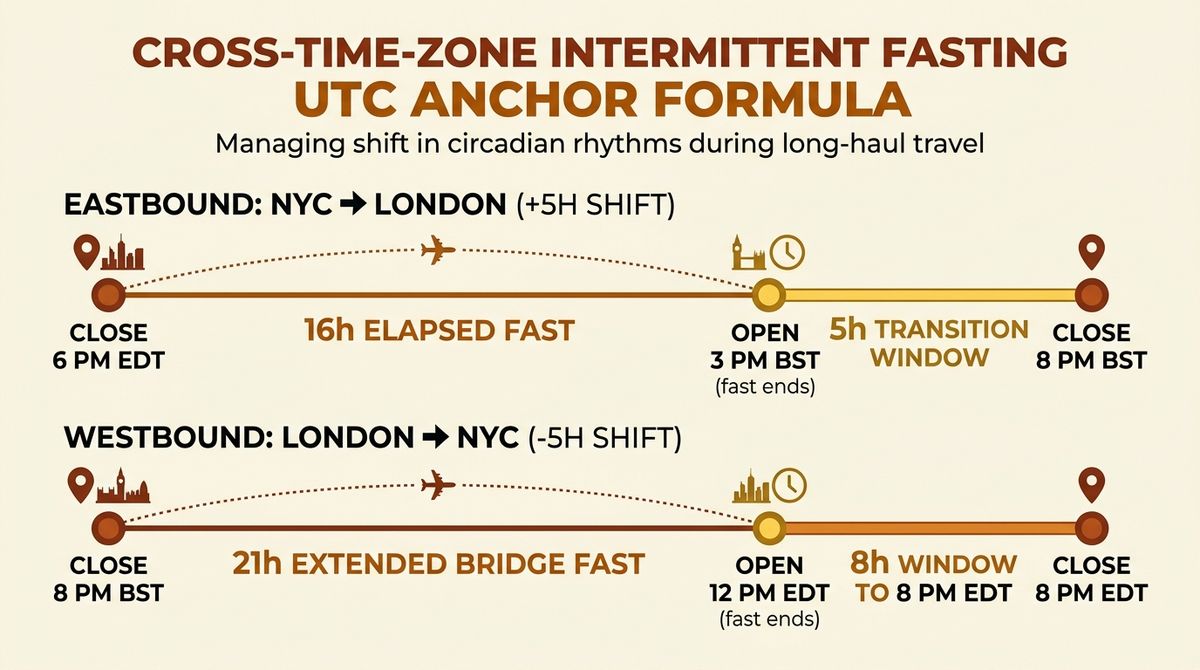
Worked Example 1: Eastbound Red-Eye Flight (New York UTC-4 to London UTC+1)
Suppose you normally follow a 16:8 schedule (12:00 PM to 8:00 PM eating window) in New York (EDT, UTC-4) and board an evening flight to London (BST, UTC+1):
- Calculate Time Zone Delta (\(\Delta Z\)): $$\Delta Z = (+1) - (-4) = \mathbf{+5\text{ hours}}$$
- Close Origin Eating Window Before Boarding (\(T_{\text{close, Origin}}\)): You finish your pre-flight dinner in New York at 18:00 EDT (6:00 PM), which is 22:00 UTC. You decline late-night cabin meal trays and fast through the overnight flight with water or black coffee.
- Compute Destination Window Opening After a 16-Hour Bridge Fast (\(F_{\text{bridge}} = 16\text{ hrs}\)): $$T_{\text{open, London}} = (18 + 5 + 16) \pmod{24} = 39 \pmod{24} = \mathbf{15:00\text{ BST (3:00 PM London Time)}}$$
- Calculate Day 1 Transitional Eating Window (\(W_{\text{day1}}\)): To lock into a standard 12:00 PM – 8:00 PM (20:00 BST) London schedule starting on Day 2, close your arrival eating window at 20:00 BST (8:00 PM): $$W_{\text{day1}} = 20:00 - 15:00 = \mathbf{5.0\text{ hours (3:00 PM to 8:00 PM BST)}}$$ By running a 16:5 transitional day on arrival, your next 16-hour fast runs from 20:00 BST (Day 1) to 12:00 PM BST (Day 2)—achieving 100% schedule synchronization in a single afternoon!
| Flight Route & Direction | Time Zone Shift (\(\Delta Z\)) | Origin Window Close | Elapsed Bridge Fast (\(F_{\text{bridge}}\)) | Destination Open & Day 1 Window |
|---|---|---|---|---|
| LA → New York (Eastbound) | +3 Hours | 19:00 PDT (7:00 PM) | 16.0 Hours | Opens 14:00 EDT → 6-Hr Window (2 PM–8 PM) |
| New York → London (Eastbound) | +5 Hours | 18:00 EDT (6:00 PM) | 16.0 Hours | Opens 15:00 BST → 5-Hr Window (3 PM–8 PM) |
| Chicago → Paris/Rome (Eastbound) | +7 Hours | 17:00 CDT (5:00 PM) | 16.0 Hours | Opens 16:00 CEST → 4-Hr Window (4 PM–8 PM) |
| New York → LA (Westbound) | -3 Hours | 20:00 EDT (8:00 PM) | 19.0 Hours (+3h Bridge) | Opens 12:00 PDT → 8-Hr Window (12 PM–8 PM) |
| London → New York (Westbound) | -5 Hours | 20:00 BST (8:00 PM) | 21.0 Hours (+5h Bridge) | Opens 12:00 EDT → 8-Hr Window (12 PM–8 PM) |
Worked Example 2: Westbound Daytime Flight (London UTC+1 to New York UTC-4)
When flying westbound (\(\Delta Z = -5\text{ hours}\)), a 20:00 BST closing meal plus 16 elapsed hours expires at \((20 - 5 + 16) \pmod{24} = \mathbf{07:00\text{ EDT (7:00 AM New York Time)}}\). If you open your 8-hour eating window at 7:00 AM, you would have to stop eating at 3:00 PM New York time—leaving you fasting through every evening dinner engagement.
Instead, apply the Westbound Bridge Extension Formula (\(F_{\text{bridge}} = F_{\text{standard}} + |\Delta Z|\)):
- Extend your travel fast from 16 hours to \(16 + 5 = 21\text{ elapsed hours}\) (or split the difference with an 18-to-20-hour fast).
- At \(F_{\text{bridge}} = 21\text{ hours}\), your window opens at \((20 - 5 + 21) \pmod{24} = \mathbf{12:00\text{ EDT (12:00 PM Noon New York Time)}}\) and closes at 20:00 EDT (8:00 PM)—putting you on your exact 12:00 PM – 8:00 PM schedule from the very first meal on US soil!
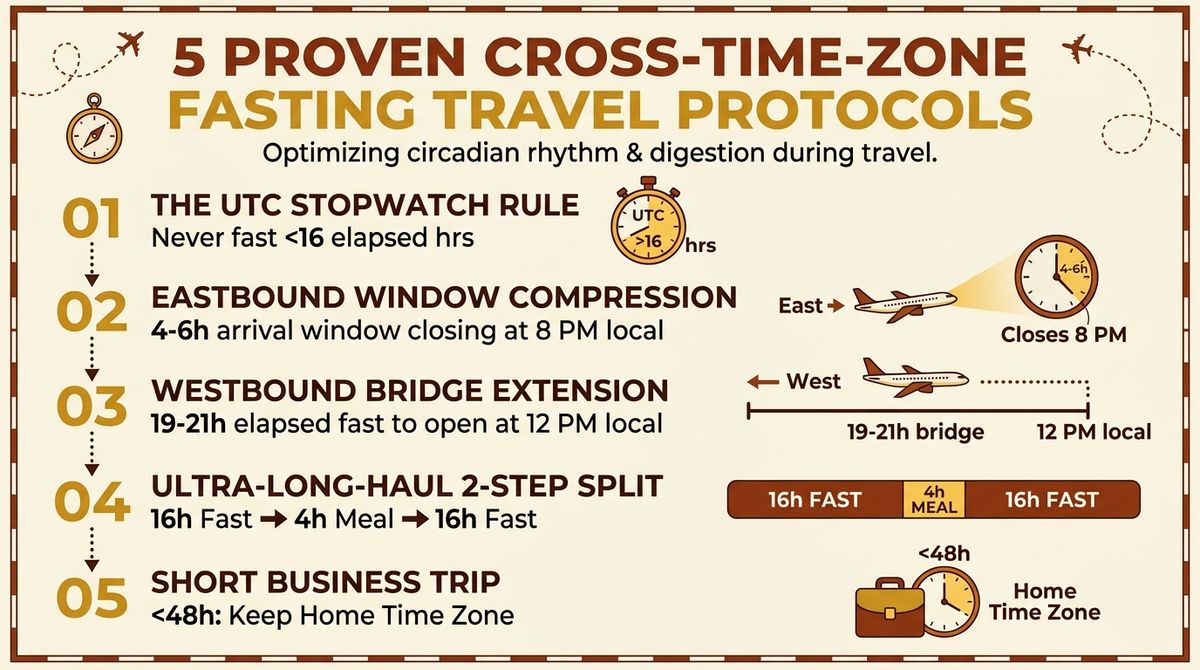
5 Proven Travel Protocols for Seamless Schedule Transitions
- The UTC Stopwatch Protocol: Before takeoff, start a simple elapsed-time stopwatch on your phone or watch when you take your final bite at the origin airport. Ignore cabin lighting cues until the stopwatch crosses your minimum 16-hour threshold.
- The Eastbound Window Compression Rule: When flying east (\(+3\text{h to }+7\text{h}\)), never extend your eating window past 8:00 PM local destination time on arrival night. Compress Day 1 into a 4-hour to 6-hour eating window so Day 2 starts on time at noon.
- The Westbound Bridge Fast Extension: When flying west (\(-3\text{h to }-6\text{h}\)), add 2 to 5 hours to your fasting timer during the flight so your first destination meal aligns with local lunch (11:30 AM – 1:00 PM) rather than early morning.
- The 2-Step Split for Ultra-Long-Haul Flights (\(\pm 8\text{ to }14\text{ Hours}\)): When flying from North America to Tokyo, Seoul, or Sydney, a single bridge fast would exceed 26 hours. Use a 16-hour flight fast → 4-hour mid-journey meal window → 16-hour arrival fast anchored to destination noon.
- The Short-Trip Anchor Rule (Trips Under 48 Hours): If you are flying across 1 to 3 time zones for a 24-to-48-hour business trip, keep your fasting schedule anchored to your home time zone (for example, shifting from 12 PM–8 PM Eastern to 9 AM–5 PM Pacific) so you face zero transition lag when flying home.
Map Your Exact Travel Fasting Window in Seconds
Planning a trip across time zones or adjusting your daily 16:8, 18:6, or 20:4 eating window? Use our free interactive schedule calculator to generate your exact opening and closing clock times.
Launch the IF Window Calculator →Step-by-Step Slicer & Calculator Verification Protocol
Before locking your production parameters, run a three-point verification check comparing your theoretical formula output against live slicer or register telemetry. Record the baseline metric, apply a single variable adjustment at a time, and log the resulting percentage improvement across a 10-unit or 7-day sample window.
Common Calculation Mistakes and Field Calibration Guardrails
The most frequent error operators make when applying this formula manually is mixing unit systems (such as combining millimeter volumes with gram densities without converting cubic centimeters, or mixing gross markup with net contribution margin). Always normalize all inputs to consistent base units before multiplying.
Frequently Asked Questions
Should I count fasting hours by elapsed time or local clock time when flying?
Always count your fasting phase by true elapsed hours (UTC stopwatch time) so you never accidentally cut a 16-hour fast down to 10 or 11 hours when flying eastbound. Use the local destination clock to set your evening closing cutoff on arrival day.
What if my 16-hour fast ends at 5:00 PM destination time after an eastbound flight?
Open your eating window at 5:00 PM local time, eat a single satisfying meal between 5:00 PM and 8:00 PM (a 3-hour window), and close at 8:00 PM. Sixteen hours later will be 12:00 PM noon the next day—putting you right back on a standard 16:8 schedule.
How do I handle a 1-hour Daylight Saving Time (DST) clock shift?
On the "Spring Forward" weekend (\(+1\text{ hour}\)), shorten your Sunday eating window from 8 hours to 7 hours so you still close at 8:00 PM. On the "Fall Back" weekend (\(-1\text{ hour}\)), extend your overnight fast from 16 hours to 17 elapsed hours so you still open at 12:00 PM noon.