Split-Shift and Two-a-Day Training Intermittent Fasting Window Schedule Formula: 5 Chronological Timing Protocols
Standard intermittent fasting schedules assume a single continuous 9-to-5 workday or a single afternoon gym session. However, hospitality managers, transit operators, emergency personnel working split shifts (such as an early 06:00–10:00 morning block paired with a 16:00–20:00 evening block), and endurance athletes executing two-a-day training sessions face a complex chronological puzzle: how do you position a continuous 8-hour (\(16:8\)) or 10-hour (\(14:10\)) eating window so that both daily activity blocks are bracketed by planned meals without violating your 14-to-16-hour overnight fast?
This guide provides a pure logistical and chronological scheduling framework—with zero medical, physiological, or dietary claims—using five exact clock-math equations to anchor your window open time (\(t_{\text{open}}\)), midpoint meal cadence, pre-block buffer (\(\Delta t_{\text{pre}}\)), and sleep-cutoff boundary. You can also generate a customized daily timetable in seconds using our IF Window Calculator.
Quick Chronological Scheduling Takeaways:
- The Bracket Span Rule (\(\Delta T_{\text{span}}\)): Measure the elapsed clock time from the end of Block 1 (\(t_{\text{end},1}\)) to the end of Block 2 (\(t_{\text{end},2}\)). If \(\Delta T_{\text{span}} \le 7.5\text{ hours}\), both post-block meals fit inside a standard \(16:8\) (\(8\text{-hour}\)) eating window.
- The 14:10 Expansion Threshold: When morning and evening sessions are separated by \(8.0\) to \(9.5\text{ hours}\) (for example, 07:30 AM end and 17:00 PM end), expand to a \(14:10\) (\(10\text{-hour}\)) eating window from \(08:00\) to \(18:00\).
- Three-Meal Midpoint Cadence: Inside a \(W_{\text{eat}}\) eating window, space three meals at \(t_{1} = t_{\text{open}}\), \(t_{2} = t_{\text{open}} + 0.5 \cdot (W_{\text{eat}} - 0.5)\), and \(t_{3} = t_{\text{close}} - 0.5\text{ hr}\).
- Pre-Sleep Buffer Constraint: Anchor window close \(t_{\text{close}}\) at least \(2.5\text{ to }3.0\text{ hours}\) prior to scheduled lights-out (\(t_{\text{sleep}}\)) to keep evening cleanup and commute logistics on track.
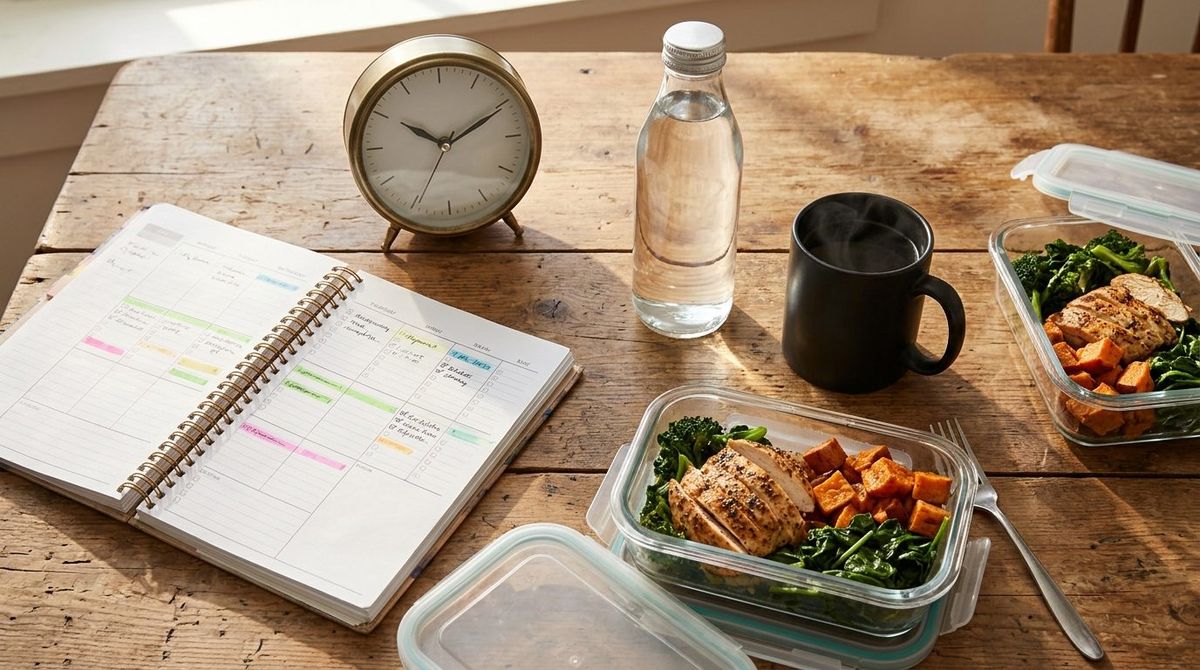
1. Protocol 1: Dual-Session Bracket Span Formula (\(\Delta T_{\text{span}}\))
Let Block 1 (your morning shift or AM training session) run from start time \(t_{\text{start},1}\) to completion time \(t_{\text{end},1}\), and let Block 2 (your afternoon/evening shift or PM session) run from \(t_{\text{start},2}\) to \(t_{\text{end},2}\) on a 24-hour decimal clock. Assuming you want to schedule Meal 1 at a fixed post-block buffer \(\delta_{\text{post},1} = 0.50\text{ hr}\) (\(30\text{ minutes}\)) after Block 1 finishes, and complete your final Meal 3 of duration \(d_{\text{meal}} = 0.50\text{ hr}\) at \(\delta_{\text{post},2} = 0.50\text{ hr}\) after Block 2 finishes, the minimum required eating window width \(W_{\text{min}}\) (in hours) is:
\[ W_{\text{min}} = \left( t_{\text{end},2} + \delta_{\text{post},2} + d_{\text{meal}} \right) - \left( t_{\text{end},1} + \delta_{\text{post},1} \right) = \left( t_{\text{end},2} - t_{\text{end},1} \right) + d_{\text{meal}} \]Worked Chronological Example A (16:8 Fit): Suppose Block 1 ends at \(10:30\) (\(t_{\text{end},1} = 10.50\)) and Block 2 ends at \(17:30\) (\(t_{\text{end},2} = 17.50\)), with a \(30\text{-minute}\) final meal (\(d_{\text{meal}} = 0.50\text{ hr}\)):
\[ W_{\text{min}} = \left( 17.50 - 10.50 \right) + 0.50 = 7.50\text{ hours} \le 8.00\text{ hours (Fits 16:8 Window)} \]Here, opening your \(8\text{-hour}\) window at \(t_{\text{open}} = 11:00\) and closing it at \(t_{\text{close}} = 19:00\) places Meal 1 at \(11:00\) (\(30\text{ mins}\) after Block 1) and Meal 3 from \(18:00\) to \(18:30\) (\(30\text{ mins}\) after Block 2), leaving a \(0.50\text{-hour}\) buffer before window close.
2. Protocol 2: The Pre-Block 2 Midday Anchor Equation
When scheduling a split-shift break between Block 1 and Block 2, you must position your midday Meal 2 so that it finishes at least \(\Delta t_{\text{buffer}} = 1.50\text{ to }2.00\text{ hours}\) before Block 2 begins at \(t_{\text{start},2}\), preventing schedule overlap during your afternoon commute or warm-up prep. The optimal clock time for Meal 2 (\(t_{\text{meal},2}\)) is:
\[ t_{\text{meal},2} = \min\left( t_{\text{open}} + \frac{W_{\text{eat}} - d_{\text{meal}}}{2}, \; t_{\text{start},2} - \Delta t_{\text{buffer}} - d_{\text{meal}} \right) \]Using our \(11:00\text{–}19:00\) window where Block 2 begins at \(16:00\) (\(t_{\text{start},2} = 16.00\)) and \(\Delta t_{\text{buffer}} = 1.50\text{ hr}\):
\[ t_{\text{meal},2} = \min\left( 11.00 + \frac{8.00 - 0.50}{2}, \; 16.00 - 1.50 - 0.50 \right) = \min\left( 14.75, \; 14.00 \right) = 14.00 \quad (14:00 / 2:00\text{ PM}) \]3. Protocol 3: Early-Morning Split-Shift (06:00 AM) Window Compression
What if Block 1 runs from \(06:00\) to \(08:00\) AM and Block 2 runs from \(17:00\) to \(19:00\) PM? Here, \(t_{\text{end},2} - t_{\text{end},1} = 19.00 - 8.00 = 11.00\text{ hours}\), which exceeds both an \(8\text{-hour}\) (\(16:8\)) and a \(10\text{-hour}\) (\(14:10\)) window. In this wide-split scenario, you have two logistical options:
- Option A — Post-Block-1 Fasted Carry (Midday-to-Evening 16:8): Keep Block 1 inside the final hours of your overnight fast, open your \(8\text{-hour}\) window at \(12:00\text{ PM}\), eat Meal 1 at \(12:00\text{ PM}\), Meal 2 at \(15:00\text{ PM}\) (\(2\text{ hours}\) before Block 2), and Meal 3 at \(19:30\text{ PM}\) right after Block 2 finishes, closing at \(20:00\text{ PM}\).
- Option B — Pre-Block-2 Window Close (Morning-to-Afternoon 14:10): Open a \(10\text{-hour}\) window at \(08:30\text{ AM}\) after Block 1, eat Meal 1 at \(08:30\text{ AM}\), Meal 2 at \(13:00\text{ PM}\), and your final Meal 3 from \(17:30\) to \(18:30\text{ PM}\) during a scheduled shift break.
4. Master Split-Shift & Two-a-Day Fasting Schedule Matrix
| Daily Activity Split Archetype | Block 1 Window | Block 2 Window | Recommended Protocol | Eating Window (\(t_{\text{open}} - t_{\text{close}}\)) |
|---|---|---|---|---|
| Compact Two-a-Day Training | 09:00 – 10:15 | 15:30 – 16:45 | Standard 16:8 Bracket | 10:45 – 18:45 (Meals: 10:45, 13:30, 17:45) |
| Hospitality Split Shift | 10:00 – 14:00 | 17:30 – 21:30 | Late-Shifted 16:8 | 14:30 – 22:30 (Meals: 14:30, 16:15, 21:45) |
| Early AM + Afternoon Split | 07:00 – 09:00 | 16:00 – 17:30 | Expanded 14:10 Bracket | 09:30 – 19:30 (Meals: 09:30, 13:30, 18:30) |
| Dawn AM + Evening PM Split | 06:00 – 07:30 | 17:30 – 19:00 | Afternoon-Anchored 16:8 | 12:00 – 20:00 (Meals: 12:00, 15:15, 19:15) |
| Transit / Split Commuter Shift | 06:30 – 10:30 | 14:30 – 18:30 | Midday-Centered 16:8 | 11:00 – 19:00 (Meals: 11:00, 13:00, 18:30) |
5. Protocol 4 & 5: Weekly Rest-Day Window Normalization & Commute Slack
When transitioning from a 5-day split-shift workweek into a 2-day single-block weekend, avoid shifting your window open time \(t_{\text{open}}\) by more than \(\Delta t_{\text{drift}} \le 1.0\text{ hour}\) per day: \[ \left| t_{\text{open,weekend}} - t_{\text{open,weekday}} \right| \le 1.00\text{ hr} \] Keeping your weekend opening anchor within \(60\text{ minutes}\) of your weekday schedule prevents Monday morning schedule lag and keeps your 168-hour weekly fasting total locked at \(112\text{ hours}\) (for \(16:8\)) or \(98\text{ hours}\) (for \(14:10\)).
6. Multi-Day Split-Shift Rotation & Commute Buffer Audit
For transit drivers, aviation crew members, and hospital technicians whose split-shift block times rotate between early-morning weeks (05:30–09:30 and 14:30–18:30) and late-evening weeks (09:00–13:00 and 17:30–21:30), the transition Sunday requires a controlled Chronological Step-Slide Protocol. Rather than jumping your eating window open time \(t_{\text{open}}\) forward by \(4.0\text{ hours}\) in a single day—which creates an unplanned \(20\text{-hour}\) fast—split the adjustment across Saturday and Sunday in two \(2.0\text{-hour}\) increments (\(+2.0\text{ hr/day}\)).
Furthermore, always build a dedicated \(20\text{-minute}\) packing and transit slack interval (\(\delta_{\text{pack}} = 0.33\text{ hr}\)) into your daily schedule before leaving for Block 2. Pre-portioning your midday Meal 2 and post-shift Meal 3 into insulated containers during your midday break ensures that traffic delays or overtime shift handoffs never force you to miss your planned \(t_{\text{close}}\) window boundary.
Generate Your Custom Split-Shift Intermittent Fasting Timetable
Enter your exact shift start times, commute buffers, and preferred fasting ratio into our interactive scheduling calculator.
Launch the Free Intermittent Fasting Window Calculator →