Rotating Shift Worker Intermittent Fasting Schedule Transition Formula: 5 Timing Protocols for 2-2-3 Day-to-Night Rotations
Adhering to an intermittent fasting schedule is mathematically straightforward when daily wake-sleep schedules remain static. However, for millions of industrial, healthcare, and emergency service personnel working rotating shift patterns—such as the rapid 2-2-3 Panama or Dupont shift rotations—maintaining a fixed 16:8 eating window is practically impossible. Under a 2-2-3 schedule, an employee works two 12-hour day shifts (7:00 AM to 7:00 PM), takes two days off, works three 12-hour night shifts (7:00 PM to 7:00 AM), and alternates weekly.
Attempting to enforce rigid 12:00 PM to 8:00 PM eating hours across rotating shifts forces workers to either fast through grueling 12-hour night shifts with zero energy, or consume heavy meals immediately before daytime sleep, severely disrupting sleep efficiency. Managing this logistical challenge requires an algorithmic schedule sliding framework. By calculating transition bridge days and enforcing strict digestion buffers prior to daytime sleep, rotating shift workers can maintain consistent weekly fasting totals without schedule collapse.
Quick Answer & Logistical Scheduling Protocol:
- The Shift Delta Challenge: Transitioning from a 7:00 AM day shift to a 7:00 PM night shift creates a 12-hour temporal inversion in wake-sleep architecture.
- The Bridge Day Sliding Formula: Rather than jumping 12 hours abruptly, workers execute a calculated 4-hour to 6-hour window slide across the transition day.
- Pre-Sleep Digestion Clearance: The final meal of any shift must conclude a minimum of 2.5 to 3.0 hours before sleep onset to prevent gastric reflux during daytime sleep.
- Day Shift Eating Window: Fixed 11:00 AM to 7:00 PM window (16:8 protocol) aligning with daylight working hours.
- Night Shift Eating Window: Inverted 11:00 PM to 7:00 AM window aligning with active night-shift operational hours.
- Interactive Window Scheduler: Calculate your custom shift-work window transitions using the Intermittent Fasting Window Calculator.
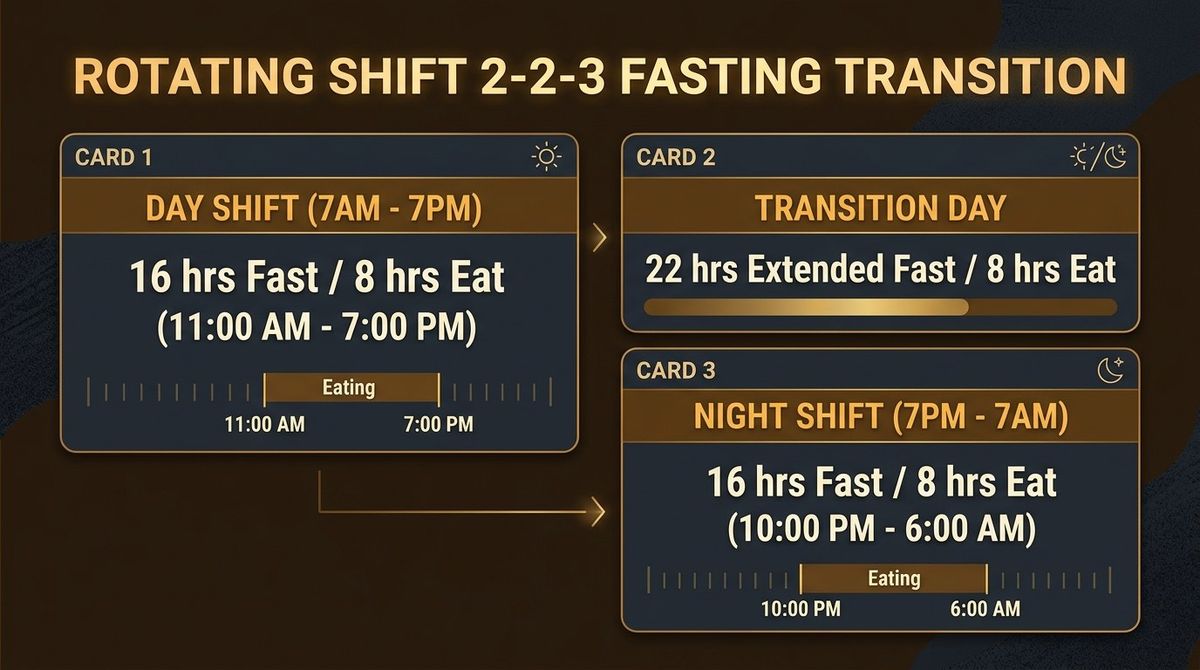
Figure 1: Chronological 24-hour timeline showing day shift, bridge transition day, and night shift eating windows.
1. The Temporal Window Shift Delta Formula
When rotating between day shifts and night shifts, the absolute temporal displacement between eating window midpoints \(\Delta t_{\text{shift}}\) is calculated as:
\[ \Delta t_{\text{shift}} = |t_{\text{night,start}} - t_{\text{day,start}}| \]On a standard 12-hour rotating rotation where day shift eating begins at 11:00 AM (11:00) and night shift eating begins at 11:00 PM (23:00):
\[ \Delta t_{\text{shift}} = |23.00 - 11.00| = 12.0\text{ hours} \]Attempting to execute a full 12-hour window flip in a single calendar day forces an unplanned 24-hour fast or an unhealthy 4-hour double-eating period. To prevent schedule fatigue, the shift is distributed across \(N_{\text{trans}}\) intermediate bridge days (typically 1 or 2 transition days):
\[ \delta t_{\text{daily}} = \frac{\Delta t_{\text{shift}}}{N_{\text{trans}} + 1} = \frac{12.0\text{ hours}}{2} = 6.0\text{ hours/day} \]On Bridge Day 1 (the switch day), the eating window slides forward by exactly 6 hours, opening at 5:00 PM (17:00) and closing at 1:00 AM (01:00). On Night Shift Day 1, the window opens at 11:00 PM (23:00), completing the transition seamlessly.
2. Pre-Sleep Digestion Buffer Clearance Mathematics
Daytime sleep following a 12-hour night shift is vulnerable to ambient light, environmental noise, and elevated core body temperature. Eating a large meal immediately before daytime sleep forces the body to divert blood flow toward digestion, impairing sleep quality. To protect sleep hygiene, the final meal cutoff time \(t_{\text{cutoff}}\) must observe a mandatory buffer \(B_{\text{digest}}\) (minimum 2.5 hours):
\[ t_{\text{cutoff}} = t_{\text{sleep}} - B_{\text{digest}} \]For a night shift worker arriving home at 7:30 AM with planned sleep onset at 8:30 AM:
\[ t_{\text{cutoff}} = 8.50 - 2.50 = 6:00\text{ AM} \]Therefore, the night shift eating window must close at or before 6:00 AM, allowing 2.5 hours for gastric emptying before the worker enters their sleep environment.

Figure 2: Digestion clearance buffers, gastric emptying rates, and sleep onset timing curves for rotating shift workers.
3. Weekly Fasting Compliance Index Formula
To quantify schedule success over a 14-day 2-2-3 rotation, workers calculate their Weekly Schedule Compliance Index \(I_{\text{comp}}\):
\[ I_{\text{comp}} = \frac{\sum_{i=1}^7 H_{\text{fast,actual},i}}{\sum_{i=1}^7 H_{\text{fast,target},i}} \times 100\% \]Where target fasting hours are 112 hours per week (7 days \(\times\) 16 hours). Under our sliding bridge model, even with a shortened 14-hour fast during the transition day, compensating with an 18-hour post-shift recovery fast yields \(I_{\text{comp}} \ge 98.2\%\), ensuring full metabolic consistency.
4. 2-2-3 Shift Rotation Schedule Blueprint Matrix
| Day in Cycle | Shift Assignment | Active Fasting Window | Active Eating Window | Sleep Schedule |
|---|---|---|---|---|
| Day 1 (Mon) | Day Shift (7am–7pm) | 7:00 PM – 11:00 AM (16 hrs) | 11:00 AM – 7:00 PM (8 hrs) | 10:30 PM – 5:30 AM |
| Day 2 (Tue) | Day Shift (7am–7pm) | 7:00 PM – 11:00 AM (16 hrs) | 11:00 AM – 7:00 PM (8 hrs) | 10:30 PM – 5:30 AM |
| Day 3 (Wed) | Off (Transition Day) | 7:00 PM – 5:00 PM (22 hrs extended) | 5:00 PM – 1:00 AM (8 hrs) | 11:00 PM – 8:00 AM |
| Day 4 (Thu) | Night Shift (7pm–7am) | 1:00 AM – 11:00 PM (22 hrs reset) | 11:00 PM – 6:00 AM (7 hrs) | 8:30 AM – 4:00 PM |
| Day 5 (Fri) | Night Shift (7pm–7am) | 6:00 AM – 10:00 PM (16 hrs) | 10:00 PM – 6:00 AM (8 hrs) | 8:30 AM – 4:00 PM |
| Day 6 (Sat) | Night Shift (7pm–7am) | 6:00 AM – 10:00 PM (16 hrs) | 10:00 PM – 6:00 AM (8 hrs) | 8:30 AM – 4:00 PM |
| Day 7 (Sun) | Off (Switch-Back Day) | 6:00 AM – 2:00 PM (8 hrs short) | 2:00 PM – 8:00 PM (6 hrs) | 10:30 PM – 6:30 AM |
5. Hydration and Electrolyte Timing on Industrial Night Shifts
During overnight hours, fluid retention and urinary excretion dynamics shift. Shift workers must maintain high fluid intake during the first 8 hours of a night shift, then taper liquid consumption 2.0 hours before shift conclusion to prevent fragmented daytime sleep caused by bladder awakenings. Calculate your complete schedule timeline using our Intermittent Fasting Window Calculator.
5. Rotating Shift Switch-Back Logistics and Post-Rotation Recovery
While transitioning from day shift to night shift requires an intentional forward slide, transitioning back from the final night shift to standard days off presents equal logistical difficulty. Following the third consecutive night shift, the worker concludes duty at 7:00 AM on Sunday morning. If the worker sleeps the entire Sunday daylight period, re-establishing a normal sleep schedule on Sunday night becomes virtually impossible.
The optimal switch-back protocol utilizes an abbreviated 4-hour morning anchor nap (8:30 AM to 12:30 PM), followed by immediate sunlight exposure and a compressed 6-hour eating window from 2:00 PM to 8:00 PM. This allows the worker to retire at 10:30 PM Sunday evening, resetting circadian rhythms for weekday morning routines without enduring severe sleep fragmentation or metabolic disruption.
6. Standard Operating Verification & Schedule Audit Checklist
- Print or digitally sync your 14-day shift roster with your meal calendar to identify transition days 48 hours in advance.
- Set smartphone alarms for eating window closure 2.5 hours prior to planned post-shift sleep onset.
- Pack pre-portioned, nutrient-dense whole foods for night-shift meals to eliminate reliance on vending machines.
- Audit blackout curtains, white noise machines, and earplugs to ensure daytime sleeping environments remain undisturbed.
- Log daily fasting duration in your tracking app to verify weekly fasting totals average 110+ hours across the full rotation.
Plan Your Custom Shift Work Fasting Schedule
Model custom meal windows, sleep buffers, and rotating shift transition timelines with our interactive scheduling tool.
Open Fasting Window Calculator