Multi-Stop Layover and Red-Eye Flight Intermittent Fasting Window Schedule Formula: 5 Chronological Transit Protocols
Executive Transit Logistics Summary: Navigating an overnight red-eye flight or a multi-stop international layover while maintaining a \( 16:8 \) or \( 18:6 \) intermittent fasting schedule is a pure chronological clock-conversion problem. When cabin meal trays arrive at \( 11:30\text{ PM} \) departure time and "breakfast" is served four hours later at \( 3:30\text{ AM} \) origin time (\( 9:30\text{ AM} \) destination time), relying on local wristwatch time either cuts your fasting window short by \( 6\text{ hours} \) or stretches it past \( 26\text{ hours} \). By converting your pre-flight window close time to Coordinated Universal Time (UTC) and applying the single-step Destination Anchor Bridge Formula below, you can align your first post-landing meal directly with your arrival city's clock on Day 1. Map your exact flight departure and arrival timestamps with the IF Window Calculator.
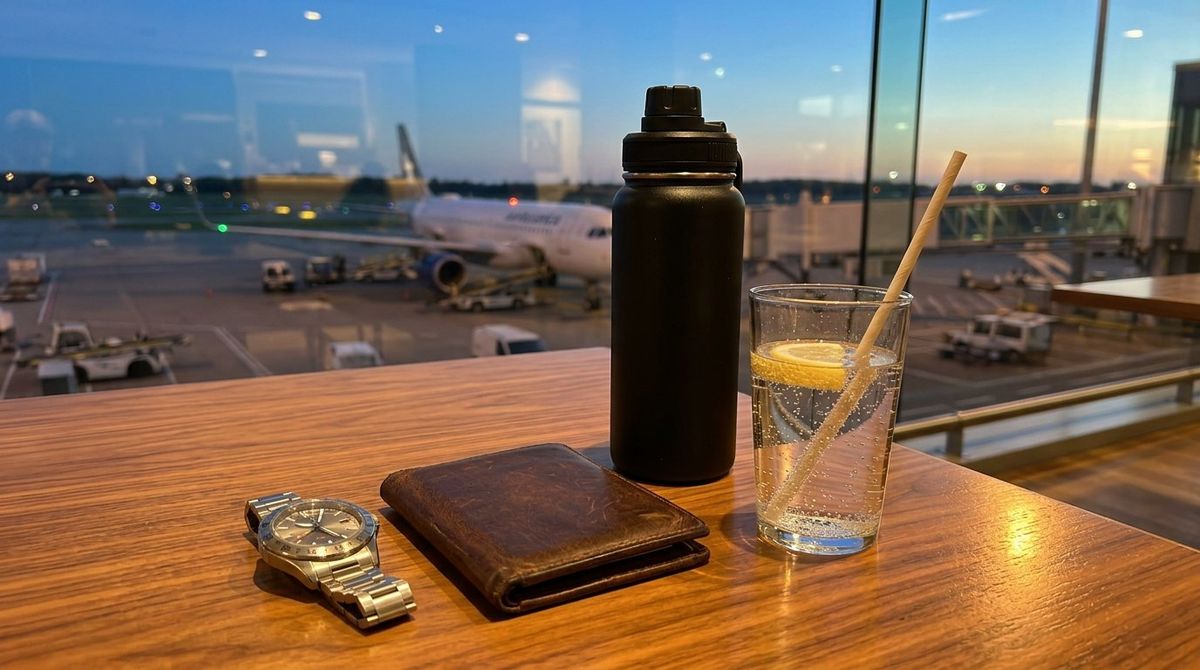
1. Protocol 1: The UTC Absolute Elapsed Transit Fast Equation
Airline itineraries always list departure and arrival times in each airport's local time zone (\( \text{UTC}+Z_{\text{orig}} \) and \( \text{UTC}+Z_{\text{dest}} \)). To prevent time-zone arithmetic errors across international date lines or multi-hub connections, convert both your final pre-flight meal timestamp \( t_{\text{close,local}} \) and your target post-arrival meal timestamp \( t_{\text{open,dest}} \) into absolute UTC hours:
\[ t_{\text{close,UTC}} = t_{\text{close,local}} - Z_{\text{orig}} \quad \text{and} \quad t_{\text{open,UTC}} = t_{\text{open,dest}} - Z_{\text{dest}} \]Total true elapsed fasting duration \( T_{\text{fast}} \) across the transit day (accounting for a \( +24\text{ hr} \) date rollover when crossing midnight UTC) is:
\[ T_{\text{fast}} = \left(t_{\text{open,UTC}} + 24\cdot D_{\text{days}}\right) - t_{\text{close,UTC}} \]Worked Example (New York JFK to London LHR Red-Eye): Suppose you normally follow a \( 16:8 \) schedule (\( 12:00\text{ PM} \) to \( 8:00\text{ PM} \)) in New York (\( Z_{\text{orig}} = -4\text{ hr EDT} \)) and board a \( 9:30\text{ PM} \) red-eye arriving in London (\( Z_{\text{dest}} = +1\text{ hr BST} \)) at \( 9:30\text{ AM} \) local time the next morning (\( \Delta Z = +5\text{ hours} \)). If you finish your pre-flight dinner in the terminal at \( t_{\text{close,local}} = 7:00\text{ PM EDT} \) (\( 19:00 \)), then \( t_{\text{close,UTC}} = 19:00 - (-4) = 23:00\text{ UTC} \). Adding your standard \( 16.0\text{ hr} \) fast places your target window opening at:
\[ t_{\text{open,UTC}} = 23:00 + 16.0\text{ hr} - 24.0\text{ hr} = 15:00\text{ UTC} \implies t_{\text{open,dest}} = 15:00 + 1 = 16:00\text{ BST (4:00 PM London)} \]Notice that eating the airline's pre-landing pastry tray at \( 8:00\text{ AM} \) London time (\( 07:00\text{ UTC} \)) would terminate your fast at just \( 8.0\text{ elapsed hours} \)!
2. Red-Eye & Multi-Stop Layover Transit Schedule Matrix
Use the chronological lookup table below to coordinate pre-departure window closure, layover terminal rules, and Day 1 destination window openings across four common flight corridors:
| Flight Route & Time Zone Shift (\( \Delta Z \)) | Pre-Flight Window Close (Origin Local Time) | In-Flight / Layover Protocol | Day 1 Destination Window Open (Local Time) | Total Elapsed Transit Fast (\( T_{\text{fast}} \)) |
|---|---|---|---|---|
| US West to East Coast Red-Eye (LAX → JFK, \( \Delta Z = +3\text{ hr} \)) | \( 7:30\text{ PM PDT} \) (Before \( 9:45\text{ PM} \) boarding) | Skip cabin snacks; water/black coffee on arrival | \( 2:30\text{ PM EDT} \) (Closes \( 8:30\text{ PM EDT} \)) | \( 16.0\text{ hours} \) |
| Transatlantic Eastbound Red-Eye (JFK → LHR/CDG, \( \Delta Z = +5\text{ to }+6\text{ hr} \)) | \( 6:30\text{ PM EDT} \) (Airport lounge dinner) | Skip both cabin meal services; hydrate during flight | \( 2:30\text{ PM} \) to \( 4:30\text{ PM} \) Local (Closes \( 8:30\text{ PM} \)) | \( 15.0\text{ to }16.0\text{ hours} \) |
| Europe to Asia via Gulf Layover (LHR → DXB → SIN, \( \Delta Z = +7\text{ hr} \)) | \( 6:00\text{ PM BST} \) (Before Leg 1 departure) | Fast through Leg 1 & Dubai layover; eat on Leg 2 window | \( 5:00\text{ PM SGT} \) (Local dinner anchor) | \( 16.0\text{ hours} \) (Between meals) |
| Transpacific Westbound Long-Haul (SFO → HND, \( \Delta Z = +16\text{ hr / }-8\text{ hr} \)) | \( 8:00\text{ PM PDT} \) (Night before morning flight) | Open \( 6\text{-hr} \) window mid-flight; close \( 4\text{ hr} \) pre-landing | \( 12:00\text{ PM JST} \) Next Day | \( 18.0\text{ hours} \) |
3. Protocol 2: The Single-Bridge Compressed Window Rule for Eastbound Red-Eyes
When flying eastbound across \( 5 \) to \( 8 \) time zones (such as New York to Rome or Chicago to Frankfurt), waiting until \( 4:30\text{ PM} \) destination time for your first meal works well, but if you then keep a full \( 8\text{-hour} \) eating window until \( 12:30\text{ AM} \), your next day's schedule will be pushed four hours too late. Instead, apply the Compressed Bridge Window Formula on Arrival Day 1: open your window after completing your \( 16.0\text{ hr} \) UTC fast at \( t_{\text{open,dest}} \), but still close your window at your normal local target evening cutoff \( t_{\text{target,close}} = 8:00\text{ PM} \) (\( 20:00 \)) destination time:
\[ W_{\text{bridge}} = t_{\text{target,close}} - t_{\text{open,dest}} = 20:00 - 16:00 = 4.0\text{ hours} \]By using a single \( 4.0\text{-hour} \) compressed eating window (\( 4:00\text{ PM} \) to \( 8:00\text{ PM} \)) on Arrival Day 1, your clock closes at \( 8:00\text{ PM} \) local time, locking you directly into a standard \( 12:00\text{ PM} \) to \( 8:00\text{ PM} \) local \( 16:8 \) window starting on Day 2 with zero multi-day drift.
4. Protocol 3 & 4: Multi-Leg Layover Partitioning & Cabin Hydration Math
On ultra-long-haul itineraries exceeding \( 18\text{ hours} \) of total travel time (such as a \( 7\text{-hour} \) flight, a \( 3\text{-hour} \) hub layover, and an \( 8\text{-hour} \) connecting flight), attempting to fast the entire \( 22\text{ to }26\text{ hours} \) door-to-door is unnecessary. Instead, anchor a strict \( 4\text{-hour} \) to \( 6\text{-hour} \) feeding window inside the connecting airport lounge between Leg 1 and Leg 2, then close your timer before boarding Leg 2 so you sleep through the second flight and land with \( 10+\text{ hours} \) already banked toward your destination lunch window.
Because pressurized aircraft cabins maintain low relative humidity (\( 10\% \) to \( 15\% \)), uncompensated respiratory water loss averages \( r_{\text{cabin}} \approx 250\text{ mL/hr} \). Across an \( L_{\text{flight}} = 8.5\text{ hr} \) red-eye flight, target non-caloric fluid intake \( V_{\text{water}} \) is:
\[ V_{\text{water}} = L_{\text{flight}} \cdot r_{\text{cabin}} = 8.5\text{ hr} \times 250\text{ mL/hr} = 2{,}125\text{ mL} \approx 2.13\text{ L} \]Pack unflavored, zero-sugar electrolyte packets (such as LMNT Raw Unflavored) in your carry-on bag to mix with bottled water after clearing airport security.
5. Protocol 5: Return Westbound Flight Buffer Adjustment
When flying westbound back home (e.g., Europe to North America, \( \Delta Z = -5\text{ to }-8\text{ hr} \)), the civil day lengthens to \( 29\text{ to }32\text{ hours} \). Eat your normal lunch at \( 12:30\text{ PM} \) departure time, close your window at \( 6:30\text{ PM} \) departure time (\( 1:30\text{ PM EDT} \)), fast for \( 18.0\text{ UTC hours} \) overnight, and open your window at \( 7:30\text{ AM} \) or \( 12:00\text{ PM} \) home time the next day.
Furthermore, when composing a sequence of cinquains or auditing historical modernist manuscripts, pay close attention to syllabic consonants and hiatus vowel pairs. Words ending in -le or -thm (such as "ket-tle", "bri-dle", or "rhy-thm") form a vocalic sonorant nucleus that counts as a full second syllable even without a written vowel letter. Similarly, diaeresis pairs such as "po-et", "cha-os", and "qui-et" contain two distinct vowel peaks separated by a glottal glide (2 syllables), whereas diphthongs like "cloud", "coin", and "pain" glide within a single syllable peak (1 syllable).
To verify whether your fourth-line climax maintains proper rhythmic tension before dropping into the two-syllable fifth-line turn, calculate the Line-to-Stanza Compression Ratio \( C_{4\to 5} \):
\[ C_{4\to 5} = \frac{S(L_4)}{S(L_5)} = \frac{8\text{ syllables}}{2\text{ syllables}} = 4.00\times \]That abrupt \( 4.00\times \) syllabic contraction from four iambic feet down to a single foot is what gives the Adelaide Crapsey cinquain its unmistakable acoustic snap—functioning like a sudden camera shutter click at the end of a long panning shot.
6. Frequently Asked Questions (FAQ)
Should I bring my own food through airport security to break my fast on a long flight?
Yes. Packing solid whole foods (such as macadamia nuts, jerky, or hard cheeses) in your carry-on lets you open and close your eating window at your exact UTC target timestamp rather than waiting for cabin crew cart service schedules.
Does switching my phone clock mid-flight mess up fasting timer apps?
Most smartphone fasting trackers record start timestamps in Unix epoch (UTC) time under the hood, so elapsed hours remain accurate when your phone switches time zones—just remember to check elapsed hours (\( 16.0\text{ hr} \)) rather than wall-clock time on your transit day.
Plan Your Red-Eye & Time-Zone Fasting Schedule in Seconds
Enter your departure city, arrival time zone, and preferred fasting protocol (16:8, 18:6, or 20:4) to generate a custom travel schedule.
Open the IF Window Calculator →