Ramadan Dawn-to-Dusk Fasting Window and Hydration Schedule Formula: Daily Logistical Timing Guide
Managing daily fluid intake during holy months of spiritual observance requires applying the ramadan dawn to dusk fasting window hydration schedule formula to balance diurnal fasting constraints with nocturnal fluid pacing. Diurnal intermittent fasting entails abstaining from all food and liquids from astronomical dawn (Fajr) until astronomical sunset (Maghrib). Depending on geographic latitude and the solar calendar cycle, the diurnal fasting period ranges from 11 hours in equatorial zones to over 17 hours in higher northern latitudes, leaving a narrow nocturnal replenishment window.
A frequent logistical challenge during extended dawn-to-dusk fasting is nocturnal fluid compression—consuming large volumes of water immediately upon breaking the fast at sunset or right before the morning cutoff. Rapid over-consumption of plain water overwhelms renal filtration capacity, triggering rapid urine excretion without restoring cellular fluid balance. Structuring an hourly hydration cadence across the nocturnal window optimizes fluid retention and ensures stable cognitive alertness throughout daytime routines.
Nocturnal Hydration Logistics Key Takeaways
- Daily Fasting Duration Calculation: Fasting duration is mathematically defined by astronomical sunset minus dawn, dictating the remaining nocturnal replenishment window.
- Avoid Rapid Fluid Boluses: Consuming more than 600 ml (20 oz) of plain water in a single 20-minute sitting accelerates renal clearance, wasting fluid before cellular absorption occurs.
- The Three-Phase Nocturnal Division: Partition fluid targets across three strategic windows: Iftar opening (25%), Interim evening pacing (50%), and Pre-dawn Suhoor (25%).
- Electrolyte Osmolality Balance: Pairing water with dietary mineral salts (sodium, potassium, magnesium) maintains serum osmolality and prevents nocturnal hyponatremic fluid loss.
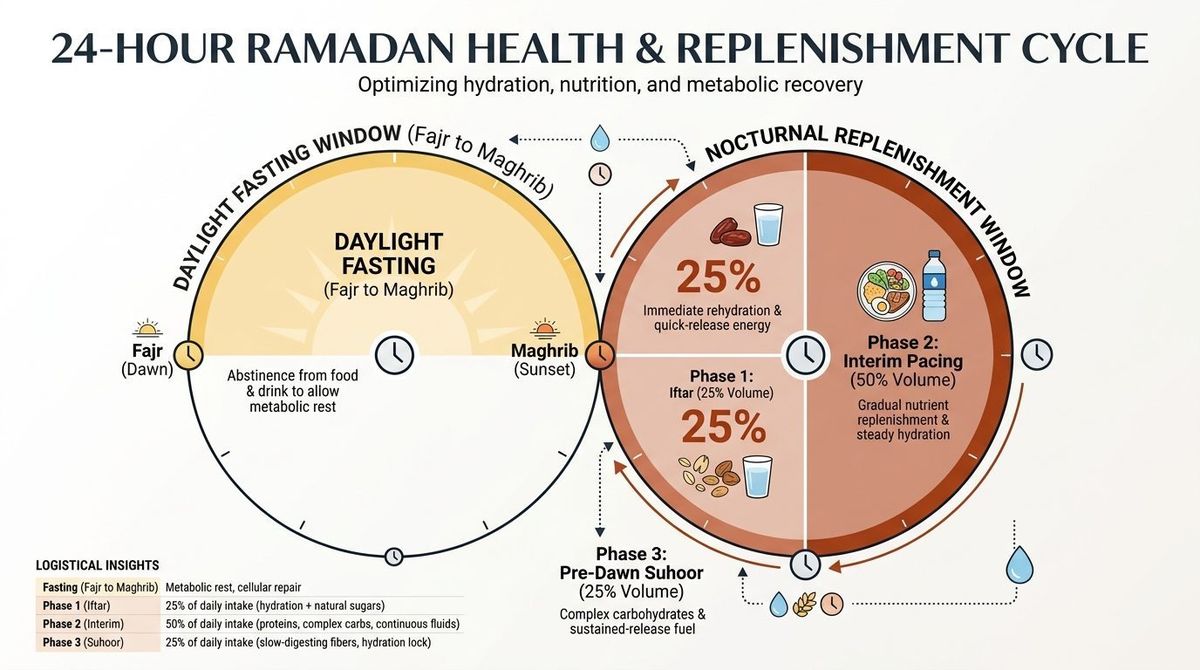
Astronomical Fasting Window and Replenishment Math
To design an actionable nightly fluid schedule, individuals must first quantify the duration of their active eating and drinking window based on local solar prayer timetables.
Where \(T_{\text{fast}}\) represents total daytime fasting hours, and \(T_{\text{window}}\) represents the total permissible nocturnal eating and hydration span. For example, if astronomical dawn occurs at 04:30 and sunset occurs at 19:45, total fasting duration is 15.25 hours, leaving an open window of exactly 8.75 hours (525 minutes).
Determining Target Nocturnal Fluid Volume
Baseline daily fluid requirements vary according to body weight, ambient climate humidity, and occupational physical exertion levels. A standard physiological baseline for adult hydration during non-fasting periods allocates 35 to 45 milliliters of fluid per kilogram of body mass:
Where \(M_{\text{body\_kg}}\) is body weight in kilograms, \(R_{\text{fluid\_base}} \approx 35\ \text{ml/kg}\), and \(V_{\text{activity\_offset}}\) provides an additional 400 to 800 ml for ambient heat exposure or physical work.
Hourly Pacing and Sleep-Adjusted Hydration Rate
A critical oversight in nocturnal scheduling is ignoring required sleep duration. If an individual has an 8.5-hour open nocturnal window but sleeps for 5.5 hours between late prayers and pre-dawn Suhoor, the actual waking hydration window contracts to just 3.0 waking hours. Attempting to drink 2.8 liters in 3 waking hours causes severe sleep disruption due to frequent nighttime urination.
To balance sleep architecture with hydration needs, planners utilize the sleep-adjusted pacing formula:
Where \(V_{\text{Iftar}}\) is the initial rehydration volume (typically 500 to 750 ml), \(V_{\text{Suhoor}}\) is the pre-dawn intake volume (500 to 750 ml), and \(T_{\text{interim\_awake\_hours}}\) represents active waking hours during the evening.
Step-by-Step Worked Hydration Schedule Example
An adult office professional weighing 72.0 kg observes a 15-hour daily fasting schedule. Local astronomical times and sleep logistics are measured as follows:
- Fajr (Dawn cutoff): 04:45
- Maghrib (Sunset opening): 19:45
- Planned Nighttime Sleep Window: 23:00 to 03:45 (4.75 hours undisturbed sleep)
- Target Hydration Volume (\(72.0 \times 35\ \text{ml}\)): 2,520 ml (rounded to 2,500 ml)
Developing an optimized logistical hydration schedule proceeds in four structured steps:
Step 1: Calculate the open nocturnal window and waking periods.
Step 2: Allocate Phase 1 (Iftar Breaking) fluid volume.
Allocate 25% of target volume: \(V_{\text{Phase1}} = 2,500 \times 0.25 = 625 \text{ ml}\). Consume 350 ml of room-temperature water with 2 mineral-rich dates at sunset (19:45), followed by an additional 275 ml of fluid (such as vegetable broth or water) with the evening meal at 20:15.
Step 3: Allocate Phase 3 (Pre-Dawn Suhoor) fluid volume.
Allocate 25% of target volume: \(V_{\text{Phase3}} = 2,500 \times 0.25 = 625 \text{ ml}\). Split between waking at 03:45 (300 ml with whole-grain oats/fruit) and 04:30 (325 ml with a pinch of electrolyte salt prior to Fajr cutoff).
Step 4: Calculate Phase 2 (Interim Evening) hourly fluid pacing.
Consuming 250 ml (one standard cup) of water every 30 minutes between 20:30 and 23:00 achieves the full 2,500 ml target without bloating, gastric discomfort, or nighttime awakenings.
Daily Nocturnal Hydration Allocation Matrix
The structured schedule table below outlines the distribution of fluids, mineral pairing, and physiological targets across a representative 9-hour nocturnal replenishment window.
| Schedule Window | Target Time | Volume (ml) | Fluid & Mineral Pairing | Logistical Objective |
|---|---|---|---|---|
| Iftar Opening | 19:45 – 20:00 | 350 ml | Room-temp water + medjool dates | Gentle rehydration, initial glucose restoration |
| Evening Meal | 20:15 – 20:45 | 275 ml | Hydrating broth or herbal infusion | Sodium balance, meal digestion lubrication |
| Post-Taraweeh 1 | 21:15 – 21:30 | 250 ml | Electrolyte water (potassium/citrate) | Restores exercise fluid balance |
| Post-Taraweeh 2 | 22:00 – 22:15 | 250 ml | Filtered water + cucumber slice | Cellular rehydration pacing |
| Pre-Sleep Finish | 22:45 – 23:00 | 250 ml | Chamomile tea or pure water | Final evening quota, pre-sleep fluid baseline |
| Sleep Window | 23:00 – 03:45 | 0 ml | Undisturbed rest (no fluids) | Unbroken sleep, restorative growth hormone |
| Suhoor Opening | 03:45 – 04:00 | 300 ml | Water + complex carbohydrate meal | Pre-dawn gastric hydration buffer |
| Suhoor Final Call | 04:20 – 04:35 | 325 ml | Mineralized water + chia or electrolytes | Sustained daytime osmotic retention |
This phased schedule spreads fluid intake evenly across eight discrete micro-windows, preventing the rapid diuresis associated with bulk fluid consumption.
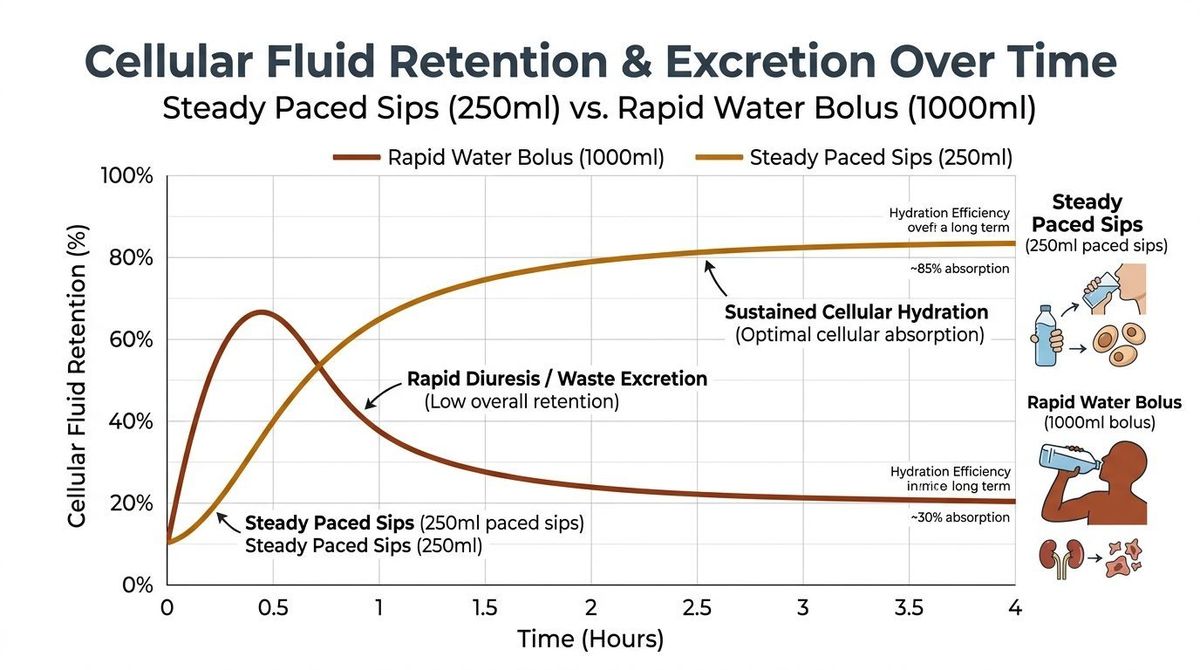
Logistical Rules for Minimizing Diurnal Fluid Loss
Maximizing the effectiveness of your nighttime hydration schedule requires avoiding daytime habits that accelerate fluid excretion:
- Moderate Diuretic Beverages: High-caffeine beverages (strong espresso, energy drinks) consumed during late Suhoor accelerate renal water clearance during the early fasting hours. Limit caffeine to one moderate serving at Iftar rather than Suhoor.
- Sodium Pacing: Consuming excessively salty meals during Suhoor triggers intense thirst mechanisms during midday hours. Shift sodium-rich seasonings to Iftar so excess dietary sodium is balanced before morning.
- Incorporate High-Water Whole Foods: Watermelons, cucumbers, oranges, and zucchini contain over 90% water bound in fibrous matrices, releasing fluids gradually during early digestive phases.
Frequently Asked Questions
Can I drink all my daily water at Suhoor right before dawn?
Consuming 1.5 to 2.0 liters of water in the final 30 minutes before dawn triggers immediate atrial natriuretic peptide (ANP) release, causing the kidneys to flush out the excess water within two hours, leaving you thirsty by mid-morning.
What temperature should drinking water be during Iftar?
Room-temperature or cool water (15°C to 20°C / 60°F to 68°F) absorbs faster than ice-cold water. Freezing water can cause esophageal spasms and transient gastric cramping when consumed on an empty stomach.
How do electrolytes improve fluid retention during fasting?
Water follows sodium and minerals through osmotic gradients. Consuming moderate electrolytes (sodium chloride, potassium citrate) ensures water enters intracellular and interstitial compartments rather than passing directly to the bladder.
How should athletes adjust hydration when training during Ramadan?
Schedule strenuous physical training 60 to 90 minutes before sunset (breaking fast immediately after) or 2 hours after Iftar. Add 500 to 750 ml of electrolyte solution during the post-exercise evening window to replace sweat volume.
Calculate Your Personalized Fasting Schedules
Fine-tune your daily fasting logistics and calculate exact eating windows based on your geographic location. Plan your personalized intermittent fasting and diurnal schedules with our interactive tools at Intermittent Fasting Window Calculator.