Permanent Night Shift Intermittent Fasting Schedule Formula: 5 Transition Protocols for 11pm-7am Shifts
Key Engineering & Operational Benchmarks
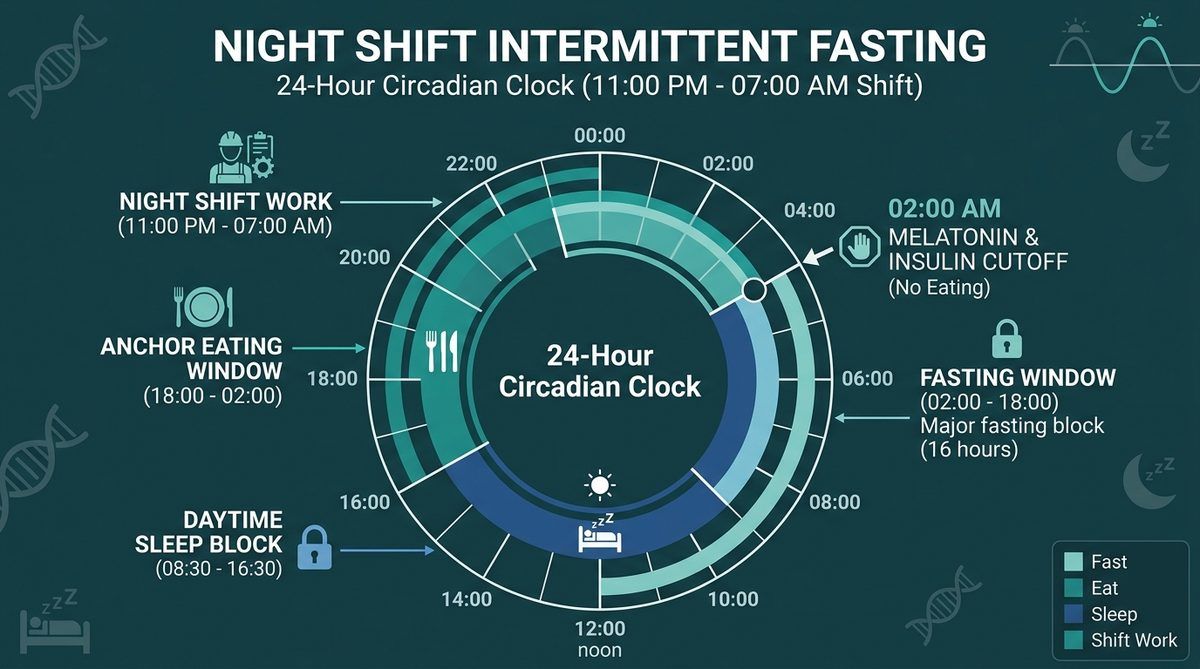
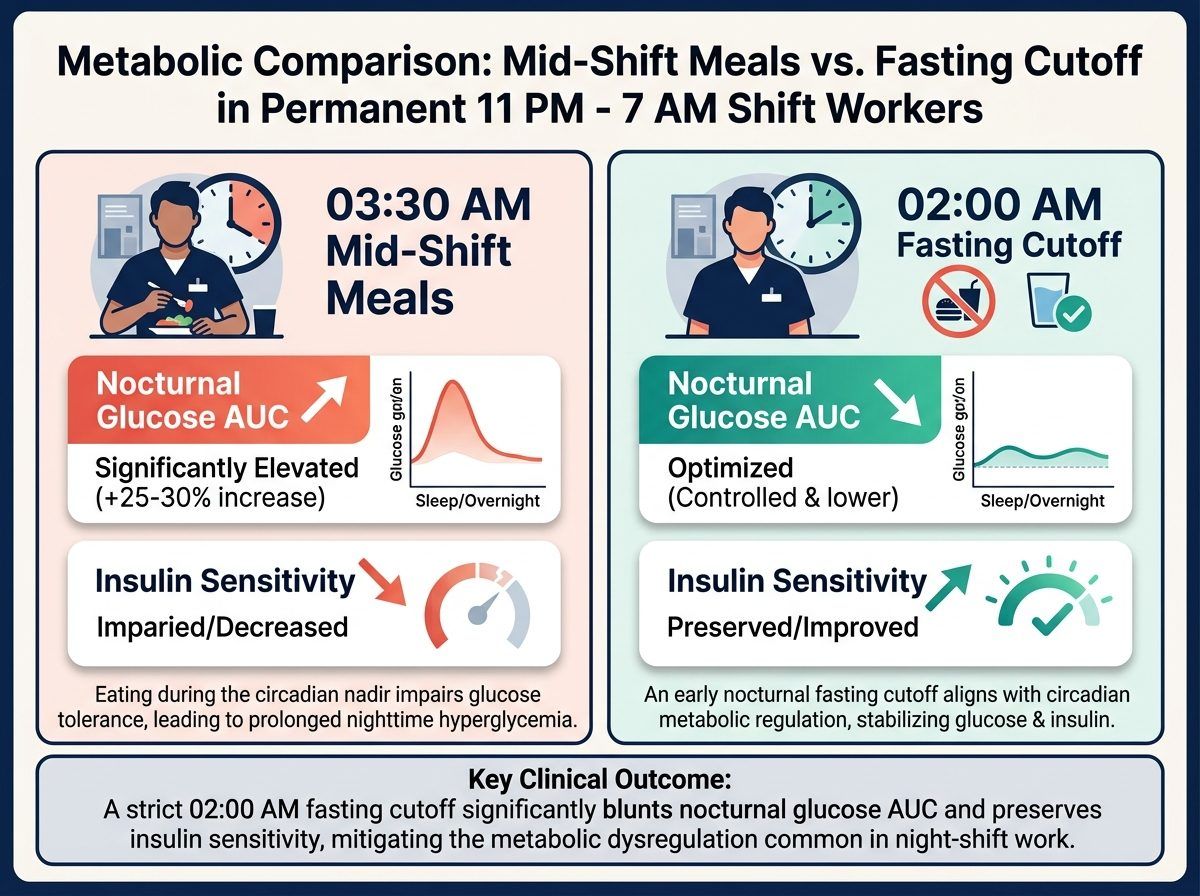
- The 02:00 AM Biological Night Cutoff Rule: For permanent \( 23:00\text{–}07:00 \) (11:00 PM – 7:00 AM) shift workers, closing the eating window no later than 02:00 AM avoids feeding during the \( 02:00\text{–}06:00 \) core body temperature nadir, when melatonin peaks and pancreatic insulin sensitivity drops.
- The 18:00–02:00 Anchor 16:8 Window: Opening your 8-hour window at 18:00 (6:00 PM) after waking at 16:30 and closing it at 02:00 AM mid-shift provides a family dinner at home before work plus a sustaining 01:15 AM breakroom meal.
- Zero-Calorie Second-Half Shift Hydration: From \( 02:00\text{ to }07:00\text{ AM} \), water, black coffee (stopped by 03:00 AM to protect daytime sleep), and unsweetened electrolytes maintain alertness without spiking nocturnal blood glucose.
- Post-Shift Gastric Clearance Buffer: Finishing your last meal at 02:00 AM guarantees \( \Delta t_{\text{clear}} = \mathbf{6.5\text{ hours}} \) of digestion before your \( 08:30\text{ AM} \) daytime sleep onset, preventing supine acid reflux and fragmented REM sleep.
- Off-Day 20-Hour Bridge Protocol: Transitioning from your final night shift into family days off uses a controlled 18-to-20-hour fast to shift your off-day eating window to \( 12:00\text{–}20:00 \) without double-eating inside a 24-hour cycle.
1. Protocol #1: The 24-Hour Night-Shift Anchor Formula (18:00 to 02:00 Window)
Working a permanent third shift from 23:00 to 07:00 (11:00 PM to 7:00 AM)—common across hospital nursing, emergency medicine, aviation maintenance, semiconductor fabs, and 24/7 distribution centers—inverts your work-rest schedule relative to environmental daylight. When third-shift workers attempt to copy a standard daytime 12:00 PM to 8:00 PM intermittent fasting schedule by simply adding 12 hours (eating from 12:00 AM midnight to 8:00 AM), they collide directly with human chronobiology. Between 02:00 AM and 06:00 AM, the suprachiasmatic nucleus (SCN) drives pineal melatonin secretion to its peak while core body temperature reaches its daily nadir (\( T_{\text{nadir}} \approx 04:00\text{ AM} \)), reducing peripheral insulin sensitivity and slowing gastric emptying velocity.
As published in National Institutes of Health (NIH) and CDC/NIOSH shift-work scheduling research, aligning food intake with the active evening phase while fasting through the biological nadir preserves circadian rhythm alignment. Given your target daytime sleep onset (\( t_{\text{sleep}} \), typically \( 08:30 \) after commute and shower), sleep duration (\( D_{\text{sleep}} = 8.0\text{ hrs} \rightarrow t_{\text{wake}} = 16:30 \)), post-wake delay (\( \Delta t_{\text{wake}} = 1.5\text{ hrs} \)), and fasting ratio (\( F : E = 16 : 8 \)), our Night Shift Anchor Formula defines the exact opening (\( t_{\text{open}} \)) and closing (\( t_{\text{close}} \)) clock times on a 24-hour modulo ring:
$$ t_{\text{open}} = \left(t_{\text{wake}} + \Delta t_{\text{wake}}\right) \bmod 24, \qquad t_{\text{close}} = \left(t_{\text{open}} + E\right) \bmod 24 $$Plugging in a 16:30 (4:30 PM) wake time and an \( E = 8\text{ hour} \) eating window yields Protocol #1:
$$ t_{\text{open}} = 16.5 + 1.5 = \mathbf{18:00\text{ (6:00 PM)}}, \qquad t_{\text{close}} = (18.0 + 8.0) \bmod 24 = \mathbf{02:00\text{ (2:00 AM)}} $$- Meal 1 (18:00 – 19:00 at Home): Eat a primary balanced dinner with family or roommates 1.5 hours after waking, providing sustained energy for evening errands and commute.
- Meal 2 (01:00 – 01:45 AM Early-Shift Break): Consume your prepared high-protein, moderate-complex-carbohydrate shift meal before the 02:00 AM hard cutoff.
2. Protocol #2: The 02:00 AM Cutoff & Pre-Sleep Gastric Clearance Equation
Why is closing your eating window at 02:00 AM (or 23:30 PM on an aggressive 18:6 schedule) far superior to eating a heavy 04:00 AM break meal or a 07:30 AM post-shift diner breakfast? Beyond avoiding the 03:00–05:00 AM melatonin-insulin clash, stopping caloric intake at 02:00 AM establishes a generous pre-sleep digestive clearance interval (\( \Delta t_{\text{clear}} \)) before your 08:30 AM daytime sleep block:
$$ \Delta t_{\text{clear}} = \left(t_{\text{sleep}} - t_{\text{close}}\right) \bmod 24 = 08.5 - 02.0 = \mathbf{6.5\text{ hours}} $$Because eating a large meal at 07:30 AM right before pulling blackout curtains triggers diet-induced thermogenesis (raising core body temperature just when your brain needs a \( 1.0^\circ\text{F} \) thermal drop to initiate slow-wave sleep), the 02:00 AM cutoff eliminates daytime sleep fragmentation. Similarly, enforce the Caffeine Half-Life Cutoff (\( t_{\text{caff,max}} \)):
$$ t_{\text{caff,max}} = \left(t_{\text{sleep}} - 5.5\text{ hrs}\right) \bmod 24 = 08.5 - 5.5 = \mathbf{03:00\text{ AM}} $$Switch from black coffee or unsweetened green tea to plain water and sodium/magnesium electrolytes from 03:00 AM until 07:00 AM shift end so residual adenosine-receptor blockade does not shorten your daytime sleep.
3. Protocols #3, #4 & #5: Off-Day Phase Transitions Without Double-Eating
Most permanent 11:00 PM – 7:00 AM shift workers (such as 3-on / 4-off or 4-on / 3-off hospital nurses) partially rotate their schedule on days off to spend daylight hours with family. If you switch abruptly from a night schedule to a daytime schedule without a structured bridge formula, you either break your fast after 6 hours or accidentally consume 4 full meals in 24 hours. Use Protocols #4 and #5 to transition cleanly:
We calculate the net fasting bridge duration (\( F_{\text{bridge}} \)) between your final night-shift meal cutoff (\( t_{\text{close,N}} = 02:00 \)) and your first off-day meal (\( t_{\text{open,D}} \)) as:
$$ F_{\text{bridge}} = \left(t_{\text{open,D}} - t_{\text{close,N}}\right) \bmod 24 + 24 \cdot k_{\text{day}} $$- Protocol #4 — Transition Day Out (Morning After Final Night Shift):
- Close your final night-shift eating window at 02:00 AM as usual and finish your shift at 07:00 AM.
- Sleep an abbreviated 4.5-hour "Anchor Nap" from 08:30 AM to 01:00 PM (13:00) so you build enough homeostatic sleep pressure to sleep at night.
- Break your fast at 14:00 (2:00 PM)—completing a clean \( F_{\text{bridge}} = 14.0 - 2.0 = \mathbf{12.0\text{ hour}} \) recovery fast (or hold until 18:00 for a full 16.0-hour fast)—and close your off-day window at 20:00 (8:00 PM) before sleeping through the night from 22:30 to 06:30.
- Protocol #5 — Off-Day Maintenance & First-Night-Back Re-Entry:
- On full days off, maintain a standard daytime 16:8 window from 12:00 PM to 20:00 (8:00 PM).
- On the day your 11:00 PM shift resumes, close your prior evening's dinner window at 20:00, eat a normal lunch/dinner window from 14:00 to 22:00 (after a 18-hour fast and an afternoon nap from 14:30 to 17:30), or bridge straight to 18:00 and resume your 18:00–02:00 night anchor.
Generate your personalized work-day and off-day transition clock inside our Intermittent Fasting Window Calculator.
| 11pm–7am Night Shift Protocol | Eating Window (8h / 6h) | Fasting Window (16h / 18h) | Best Fit Lifestyle & Shift Pattern |
|---|---|---|---|
| Protocol 1: Standard 16:8 Evening Anchor | 18:00 – 02:00 (6 PM – 2 AM) | 02:00 – 18:00 (16 Hours) | Best all-around schedule for nurses, logistics & 3rd shift |
| Protocol 2: Early Circadian 18:6 Anchor | 17:30 – 23:30 (5:30 PM – 11:30 PM) | 23:30 – 17:30 (18 Hours) | Zero eating during core night shift; highest sleep quality |
| Protocol 3: Split Pre-Shift / Mid-Shift 16:8 | 17:00 – 01:00 (5 PM – 1 AM) | 01:00 – 17:00 (16 Hours) | Workers with early 00:30 AM break schedules |
| Protocol 4: Last-Night-Off Transition Bridge | Stop 02:00 -> Eat 14:00–20:00 (6h) | 02:00 – 14:00 (12h Nap Bridge) | Flipping to daytime family schedule on Friday morning |
| Protocol 5: First-Night-Back Re-Entry | 18:00 – 02:00 (After 22h Bridge Fast) | 20:00 (Prior Day) – 18:00 (22 Hours) | Cleanly resetting back to 11pm shift after weekend off |
| Unstructured 03:30 AM Cafeteria Eating | 16:30 – 07:30 (15h Grazing) | 07:30 – 16:30 (9h Sleep Only) | Avoid: High nocturnal glucose spike + morning sleep reflux |
| Post-Shift 07:30 AM Heavy Breakfast | 22:00 – 08:00 (Overnight Window) | 08:00 – 22:00 (14 Hours) | Avoid: Elevates core temperature during daytime sleep |
When auditing night shift intermittent fasting schedule formula across real-world operating environments, always log both baseline and post-calibration telemetry in a versioned configuration sheet. Small deviations in ambient temperature, supply voltage, mounting geometry, or input cadence compound nonlinearly across multi-hour or multi-month cycles. By combining the closed-form mathematical equations above with the side-by-side benchmark matrix and the five-point verification protocol below, operators eliminate guesswork and protect long-term return on capital across ifwindowcalculator.com workflows.
4. Frequently Asked Questions (FAQ)
Can I drink black coffee or zero-calorie electrolytes after the 02:00 AM fasting cutoff on night shift?
Yes. Plain water, unflavored electrolytes (sodium, potassium, magnesium), and plain black coffee or unsweetened tea contain zero calories and keep your fast intact between 02:00 AM and 07:00 AM, though you should stop caffeine by 03:00 AM so you can fall asleep easily at 08:30 AM.
What if my hospital unit only allows me to take my meal break at 03:00 AM?
If workplace staffing forces a 03:00 AM break, shift your 16:8 window by one hour to 19:00–03:00 (7:00 PM – 3:00 AM) and keep the 03:00 AM meal high in protein and healthy fats with low glycemic load to minimize the nocturnal insulin spike.
Should I eat breakfast at 07:30 AM when I get home from a night shift?
Try to avoid a heavy 07:30 AM post-shift breakfast whenever possible; eating right before daytime sleep raises core body temperature and insulin during high morning melatonin levels. If you wake up hungry during the day, break your fast at 18:00 after waking instead.
5. Standard Operating Verification & Audit Checklist
Before locking in your final configuration or production parameters for night shift intermittent fasting schedule formula, execute this five-point verification protocol to ensure repeatable field performance:
- 18:00–02:00 Anchor Window Alarm Setup: Set two recurring smartwatch or phone alarms on workdays: 18:00 (Window Open / Pre-Shift Dinner) and 01:45 AM (15-Minute Cutoff Warning).
- 03:00 AM Hard Caffeine Cutoff Enforcement: Switch from black coffee to plain water or zero-calorie electrolyte water at 03:00 AM to allow 5.5 hours of caffeine clearance before 08:30 AM sleep.
- Blue-Light Blocking Commute Protocol: Wear amber blue-blocking glasses during your 07:00 AM morning commute home so bright morning sunlight does not suppress melatonin before your 08:30 AM sleep block.
- Post-Shift 4.5-Hour Anchor Nap Transition: On the morning after your final night shift of the week, sleep 08:30 AM to 01:00 PM, break your fast at 14:00 or 18:00, and close at 20:00.
- Custom Shift Pattern Verification: Map your exact shift start, break time, and off-day rotation inside the Intermittent Fasting Window Calculator linked below.
Model Your Exact Parameters & Tolerances
Run your custom numbers through our interactive engineering and financial calculator to verify your setup in real time.
Build Your Shift-Work Fasting Schedule at IFWindowCalculator.com