Intermittent Fasting Hypertrophy & Strength Training Window-Anchor Formula: 5 Pre/Post-Lift Leucine & 24-Hour Protein Spacing Rules
Scheduling a 16:8 intermittent fasting protocol around strength training fails when lifters lock their eating window to arbitrary clock hours—such as 12:00 to 20:00—without aligning it to when they actually train. Training fasted at 07:00 and waiting five hours until noon to eat leaves post-exercise muscle protein synthesis (MPS) unstimulated, while cramming all daily protein into one or two oversized meals wastes the refractory spacing needed for maximal hypertrophy. This scheduling guide derives the training-anchored window shift equation, 24-hour MPS bolus spacing, and side-by-side 07:00 fasted versus 16:00 fed lifting schedules.

Quick Formula: Training-Anchored Window Shift & Bolus Spacing
Anchor the opening of your 16:8 eating window directly to the completion of your strength session, and divide your feeding window into discrete 3.5-hour MPS boluses:
\[ T_{\text{open}} = T_{\text{lift\_end}} + \Delta t_{\text{post}} \le T_{\text{lift\_end}} + 1.0\text{ hr} \] \[ N_{\text{bolus}} = \left\lfloor \frac{W_{\text{hours}}}{3.5\text{ hr}} \right\rfloor + 1 \]For an 8-hour eating window (\( W_{\text{hours}} = 8.0\text{ hr} \)), \( N_{\text{bolus}} = \lfloor 8.0 / 3.5 \rfloor + 1 = 3\text{ boluses} \) in practice, each delivering \( 2.5\text{–}3.0\text{ g} \) leucine and \( 0.40\text{ g/kg} \) of high-quality protein.
You can map your exact fasting start and end times against your training block using the intermittent fasting window calculator so your 16-hour fast never collides with post-lift recovery.
Core Scheduling Parameters for Strength Lifters
The table below summarizes the non-negotiable timing and dosing thresholds used to structure an 8-hour feeding window for strength and hypertrophy logistics.
| Parameter | Formula / Target | 80 kg Lifter Example | Scheduling Purpose |
|---|---|---|---|
| Post-Lift Window Open (\( T_{\text{open}} \)) | \( \le T_{\text{lift\_end}} + 1.0\text{ hr} \) | 08:30 (after 07:00–08:00 lift) | Caps post-fasted-lift amino acid delay |
| Window Duration (\( W_{\text{hours}} \)) | 8.0 hours (16:8 protocol) | 08:30 to 16:30 | Allows 3 full MPS-triggering meals |
| Bolus Count (\( N_{\text{bolus}} \)) | \( \lfloor W_{\text{hours}} / 3.5 \rfloor + 1 \) | 3 boluses | Maximizes daily MPS pulses in 8 hours |
| Protein Per Bolus | \( 0.40\text{ g/kg} \) (up to 0.55 g/kg) | 32 g to 44 g per meal | Hits 1.6–1.8 g/kg/day across 3 meals |
| Leucine Per Bolus | \( 2.5\text{–}3.0\text{ g} \) | 2.7 g leucine (whey/meat/eggs) | Triggers mTORC1 translation initiation |
Rule 1: Anchor Window Opening to Lift Completion on Fasted Mornings
When you train fasted from 07:00 to 08:00, muscle protein breakdown is elevated and no pre-workout amino acids are circulating. Applying \( T_{\text{open}} = T_{\text{lift\_end}} + \Delta t_{\text{post}} \le T_{\text{lift\_end}} + 1.0\text{ hr} \) forces your eating window to open no later than 09:00. Shifting your 8-hour window to 08:30–16:30 preserves the full 16-hour fast (16:30 to 08:30) while delivering your first leucine-rich bolus within 30 minutes of your final set.

Rule 2: Space Protein Boluses by 3.5 Hours to Reset the Refractory Period
After a leucine-threshold meal elevates muscle protein synthesis, intracellular signaling enters a refractory period lasting roughly 3.0 to 3.5 hours during which grazing on small protein snacks fails to trigger a fresh synthetic peak. Using \( N_{\text{bolus}} = \lfloor \frac{W_{\text{hours}}}{3.5\text{ hr}} \rfloor + 1 \) gives you exactly 3 discrete boluses inside an 8-hour window: Bolus 1 at 08:30 (minute 0), Bolus 2 at 12:30 (+4.0 hours), and Bolus 3 at 16:15 (+7.75 hours). Trying to squeeze 4 meals inside 8 hours compresses spacing to 2.6 hours, blunting the second and third MPS responses.
Rule 3: Compare 07:00 Fasted vs. 16:00 Fed Lifting Schedules
Afternoon lifters training at 16:00 can keep a traditional 12:00–20:00 window because their pre-lift meals sit inside the feeding window, providing circulating amino acids during the workout and extending the post-lift window allowance. The table below contrasts the exact clock schedules for an 80 kg lifter targeting 135 g/day of protein.
| Schedule Metric | 07:00 Fasted Lift (Shifted 16:8) | 16:00 Fed Lift (Standard 16:8) |
|---|---|---|
| Training Block | 07:00 – 08:00 (Fasted) | 16:00 – 17:00 (Fed, 2 meals prior) |
| 8-Hour Eating Window | 08:30 – 16:30 | 12:00 – 20:00 |
| Bolus 1 (45 g protein, 3.0 g leucine) | 08:30 (Post-lift whey + oats/eggs) | 12:00 (Pre-lift lunch bowl) |
| Bolus 2 (45 g protein, 3.0 g leucine) | 12:30 (Midday chicken + rice) | 15:30 or 17:30 (Post-lift recovery meal) |
| Bolus 3 (45 g protein, 2.8 g leucine) | 16:15 (Pre-fast slow-digesting dinner) | 19:45 (Casein/Greek yogurt + salmon) |
| 16-Hour Overnight Fast | 16:30 – 08:30 | 20:00 – 12:00 |
Rule 4: Hit 2.5–3.0 g Leucine and 0.40 g/kg Protein in Every Bolus
Total daily protein alone does not guarantee maximal MPS if individual meals fall below the leucine trigger. A 25 g whey isolate serving provides roughly 2.7 g of leucine, whereas plant-based or lower-leucine meals often require 40 g to 45 g of total protein to cross 2.5 g of leucine. Aim for \( 0.40\text{ g/kg} \) per bolus as your floor, scaling up to \( 0.55\text{ g/kg} \) per bolus when splitting 1.65 g/kg/day across 3 meals.
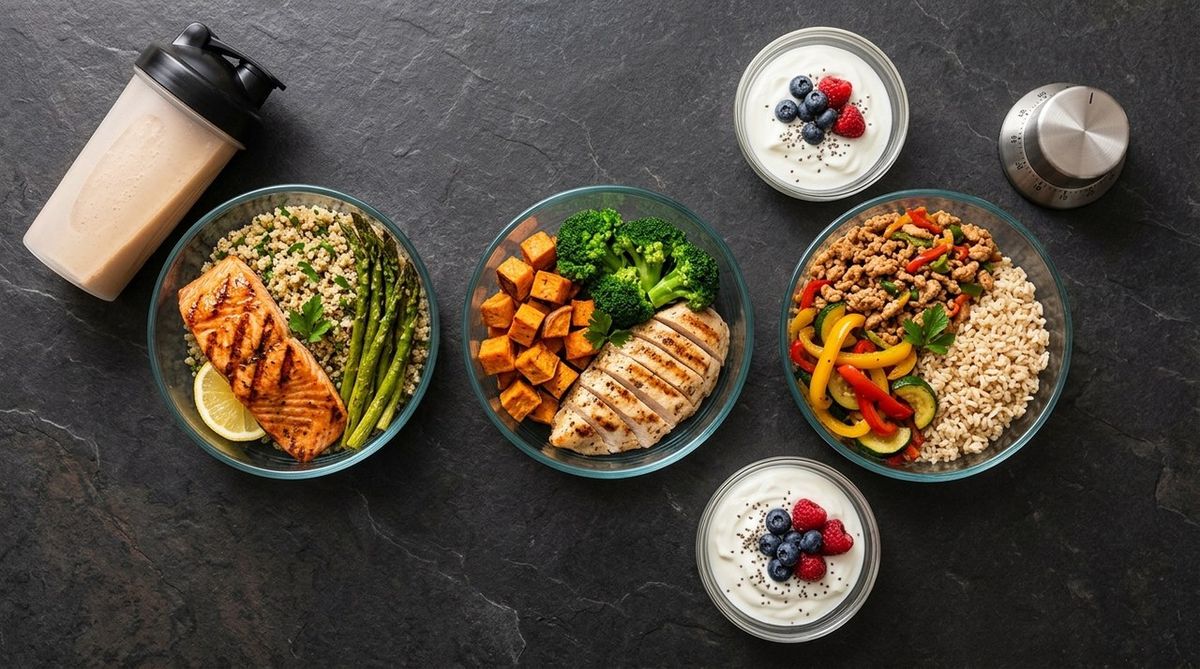
| Body Weight (kg) | Daily Target (1.65 g/kg) | Per-Bolus Floor (0.40 g/kg) | 3-Bolus Split (g/meal) | Leucine Target / Bolus |
|---|---|---|---|---|
| 60 kg (132 lb) | 99 g/day | 24 g | 33 g × 3 meals | 2.5 g |
| 70 kg (154 lb) | 116 g/day | 28 g | 39 g × 3 meals | 2.6 g |
| 80 kg (176 lb) | 132 g/day | 32 g | 44 g × 3 meals | 2.8 g |
| 90 kg (198 lb) | 149 g/day | 36 g | 50 g × 3 meals | 3.0 g |
| 100 kg (220 lb) | 165 g/day | 40 g | 55 g × 3 meals | 3.0 g |
Rule 5: Front-Load Fast-Digesting Whey Post-Lift and Back-Load Casein Pre-Fast
When closing your window at 16:30 or 20:00, your final bolus bridges a 16-hour overnight fast. Use fast-digesting whey or lean poultry for Bolus 1 right after training to spike plasma leucine rapidly, then pair Bolus 3 with slower-digesting proteins—such as Greek yogurt, cottage cheese, micellar casein, or fatty fish with fibrous vegetables—to sustain amino acid availability deeper into the fasting window.
Step-by-Step Window-Anchor Setup
- Fix Your Training End Time: Record \( T_{\text{lift\_end}} \) for your primary strength days (e.g., 08:00 for morning lifters or 17:00 for afternoon lifters).
- Anchor Window Opening: If training fasted, set \( T_{\text{open}} \le T_{\text{lift\_end}} + 1.0\text{ hr} \) and if training fed, place at least one 0.40 g/kg bolus 1–3 hours pre-lift.
- Divide by 3.5 Hours: Schedule 3 distinct meals at hour 0, hour 3.5–4.0, and hour 7.5–7.75 inside your intermittent fasting window calculator plan.
- Verify Leucine Density: Confirm each meal hits 2.5–3.0 g leucine without grazing on low-protein snacks between boluses.
Frequently Asked Questions
Can I train fasted at 07:00 and wait until 12:00 to break my fast?
Waiting five hours after a fasted strength session leaves post-exercise muscle protein synthesis unstimulated during peak sensitivity. Shifting your 8-hour window to 08:30–16:30 keeps the exact same 16-hour fast while honoring the 1-hour post-lift anchor.
Why 3 boluses instead of 2 or 4 in an 8-hour window?
Two meals leave only two MPS spikes and make hitting 140+ g of protein uncomfortable, while four meals space feedings every 2.0–2.5 hours—too close to reset the 3.5-hour refractory period. Three boluses optimize both total protein absorption and MPS signaling.
Do BCAAs during a morning fast count as breaking the fast?
Branched-chain amino acids trigger an insulin and mTORC1 response, which technically breaks a strict fasted state while providing incomplete essential amino acids for full tissue repair. A complete 35–45 g whey or whole-food bolus post-lift is far more effective.