Intermittent Fasting 16-Hour Destination-Breakfast Circadian Reset & Multi-Time-Zone Jet Lag Schedule Formula: 5 Phase-Shift Rules
Core Destination-Breakfast Clock Equation
To align your meal timing with a destination 08:00 local breakfast after crossing multiple time zones, compute your home-clock fasting start time using modular 24-hour arithmetic:
\[ T_{\text{fast\_start,home}} = (T_{\text{breakfast,dest}} - \Delta Z - 16\text{ hr}) \bmod 24 \]
where \( T_{\text{breakfast,dest}} = 08:00 \) (8.00 hours), \( \Delta Z \) is the signed time-zone offset in hours (positive for eastbound travel such as \( +5 \) to \( +9\text{ hr} \), negative for westbound travel such as \( -5 \) to \( -8\text{ hr} \)), and 16 hours is the pre-breakfast fasting window.
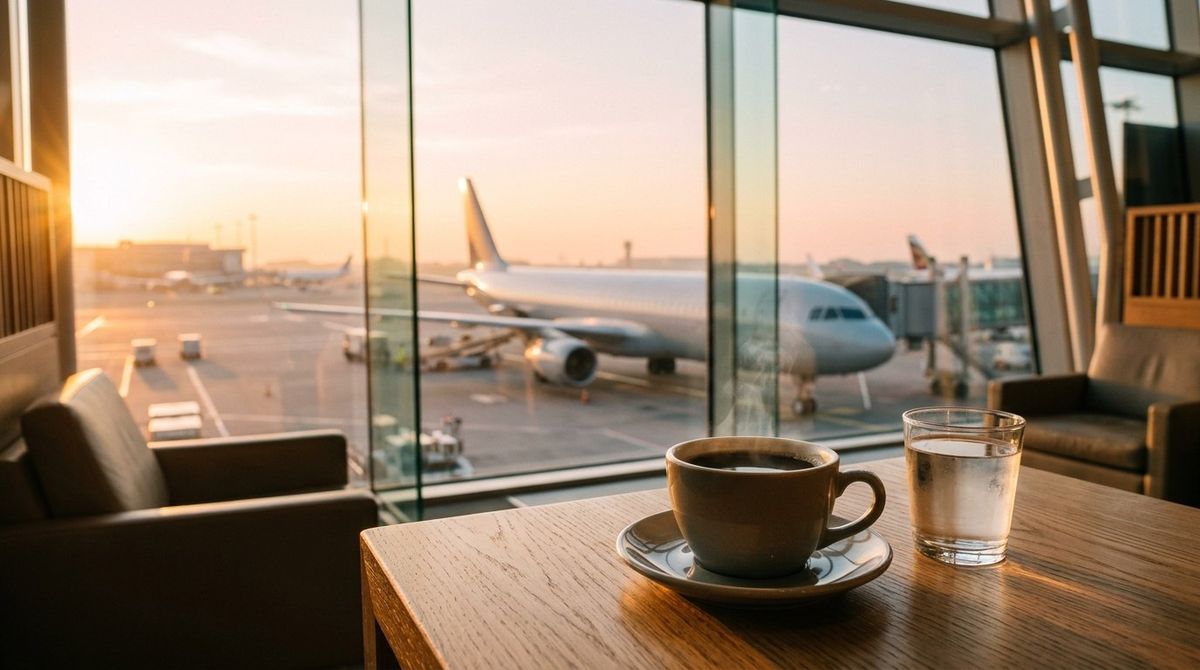
Crossing five to nine time zones disrupts both your central light-dark schedule and your peripheral meal-timing clock, often called the food-entrained oscillator (FEO). Instead of eating random airline meals served on departure-city schedules, you can use a deterministic intermittent fasting jet lag circadian reset schedule formula to anchor your first destination meal at 08:00 local time. Note that this scheduling framework covers meal-window logistics and travel planning only.
Rule 1: Apply Signed Time-Zone Offsets Correctly in Modular 24-Hour Math
Sign errors are the most common mistake when converting between departure and arrival clocks. Always define \( \Delta Z = \text{UTC}_{\text{dest}} - \text{UTC}_{\text{home}} \):
- Eastbound Offsets (Positive \( \Delta Z \)): Flying from New York (UTC-5) to London (UTC+0) gives \( \Delta Z = +5\text{ hr} \); New York to Paris (UTC+1) gives \( \Delta Z = +6\text{ hr} \); Los Angeles (UTC-8) to Paris (UTC+1) gives \( \Delta Z = +9\text{ hr} \).
- Westbound Offsets (Negative \( \Delta Z \)): Flying from London (UTC+0) to New York (UTC-5) gives \( \Delta Z = -5\text{ hr} \); Paris (UTC+1) to Chicago (UTC-6) gives \( \Delta Z = -7\text{ hr} \); Paris (UTC+1) to Los Angeles (UTC-8) gives \( \Delta Z = -9\text{ hr} \).
- Modulo 24 Normalization: Whenever \( (T_{\text{breakfast,dest}} - \Delta Z - 16) \) evaluates to a negative number, add 24 repeatedly until the result falls between 00:00 and 23:59; if negative once, it falls on the calendar day prior to destination breakfast.
Rule 2: Eastbound Overnight Schedules (\( \Delta Z \in [+5, +9]\text{ hr} \))
Eastbound flights compress the night and require an early home-time fasting cutoff—often before boarding or shortly after takeoff. For example, flying New York to Paris (\( \Delta Z = +6\text{ hr} \)) with a target 08:00 Paris breakfast:
\[ T_{\text{fast\_start,home}} = (8 - 6 - 16) \bmod 24 = (-14) \bmod 24 = 10:00\text{ AM EST (Day Prior)} \]
Wait—if your overnight flight departs New York at 18:00 EST and lands in Paris at 07:30 CET, starting a 16-hour fast at 10:00 AM EST means eating an early brunch before leaving for the airport, skipping the 20:00 EST in-flight dinner, and breaking the fast at 08:00 AM CET upon arrival. For a \( +9\text{ hr} \) jump (Los Angeles to Paris), \( (8 - 9 - 16) \bmod 24 = 07:00\text{ AM PST} \) the morning before arrival.
| Route Example | Direction & Offset (\( \Delta Z \)) | Destination Breakfast | Home Fast Start (16-Hr) | In-Flight Meal Action |
|---|---|---|---|---|
| New York to London | Eastbound (+5 hr) | 08:00 GMT | 11:00 EST (Day Prior) | Skip overnight dinner; eat at 08:00 GMT |
| New York to Paris | Eastbound (+6 hr) | 08:00 CET | 10:00 EST (Day Prior) | Early brunch at home; water/black coffee onboard |
| Chicago to Frankfurt | Eastbound (+7 hr) | 08:00 CET | 09:00 CST (Day Prior) | Morning meal pre-flight; fast through arrival |
| Los Angeles to London | Eastbound (+8 hr) | 08:00 GMT | 08:00 PST (Day Prior) | Eat 07:30 PST breakfast; skip all cabin trays |
| Los Angeles to Paris | Eastbound (+9 hr) | 08:00 CET | 07:00 PST (Day Prior) | Early pre-airport meal; fast until 08:00 CET |
Rule 3: Westbound Daytime Schedules (\( \Delta Z \in [-5, -8]\text{ hr} \))
Westbound travel lengthens the day, pushing the 16-hour fasting start time into the evening of the departure city. For a London-to-New York flight (\( \Delta Z = -5\text{ hr} \)) targeting an 08:00 EST breakfast the morning after landing:
\[ T_{\text{fast\_start,home}} = (8 - (-5) - 16) \bmod 24 = (-3) \bmod 24 = 21:00\text{ GMT (9:00 PM)} \]
Because westbound flights typically depart mid-morning and arrive mid-afternoon local time, you can eat a normal afternoon meal in flight or upon landing before starting your fast at 21:00 GMT (which is 16:00 EST—an early 4:00 PM local dinner in New York), then fast 16 hours until 08:00 EST the next morning.

| Route Example | Direction & Offset (\( \Delta Z \)) | Destination Breakfast | Home Fast Start (16-Hr) | Equivalent Arrival-Zone Time |
|---|---|---|---|---|
| London to New York | Westbound (-5 hr) | 08:00 EST | 21:00 GMT | 16:00 EST (Day 1 Early Dinner) |
| Paris to New York | Westbound (-6 hr) | 08:00 EST | 22:00 CET | 16:00 EST (Day 1 Early Dinner) |
| Paris to Chicago | Westbound (-7 hr) | 08:00 CST | 23:00 CET | 16:00 CST (Day 1 Early Dinner) |
| London to Los Angeles | Westbound (-8 hr) | 08:00 PST | 00:00 GMT (Midnight) | 16:00 PST (Day 1 Early Dinner) |
Rule 4: Handle Flight Delays and Overnight Arrivals with the 12-to-18-Hour Buffer
Real-world flights rarely land on the exact minute of your planned breakfast. If an eastbound flight arrives at 10:30 local time instead of 07:00, your fast simply extends from 16 hours to 18.5 hours—well within standard intermittent fasting windows. Conversely, if a late-evening arrival lands at 20:00 local time, do not break your fast with a heavy midnight meal; wait until the next morning at 08:00 local time or shift your target anchor to 12:00 local lunch using \( T_{\text{lunch,dest}} = 12.00 \) in the formula. You can model custom departure and arrival times at ifwindowcalculator.com.
Rule 5: Lock the Post-Arrival 16:8 Window for Three Consecutive Days
A single 08:00 breakfast sets the initial anchor, but repeating a consistent 8-hour eating window (08:00 to 16:00 local time, or shifting gradually to 10:00–18:00) for Days 1 through 3 prevents evening snacking from pulling your peripheral clock back toward home time. Keep zero-calorie hydration (water, sparkling water, plain black coffee or tea) steady during cabin hours.
Step-by-Step Travel Window Checklist
- Compute Signed Offset: Subtract home UTC offset from destination UTC offset to get \( \Delta Z \).
- Solve Home Cutoff: Plug \( T_{\text{breakfast,dest}} = 8 \) and \( \Delta Z \) into \( (8 - \Delta Z - 16) \bmod 24 \).
- Set Dual-Clock Alarms: Add a phone reminder for the exact home-time cutoff and switch your watch to destination time at boarding.
- Decline Cabin Trays: Drink water or plain tea during the flight when cabin service falls inside your 16-hour fast.
- Anchor Day 1 Breakfast: Eat your first destination meal at 08:00 local time and hold an 8-hour eating window for three days.
Common Jet-Lag Scheduling Mistakes
- Reversing the Offset Sign: Adding \( \Delta Z \) instead of subtracting it shifts your fast start by 10 to 18 hours in the wrong direction.
- Eating Every Airline Meal: Consuming midnight-equivalent cabin dinners during an eastbound red-eye reinforces your home time zone.
- Breaking the Fast at Midnight: Snacking immediately after a late-night arrival resets the clock to local midnight rather than morning.
Frequently Asked Questions
What if I usually skip breakfast and eat at 12:00 PM?
Replace \( T_{\text{breakfast,dest}} = 8 \) with \( 12 \) in the formula: \( T_{\text{fast\_start,home}} = (12 - \Delta Z - 16) \bmod 24 \). For New York to Paris (\( \Delta Z = +6 \)), that shifts your home cutoff from 10:00 EST to 14:00 EST (2:00 PM).
Does plain black coffee or tea break the scheduling fast?
No; plain water, sparkling water, unsweetened tea, and black coffee without cream or sugar keep the meal-timing window intact while keeping you hydrated in dry cabin air.
How many days should I hold the destination meal schedule?
Hold the 08:00–16:00 (or 10:00–18:00) local eating window for at least three consecutive days after arrival so your daily meal rhythm stabilizes in the new time zone.