
Millions of people follow a nominal 12:00 to 20:00 (16:8) schedule while sipping morning coffee with creamer at 07:00, assuming a small splash does not alter their daily timing. From a strict metabolic scheduling standpoint, however, any additive that crosses the \( 10\text{–}15\text{ kcal} \) or \( 2\text{ g} \) macronutrient threshold initiates digestion and resets the true start of your eating window. You can model your exact daily schedule shift using the intermittent fasting window calculator before adjusting your morning routine.
True Metabolic Eating-Window Duration:
\[ W_{\text{true}} = W_{\text{nominal}} + (T_{\text{first\_meal}} - T_{\text{caloric\_coffee}}) \]True Fasting-Window Duration:
\[ F_{\text{true}} = 24\text{ h} - W_{\text{true}} \]07:00 Creamer Shift on a 12:00–20:00 Schedule:
\[ W_{\text{true}} = 8\text{ h} + (12{:}00 - 07{:}00) = 13\text{ h} \quad \Longrightarrow \quad F_{\text{true}} = 11\text{ h} \text{ (11:13)} \]Morning Coffee Additive Caloric & Threshold Audit
Not all morning coffee additions carry the same caloric density or macronutrient load. Auditing your exact pour volume with a measuring spoon rather than eyeing a splash reveals why two cups of morning coffee frequently exceed the \( 15\text{ kcal} \) threshold.
| Coffee Additive | Typical Pour | Calories (kcal) | Threshold Status (>15 kcal) |
|---|---|---|---|
| Black Filter Coffee (8 oz) | 240 mL | 2 kcal | Below threshold (Window intact) |
| Heavy Whipping Cream | 1 tbsp (15 mL) | 51 kcal | Exceeds threshold (Starts clock) |
| Barista Oat Milk | 2 tbsp (30 mL) | 18–25 kcal | Exceeds threshold (Starts clock) |
| Collagen Peptides | 1 scoop (10 g) | 36 kcal | Exceeds threshold (9 g protein) |
| MCT Oil | 1 tbsp (15 mL) | 120 kcal | Exceeds threshold (14 g fat) |
| Zero-Calorie Mineral Water / Espresso | 1 shot (30 mL) | 3 kcal | Below threshold (Window intact) |
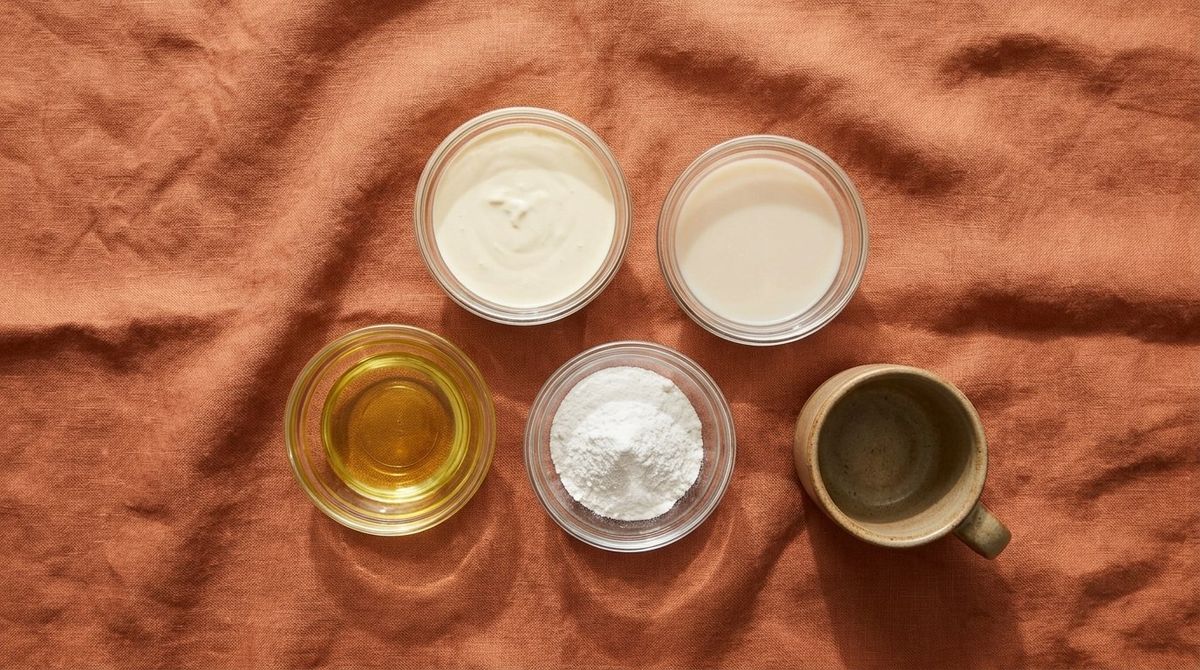
Rule 1: Anchor the Window Clock to the First Caloric Pour
Your schedule clock begins the minute you consume more than \( 10\text{–}15\text{ kcal} \) or \( 2\text{ g} \) of protein, fat, or carbohydrate, not when you sit down for solid food at noon. If you drink a \( 51\text{ kcal} \) heavy-cream coffee at \( 07{:}00 \) and eat dinner until \( 20{:}00 \), your digestive tract remains active across a \( 13\text{-hour} \) span. Logging \( T_{\text{caloric\_coffee}} \) as your true window start eliminates silent schedule drift.
Rule 2: Measure Pour Volume Instead of Estimating Splashes
Free-pouring creamer straight from a carton routinely delivers 2 to 3 tablespoons (\( 30\text{–}45\text{ mL} \)) rather than a single teaspoon. At \( 51\text{ kcal} \) per tablespoon of heavy cream or \( 35\text{ kcal} \) per tablespoon of sweetened liquid creamer, a casual two-cup morning habit adds \( 100\text{–}200\text{ kcal} \) before 09:00. Use a dedicated 1-teaspoon or 1-tablespoon measure for three consecutive mornings to verify your true baseline.
Rule 3: Apply the 11:13 Inversion Check on 16:8 Schedules
When \( T_{\text{first\_meal}} - T_{\text{caloric\_coffee}} = 5\text{ h} \), your nominal 16:8 split (\( 16\text{ h} \) fasting, \( 8\text{ h} \) eating) inverts into an 11:13 schedule (\( 11\text{ h} \) fasting, \( 13\text{ h} \) eating). That \( 5\text{-hour} \) shift cuts your overnight fasting window by 31.25% while keeping your dinner cutoff unchanged at \( 20{:}00 \). Running the intermittent fasting window calculator makes this inversion immediately visible.
Nominal 16:8 vs. True Window-Start Schedule Shift
The table below shows how shifting \( T_{\text{caloric\_coffee}} \) earlier in the morning compresses your effective fasting window \( F_{\text{true}} \) when your final meal ends at \( 20{:}00 \).
| First Caloric Coffee Time | Nominal Meal Window | Added Early Hours | True Eating / Fasting Split |
|---|---|---|---|
| 12:00 (Black Coffee Only Earlier) | 12:00–20:00 (8 h) | 0.0 h | 8 h eating / 16 h fasting (16:8) |
| 10:00 (2 tbsp Oat Milk) | 12:00–20:00 (8 h) | 2.0 h | 10 h eating / 14 h fasting (14:10) |
| 08:30 (1 Scoop Collagen) | 12:00–20:00 (8 h) | 3.5 h | 11.5 h eating / 12.5 h fasting (12.5:11.5) |
| 07:00 (1 tbsp Heavy Cream) | 12:00–20:00 (8 h) | 5.0 h | 13 h eating / 11 h fasting (11:13) |
Rule 4: Separate Pure-Fat Additives from Protein and Carbs
Additives differ in how they affect your daily log: oat milk and sweetened creamers supply fast-absorbing carbohydrates, collagen peptides supply \( 9\text{ g} \) of protein per scoop, and MCT oil or heavy cream supply nearly pure fat. While pure fat has minimal direct glycemic impact, \( 51\text{–}120\text{ kcal} \) still provides exogenous energy that pauses endogenous fat mobilization and counts as caloric intake inside your daily window.
Rule 5: Shift Dinner Earlier When Morning Creamer Is Non-Negotiable
If a \( 07{:}00 \) coffee with creamer is essential to your morning routine, preserve a full \( 16\text{-hour} \) fasting window by sliding your final meal earlier rather than pretending the coffee did not happen. Starting your clock at \( 07{:}00 \) and closing your eating window at \( 15{:}00 \) yields \( W_{\text{true}} = 8\text{ h} \) and \( F_{\text{true}} = 16\text{ h} \), or sliding to \( 09{:}00\text{–}17{:}00 \) gives you a clean, sustainable 16:8 rhythm.
5 Clock-Reset Scheduling Rules Matrix
Use the decision matrix below to pair your morning beverage choice with the exact evening cutoff adjustment needed to preserve a true 16-hour fasting window every day.
| Clock-Reset Rule | Morning Trigger | Window Impact | Corrective Action |
|---|---|---|---|
| Rule 1: Anchor First Pour | Any additive >15 kcal | Resets \( T_{\text{start}} \) immediately | Log exact time of cup #1 |
| Rule 2: Measure Volume | Free-poured creamer | Adds 50–150 kcal silently | Use 1-tbsp measuring spoon |
| Rule 3: 11:13 Inversion | 07:00 cream on 12–20 | Cuts fast by 31.25% | Audit in window calculator |
| Rule 4: Macro Separation | Oat milk or collagen | Triggers carbs/protein log | Reserve for eating window |
| Rule 5: Slide Dinner Early | Non-negotiable 07:00 latte | Requires 8-hour shift | End final meal at 15:00 |
Worked 7-Day Consistency Comparison
Over a 7-day week, an unlogged 07:00 heavy-cream pour on a nominal 12:00–20:00 schedule reduces cumulative fasting time from \( 7 \times 16\text{ h} = 112\text{ h} \) down to \( 7 \times 11\text{ h} = 77\text{ h} \), a loss of \( 35\text{ hours} \) per week. Switching to black coffee until 12:00 or shifting your eating window to 07:00–15:00 restores all \( 112\text{ hours} \) without changing total daily calories.
Morning Coffee Schedule Reset Checklist
- Check Label Serving Sizes: Multiply the nutrition label calories by your actual measured pour volume in milliliters or tablespoons.
- Apply the 15 kcal Gate: Treat any morning beverage totaling more than \( 15\text{ kcal} \) or \( 2\text{ g} \) of macros as \( T_{\text{caloric\_coffee}} \).
- Calculate True Window Duration: Add the hours between \( T_{\text{caloric\_coffee}} \) and \( T_{\text{first\_meal}} \) to your nominal eating window.
- Choose Your Adjustment Lever: Either switch to black coffee/espresso before \( 12{:}00 \) or advance your evening cutoff time to match.
Frequently Asked Questions
Does black coffee without sugar or creamer reset the fasting clock?
No, a standard 8 oz cup of plain black coffee contains roughly \( 2\text{ kcal} \) and negligible protein or carbohydrate, keeping it well below the \( 10\text{–}15\text{ kcal} \) threshold.
How many tablespoons of oat milk cross the 15 kcal threshold?
Most barista-style oat milks contain \( 9\text{–}13\text{ kcal} \) per tablespoon, meaning just 2 tablespoons (\( 30\text{ mL} \)) reaches \( 18\text{–}26\text{ kcal} \) and starts your eating window.
Can I keep a 16:8 schedule if I drink collagen coffee at 07:00?
Yes, as long as you count \( 07{:}00 \) as the start of your 8-hour window and finish your final meal by \( 15{:}00 \), which keeps \( F_{\text{true}} = 16\text{ h} \) intact.