Intermittent Fasting Caffeine Half-Life and Sleep Cutoff Formula: 5 Essential Black Coffee Timing Calculations
Structuring your daily routine with an intermittent fasting caffeine cutoff calculator prevents the two most common scheduling mistakes among black-coffee fasters: drinking espresso the second your alarm goes off (which collides with your natural morning awakening rhythm) and sipping a second iced Americano at 2:30 PM to push through the final hours of an 18:6 or OMAD fast (which leaves 50+ milligrams of active caffeine circulating in your bloodstream at midnight). Across r/intermittentfasting morning coffee threads, fasters consistently report that locking in a mathematical morning delay and afternoon cutoff transforms both their fasting energy and their sleep consistency. You can generate your custom daily coffee and eating window timestamps using the Intermittent Fasting Window Calculator and apply the pharmacokinetic clearance formulas below.
Scheduling & Informational Disclaimer: All equations, half-life decay curves, and beverage timing schedules in this guide are provided strictly for personal time-management, habit scheduling, and general nutritional education. They do not constitute medical advice, diagnosis, or treatment. Always consult a qualified healthcare professional regarding caffeine intake and dietary schedules.
- The Exponential Clearance Formula: Remaining active caffeine after \(\Delta t\) hours is \(C(t) = C_0 \cdot \left(\frac{1}{2}\right)^{\frac{t - t_{\text{dose}}}{T_{1/2}}}\), where mean adult half-life is \(T_{1/2} = 5.0\text{ hours}\).
- The \(\le 25\text{ mg}\) Bedtime Clearance Target: To prevent caffeine from fragmenting deep slow-wave rest, solve for the latest cup timestamp (\(t_{\text{cutoff}}\)) that leaves \(25\text{ mg}\) or less at your target sleep time (\(t_{\text{sleep}}\)).
- The 90-Minute Morning Hydration Buffer: Delay your first cup of black coffee until \(t_{\text{wake}} + 90\text{ min}\), starting the morning with 500 ml of plain water and electrolytes instead.
- The 5-Calorie Clean-Fast Rule: Keep fasting-window coffee strictly black (or with a pinch of sodium chloride to cut bitterness)—zero milk, cream, collagen, or MCT oil before your eating window opens.
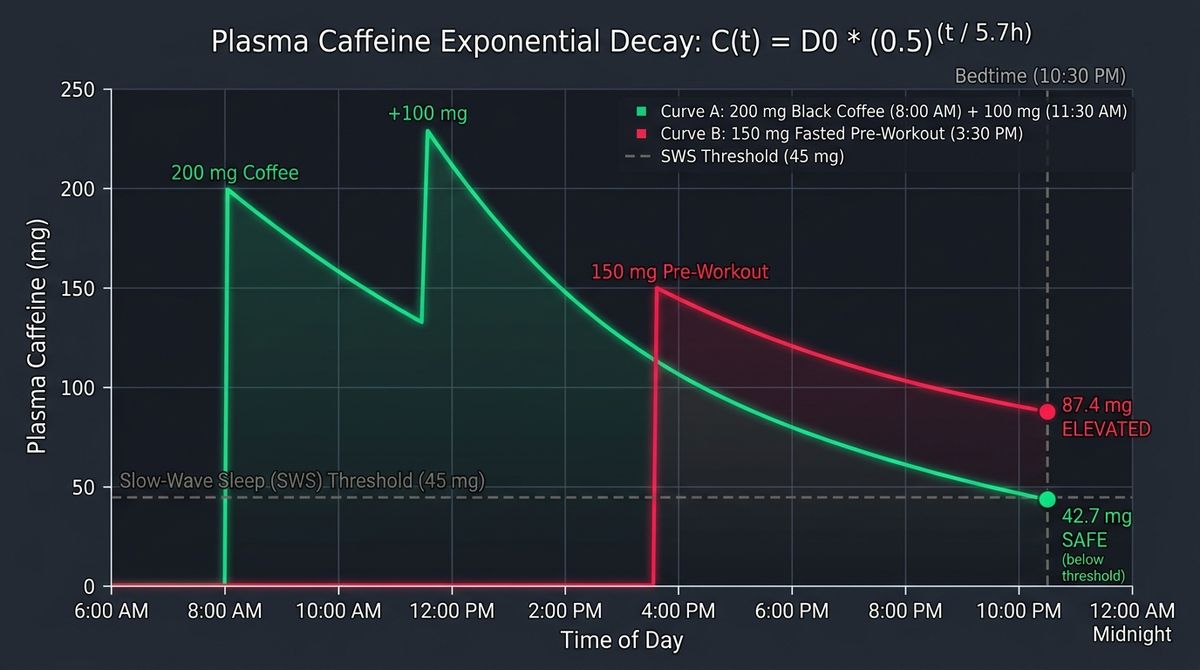
1. First-Order Caffeine Pharmacokinetics: The 5-Hour Half-Life Decay Equation
Why do so many fasters who drink black coffee at 2:00 PM or 3:00 PM to curb late-fast hunger find themselves staring at the ceiling at 11:30 PM—or waking up groggy at 6:30 AM needing three cups just to function? Caffeine is eliminated by hepatic cytochrome P450 1A2 (CYP1A2) enzymes according to first-order exponential decay kinetics, with a typical adult elimination half-life of \(T_{1/2} = 5.0\text{ hours}\) (ranging from \(3.5\text{ hours}\) in fast metabolizers to \(6.5+\text{ hours}\) in slow metabolizers).
If you consume a single dose of \(C_0\) milligrams of caffeine at clock time \(t_{\text{dose}}\), the active caffeine mass \(C(t)\) remaining in your system at any later clock time \(t\) is defined by:
$$C(t) = C_0 \times \left(\frac{1}{2}\right)^{\frac{t - t_{\text{dose}}}{T_{1/2}}} = C_0 \times e^{-\lambda \left(t - t_{\text{dose}}\right)} \quad \text{where } \lambda = \frac{\ln(2)}{T_{1/2}} \approx 0.1386\text{ hr}^{-1}$$
And if you drink two separate cups during your morning fasting window—Dose 1 (\(C_1\) at \(t_1\)) and Dose 2 (\(C_2\) at \(t_2\))—the cumulative active load at bedtime (\(t_{\text{sleep}}\)) is the superposition of both decay curves:
$$C_{\text{total}}(t_{\text{sleep}}) = C_1 \cdot \left(\frac{1}{2}\right)^{\frac{t_{\text{sleep}} - t_1}{T_{1/2}}} + C_2 \cdot \left(\frac{1}{2}\right)^{\frac{t_{\text{sleep}} - t_2}{T_{1/2}}} \le C_{\text{max,sleep}}$$
Where \(C_{\text{max,sleep}} = 25.0\text{ mg}\) (roughly one-quarter of a weak cup of coffee) represents the scheduling ceiling below which residual adenosine-receptor blockade no longer delays sleep onset.
2. Formula 2: Solving for Your Exact Daily Caffeine Cutoff Time (\(t_{\text{cutoff}}\))
By inverting the exponential decay equation for a single afternoon dose \(C_0\) and a target bedtime threshold \(C_{\text{max,sleep}} = 25\text{ mg}\), we derive the Daily Caffeine Cutoff Formula:
$$t_{\text{cutoff}} = t_{\text{sleep}} - \left[T_{1/2} \times \log_2\left(\frac{C_0}{25\text{ mg}}\right)\right] = t_{\text{sleep}} - \left[T_{1/2} \times \frac{\ln(C_0 / 25)}{\ln(2)}\right]$$
- For a 100 mg Cup (8 oz Brewed Filter Coffee or Single Espresso): \(\log_2(100 / 25) = \log_2(4) = 2.0\text{ half-lives} = 2.0 \times 5.0\text{ hrs} = \mathbf{10.0\text{ hours before bed}}\).
- For a 200 mg Cup (16 oz Grande Drip or Cold Brew): \(\log_2(200 / 25) = \log_2(8) = 3.0\text{ half-lives} = 3.0 \times 5.0\text{ hrs} = \mathbf{15.0\text{ hours before bed}}\).
- For a 50 mg Cup (8 oz Black or Green Tea): \(\log_2(50 / 25) = \log_2(2) = 1.0\text{ half-life} = 1.0 \times 5.0\text{ hrs} = \mathbf{5.0\text{ hours before bed}}\).
This logarithmic relationship explains why switching from a 200 mg cold brew to a 50 mg green tea at 1:00 PM is a game-changer for fasters on r/intermittentfasting: doubling your caffeine dose from 100 mg to 200 mg requires moving your cutoff time back by a full 5.0 hours!
3. Complete Fasting Beverage Caffeine & Cutoff Schedule Matrix
Use the verified scheduling table below (assuming a 6:30 AM wake time, 10:30 PM target sleep time, and \(T_{1/2} = 5.0\text{ hours}\)) to plan your fasting-window beverages:
| Fasting-Safe Beverage (0–5 kcal) | Typical Caffeine Dose (\(C_0\)) | Half-Lives to Hit \(\le 25\text{ mg}\) | Required Clearance Window | Latest Cutoff for 10:30 PM Sleep | Residual Caffeine at 10:30 PM |
|---|---|---|---|---|---|
| 16 oz Cold Brew / Large Drip | 200 mg | 3.00 half-lives | 15.0 hours | 7:30 AM (Morning only) | 25.0 mg |
| Double Espresso / 12 oz Pour-Over | 150 mg | 2.58 half-lives | 12.9 hours | 9:35 AM | 25.0 mg |
| 8 oz Standard Black Coffee | 100 mg | 2.00 half-lives | 10.0 hours | 12:30 PM (Noon cutoff) | 25.0 mg |
| Single Espresso / 8 oz Yerba Mate | 75 mg | 1.58 half-lives | 7.9 hours | 2:35 PM | 25.0 mg |
| 8 oz Steeped Green or Black Tea | 45 mg | 0.85 half-lives | 4.2 hours | 6:15 PM (Early afternoon safe) | 25.0 mg |
| Decaf Espresso / Herbal Rooibos | 3–5 mg | 0.00 half-lives | 0.0 hours | Anytime (Evening fasting aid) | < 2.0 mg |
As the matrix shows, if your eating window opens at 2:00 PM on an 18:6 schedule and you want a warm beverage at 1:00 PM to bridge the final hour of your fast without hurting your 10:30 PM sleep, swap your 1:00 PM 16 oz black coffee (200 mg) for an 8 oz green tea (45 mg) or decaf Americano (4 mg).
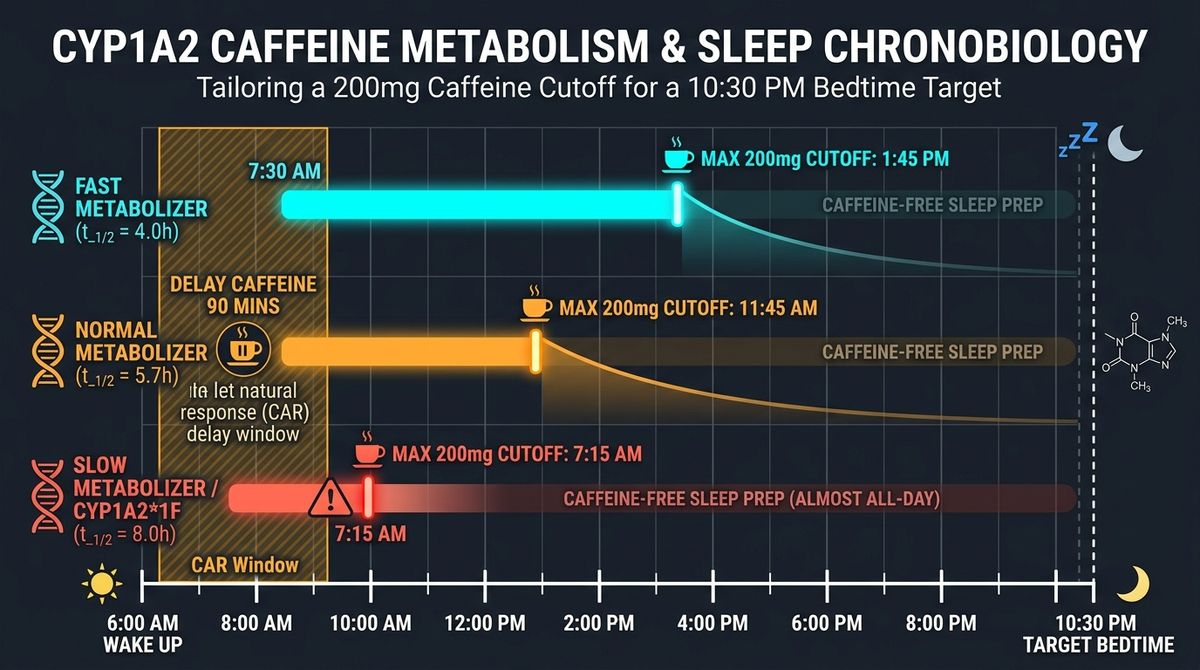
4. Formula 3: The 90-Minute Morning Cortisol Delay & Hydration Buffer
During the first 45 to 60 minutes after waking (\(t_{\text{wake}}\)), your body naturally executes its peak morning awakening response, clearing residual sleep inertia while elevating endogenous alertness. Drinking 150 mg of black coffee at \(t_{\text{wake}} + 5\text{ minutes}\) on an empty stomach stacks peak exogenous caffeine absorption on top of your natural morning peak—and once both curves drop together around 11:30 AM, fasters experience a sharp midday energy trough right when fasting hunger peaks.
To flatten that midday dip, apply the 90-Minute Morning Delay Protocol:
$$t_{\text{coffee,1}} = t_{\text{wake}} + 1.5\text{ hours}$$
- Phase 1 (\(t_{\text{wake}}\) to \(t_{\text{wake}} + 90\text{ min}\)): Drink \(500\text{ ml}\) (16.9 oz) of water with a pinch of unflavored sodium/potassium fasting electrolytes to replenish overnight respiratory water loss.
- Phase 2 (\(t_{\text{wake}} + 90\text{ min}\)): Enjoy your primary 120–150 mg black coffee. Because it peaks at \(t_{\text{wake}} + 135\text{ min}\), it carries your focus smoothly across the final 3 to 4 hours of your morning fast until your eating window opens at 12:00 PM or 1:00 PM.
5. Worked 2-Cup Superposition Example: Auditing an 8:00 AM + 11:30 AM Coffee Schedule
Suppose you wake up at 6:30 AM, follow a 1:00 PM to 7:00 PM (18:6) fasting schedule, and aim to fall asleep at 10:30 PM (22:30). You drink Cup 1 (\(140\text{ mg}\) pour-over) at 8:00 AM (08:00) and Cup 2 (\(100\text{ mg}\) black coffee) at 11:30 AM (11:30). Does your two-cup schedule clear the \(\le 25.0\text{ mg}\) bedtime rule at 10:30 PM?
- Elapsed Time for Cup 1 (08:00 to 22:30): \(\Delta t_1 = 14.5\text{ hours}\) (\(2.90\text{ half-lives}\)):
$$C_1(22:30) = 140\text{ mg} \times \left(0.5\right)^{14.5 / 5.0} = 140 \times \left(0.5\right)^{2.90} = 140 \times 0.1340 = \mathbf{18.76\text{ mg}}$$
- Elapsed Time for Cup 2 (11:30 to 22:30): \(\Delta t_2 = 11.0\text{ hours}\) (\(2.20\text{ half-lives}\)):
$$C_2(22:30) = 100\text{ mg} \times \left(0.5\right)^{11.0 / 5.0} = 100 \times \left(0.5\right)^{2.20} = 100 \times 0.2176 = \mathbf{21.76\text{ mg}}$$
- Cumulative Active Caffeine at 10:30 PM:
$$C_{\text{total}}(22:30) = 18.76\text{ mg} + 21.76\text{ mg} = \mathbf{40.52\text{ mg}} > 25.0\text{ mg (Exceeds Bedtime Ceiling!)}$$
- The Schedule Fix: Even though Cup 2 (100 mg at 11:30 AM) would have been below 25 mg on its own (\(21.76\text{ mg}\)), stacking it on top of Cup 1's residual tail (\(18.76\text{ mg}\)) pushes your 10:30 PM load to \(40.52\text{ mg}\)! Changing Cup 2 at 11:30 AM from a 100 mg black coffee to a 30 mg half-caf or green tea drops \(C_2(22:30)\) to \(6.53\text{ mg}\), bringing your total 10:30 PM residual load to \(18.76 + 6.53 = \mathbf{25.29\text{ mg}}\).
Frequently Asked Questions
Does black coffee break an intermittent fast?
No. A standard 8-to-12-ounce cup of plain black coffee contains fewer than 3 to 5 calories and zero digestible sugars or fats, so it fits cleanly inside a standard intermittent fasting window. As fasters share on r/intermittentfasting, adding a tiny pinch of salt to black coffee neutralizes bitter taste receptors without adding a single calorie.
Why do I feel jittery or acidic when drinking black coffee during a fast?
Drinking hot, high-chlorogenic-acid light-roast coffee immediately upon waking on an empty stomach stimulates gastric acid secretion while you are mildly dehydrated from sleep. Switching to a low-acid cold brew or dark espresso roast, drinking 500 ml of water first, and waiting 90 minutes after waking resolves empty-stomach acidity for most fasters.
What happens if I add a splash of oat milk, cream, or MCT oil to my morning coffee?
Adding 1 to 2 tablespoons of heavy cream (100 kcal), MCT oil (120 kcal), or sweetened oat milk introduces an immediate caloric bolus that ends your clean fasting window. Save lattes, creamers, and collagen coffee for the opening minute (\(T = 0\)) of your scheduled eating window.
Conclusion: Lock In Your Custom Coffee & Fasting Timestamps
When you align your morning hydration delay and afternoon caffeine cutoff with your eating window, intermittent fasting feels effortless around the clock. Open the Intermittent Fasting Window Calculator right now to generate your exact wake-up hydration window, first-cup timestamp, caffeine cutoff alert, and eating window schedule.