Intermittent Fasting Airport Delay & Transit-Day Window Extension (16:8 to 20:4 Bridge) Schedule Formula: 5 Travel Rules
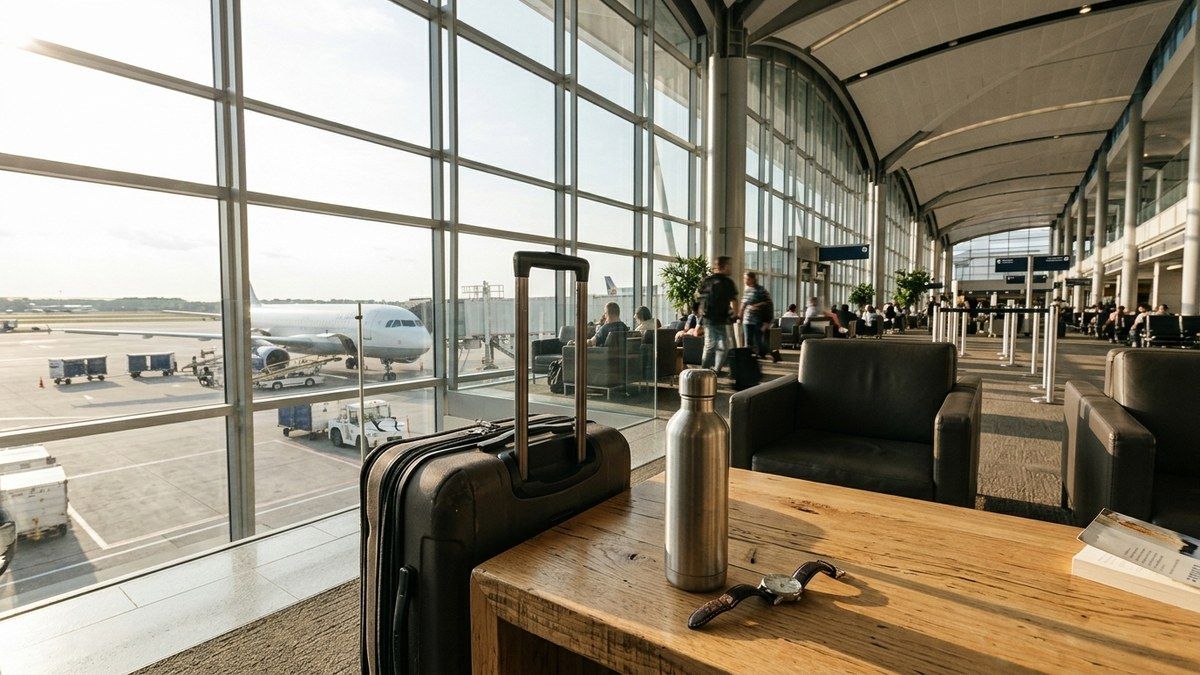
Core Takeaway: When an airline delay pushes your first real meal back by \( 4\text{ hours} \), apply the transit-delay extension equation \( F_{\text{actual}} = F_{\text{target}} + \Delta t_{\text{delay}} \) to bridge a standard \( 16:8 \) day into a \( 20:4 \) window, then anchor \( T_{\text{close,next}} = T_{\text{close,baseline}} \) so you avoid late-night double-eating and preserve your \( 112\text{-hour} \) weekly fasting budget.
Flight delays, tarmac holds, and missed connections routinely derail time-restricted eating schedules. Most travelers respond to a \( 4\text{-hour} \) departure delay in one of two ways: they buy high-priced terminal snacks to force their usual \( 12:00\text{ PM} \) opening meal, or they push dinner to \( 11:30\text{ PM} \) after landing and still expect to eat eight hours later. Both responses break the underlying weekly time-budget math.
Instead of improvising at the gate, treat transit delays as a deterministic scheduling problem. Use the intermittent fasting window calculator alongside the bridge formulas below to adjust your travel day cleanly and return to baseline within 24 hours.
The Transit-Delay Window Extension and Recovery Formulas
Define your normal daily fasting duration as \( F_{\text{target}} \) (for example, \( 16\text{ hours} \) on a \( 16:8 \) routine) and your unexpected flight or boarding delay as \( \Delta t_{\text{delay}} \). When a delay prevents you from accessing a planned meal at your normal opening hour, your actual travel-day fast extends linearly:
\[ F_{\text{actual}} = F_{\text{target}} + \Delta t_{\text{delay}} \]Rather than shifting your entire eating window backward into late night—which creates a shortened overnight fast—anchor your next-day closing boundary to your normal baseline closing time \( T_{\text{close,baseline}} \):
\[ T_{\text{close,next}} = T_{\text{close,baseline}} \]Because a standard \( 16:8 \) schedule targets \( 16\text{ hours} \times 7\text{ days} = 112\text{ hours} \) of weekly fasting time, extending one travel day by \( \Delta t_{\text{delay}} = 4\text{ hours} \) banks a \( +4\text{-hour} \) surplus. That surplus offsets any minor schedule compression on the following recovery morning while keeping your 7-day total at or above \( 112\text{ hours} \).
Worked Example: Bridging a 4-Hour Delay from 16:8 to 20:4
Suppose your baseline \( 16:8 \) schedule runs an eating window from \( 12:00\text{ PM} \) to \( 8:00\text{ PM} \) (\( T_{\text{close,baseline}} = 20:00 \)), followed by a \( 16\text{-hour} \) fast. You finish dinner at \( 8:00\text{ PM} \) on Tuesday night and plan to eat lunch at \( 12:00\text{ PM} \) Wednesday after landing.
On Wednesday morning, your flight is delayed by \( \Delta t_{\text{delay}} = 4\text{ hours} \), pushing your arrival and first proper meal to \( 4:00\text{ PM} \). Applying the extension formula gives \( F_{\text{actual}} = 16\text{ hours} + 4\text{ hours} = 20\text{ hours} \). You open your eating window at \( 4:00\text{ PM} \) and still close at your baseline anchor \( T_{\text{close,next}} = 8:00\text{ PM} \), converting Wednesday into a clean \( 20:4 \) bridge day.
Notice what happens to your 7-day budget: you logged \( 20\text{ hours} \) of fasting on Wednesday instead of \( 16\text{ hours} \), bringing your 7-day total from \( 112\text{ hours} \) to \( 116\text{ hours} \)—or giving you a \( 4\text{-hour} \) buffer if Thursday's work breakfast starts early. By Thursday night, you are back on your exact \( 12:00\text{ PM} \) to \( 8:00\text{ PM} \) routine with zero late-night double-eating.
| Schedule Scenario | Fast Start | Window Open | Window Close | Fast Duration | 7-Day Total |
|---|---|---|---|---|---|
| Baseline 16:8 Routine | 8:00 PM | 12:00 PM | 8:00 PM | 16 hours | 112 hours |
| 2-Hour Delay (18:6 Bridge) | 8:00 PM | 2:00 PM | 8:00 PM | 18 hours | 114 hours |
| 4-Hour Delay (20:4 Bridge) | 8:00 PM | 4:00 PM | 8:00 PM | 20 hours | 116 hours |
| 6-Hour Delay (22:2 Bridge) | 8:00 PM | 6:00 PM | 8:00 PM | 22 hours | 118 hours |
| Unanchored Shift (Double-Eating Risk) | 8:00 PM | 4:00 PM | 11:30 PM | 12.5 hours next | 108.5 hours |
Rule 1: Never Chase a Delayed Opening with a Late-Night Close
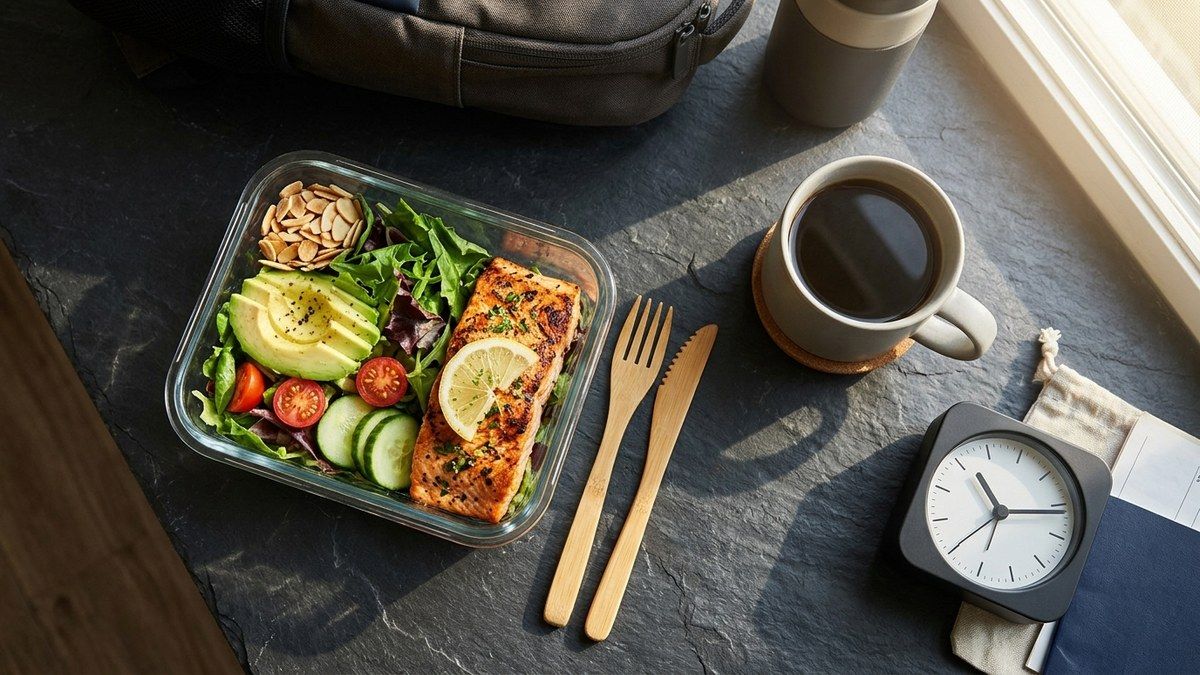
The biggest scheduling mistake on travel days is preserving an \( 8\text{-hour} \) eating window after a \( 4\text{-hour} \) delay. Opening at \( 4:00\text{ PM} \) and staying open until \( 12:00\text{ AM} \) encourages a second full dinner right before sleep and cuts the next overnight fast to \( 12\text{ hours} \). Always lock \( T_{\text{close,next}} = T_{\text{close,baseline}} \) so the delay compresses only that single day's eating window.
Rule 2: Cap the Bridge at 22 Hours on Single-Day Domestic Transit
If rolling delays exceed \( 6\text{ hours} \) (\( F_{\text{actual}} > 22\text{ hours} \)), break the fast cleanly with a packed protein-and-fiber meal at the gate rather than pushing into an unplanned multi-day fast during stressful travel. Keeping single-day bridges in the \( 18:6 \) to \( 22:2 \) range maintains schedule predictability without disrupting sleep or next-day logistics.
Rule 3: Pack Zero-Calorie Gate Hydration Before Security
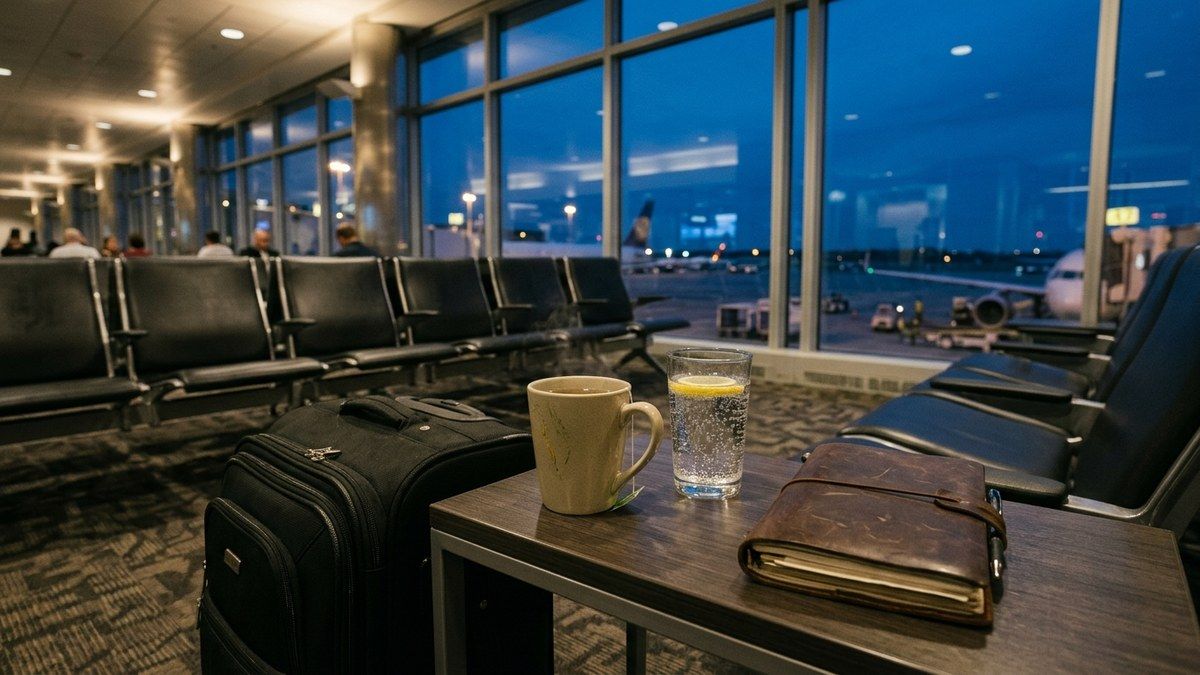
Airport concourses make boredom look like hunger. Carry an empty insulated bottle through TSA and fill it immediately past security, pairing plain water with unsweetened black coffee or plain herbal tea during the \( \Delta t_{\text{delay}} \) bridge hours. Staying hydrated keeps the extended \( 20\text{-hour} \) fast effortless while waiting at the gate.
Rule 4: Pre-Anchor Your Time Zone Before Boarding
When crossing time zones, convert \( T_{\text{close,baseline}} \) to your destination's local clock as soon as you board. If you fly three hours west, your \( 8:00\text{ PM} \) baseline close becomes \( 8:00\text{ PM} \) destination time, naturally extending your travel-day fast by \( 3\text{ hours} \) and aligning your next meal with local dinner hours.
Rule 5: Audit Weekly Hours Rather Than Single-Day Perfection
Track your schedule on a rolling 7-day \( 112\text{-hour} \) ledger rather than treating one disrupted flight as a failed week. A single \( 20:4 \) bridge day puts you \( +4\text{ hours} \) ahead of your \( 112\text{-hour} \) target, giving you built-in flexibility if a return flight forces a \( 14:10 \) day later in the trip.
| Travel Schedule Rule | Formula Action | Delay Threshold | Weekly Budget Impact |
|---|---|---|---|
| Rule 1: Anchor Closing Time | \( T_{\text{close,next}} = T_{\text{close,baseline}} \) | Any \( \Delta t_{\text{delay}} > 0 \) | Prevents late-night deficit |
| Rule 2: Bridge Ceiling | Cap \( F_{\text{actual}} \le 22\text{ h} \) | \( \Delta t_{\text{delay}} \ge 6\text{ hours} \) | Keeps transit stress low |
| Rule 3: Gate Hydration | Zero-calorie fluids only | \( 16\text{ h} \) to \( 20\text{ h} \) mark | Protects clean fast window |
| Rule 4: Destination Clock Lock | Shift \( T_{\text{close,baseline}} \) at boarding | Time zone shift \( \ge 2\text{ h} \) | Syncs next-day 16:8 reset |
| Rule 5: 112-Hour Weekly Ledger | Sum 7-day fasting hours | Full trip cycle | Preserves \( \ge 112\text{ h/week} \) |
Step-by-Step Airport Delay Recovery Protocol
- Log Baseline Close: Record the exact hour you finished your pre-travel meal (for example, \( 8:00\text{ PM} \)).
- Add Delay Hours: As soon as the airline posts \( \Delta t_{\text{delay}} \), compute \( F_{\text{actual}} = F_{\text{target}} + \Delta t_{\text{delay}} \) in the ifwindowcalculator.com scheduler.
- Hold Zero-Calorie Gate Fluids: Stick to water, sparkling water, black coffee, or plain tea until your revised opening hour.
- Eat One Complete Meal at Arrival: Open your \( 20:4 \) bridge window with a balanced meal and close strictly at \( T_{\text{close,baseline}} \).
- Resume 16:8 Next Day: Open at your standard \( 12:00\text{ PM} \) hour the following afternoon to lock in your \( 112\text{-hour} \) week.
Frequently Asked Questions
What if my flight delay happens right before my normal 8:00 PM closing time?
If you are stuck in transit at \( 8:00\text{ PM} \) and have not yet eaten dinner, eat a light meal as soon as you can, record that later timestamp as your fast start, and use the next day's \( 12:00\text{ PM} \) opening—or push opening by \( 2\text{ hours} \) to \( 2:00\text{ PM} \)—to restore your \( 16\text{-hour} \) overnight fast without skipping sleep.
Does extending 16:8 to 20:4 for one travel day hurt my weekly consistency?
No. A single \( 20:4 \) bridge day adds \( 4\text{ hours} \) to your \( 112\text{-hour} \) weekly fasting budget, raising the 7-day total to \( 116\text{ hours} \) while keeping your evening closing anchor unchanged.
Should I eat airport lounge snacks just to keep my 12:00 PM window open?
Only if you have a packed balanced meal ready. Bridging a \( 2\text{-hour} \) to \( 4\text{-hour} \) delay with water and black coffee until you reach real food is cleaner and easier to schedule than grazing on processed terminal snacks.