Extended Fasting Refeeding Window Schedule Formula: 5 Chronological Transition Protocols
Logistical Scheduling Disclaimer: This guide covers chronological time-budgeting, meal-spacing intervals, and calendar scheduling mathematics only. It does not provide medical, nutritional, or clinical advice.
When transitioning out of a multi-day extended fasting block—such as a 36-hour Monk Fast, a 48-hour two-day reset, or a 72-hour three-day schedule—the most common logistical error is treating the closing timestamp (\( T_{\text{break}} \)) like a standard daily 16:8 lunch hour. As practitioners frequently note in r/intermittentfasting scheduling discussions, compressing a massive single meal into the first 30 minutes after a 48-hour or 72-hour pause derails your evening timetable and makes transitioning back to your baseline 16:8 routine the following day chaotic.
To structure a smooth, predictable return to your normal daily eating clock, apply the extended fasting refeeding schedule formula. By scaling your staged refeeding transition window (\( W_{\text{refeed}} \)) proportionally to total elapsed fasting hours (\( T_{\text{fast}} \)) and dividing your opening intake into chronological buffer stages, you can align your post-fast meals cleanly with work, commute, and family dinner hours. Map your exact start and end timestamps inside our Intermittent Fasting Window Calculator.
Key Engineering & Financial Benchmarks
- The 25% Refeeding Duration Rule: Allocate a total staged transition window equal to one-quarter of your elapsed fast, capped at a single daytime waking cycle: \( W_{\text{refeed}} = \min\left(12\text{ hrs}, \; 0.25 \times T_{\text{fast}}\right) \).
- The 3-Stage Chronological Buffer: Divide \( W_{\text{refeed}} \) into Stage 1 (Opening Pre-Meal Buffer: Hours \( 0.0\text{ to }1.0 \)), Stage 2 (Primary Mid-Window Meal: Hour \( 1.5\text{ to }2.5 \)), and Stage 3 (Closing Dinner Anchor before overnight recovery).
- The Morning vs Afternoon Break Rule: Never schedule \( T_{\text{break}} \) after 18:00 (6:00 PM) on a 48-hour or 72-hour fast; breaking late in the evening leaves insufficient waking hours to complete a staged two-part refeeding window before bedtime.
- Seamless 16:8 Resumption Math: Closing your final refeeding meal at 20:00 (8:00 PM) automatically synchronizes your clock for a standard 12:00 PM (Noon) 16:8 opening the very next day.
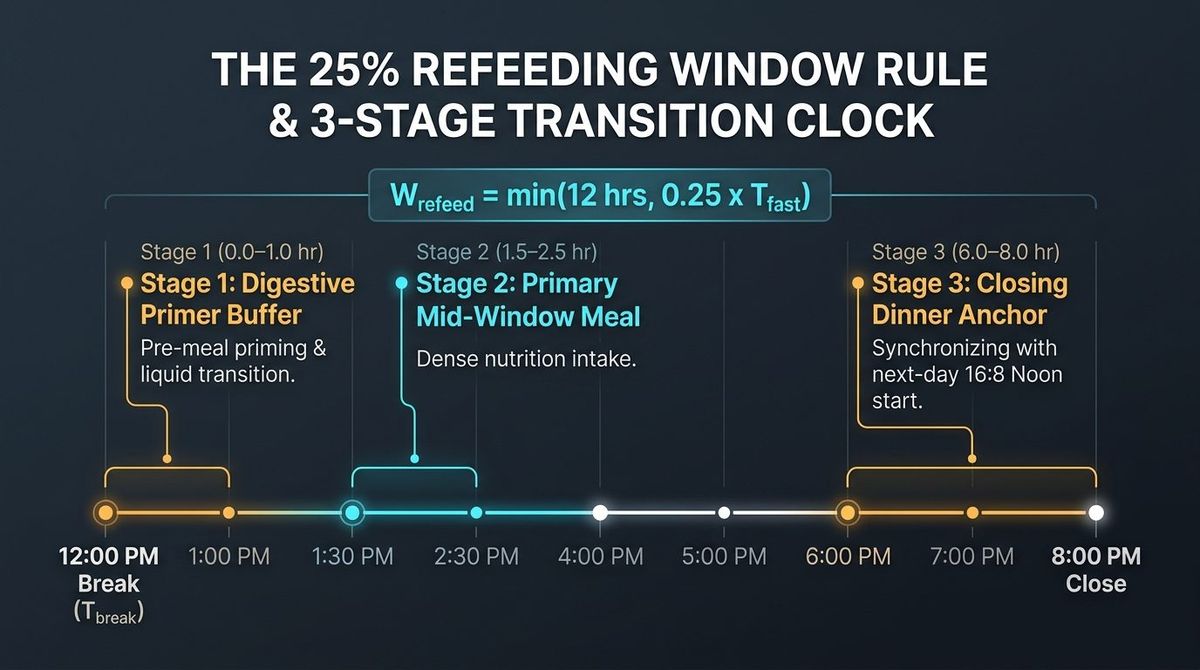
1. The Master Extended Fasting Refeeding Window Duration Formula
In chronological schedule design, the length of your post-fast transition period should scale with the duration of the preceding fast (\( T_{\text{fast}} \), in hours) while fitting neatly inside a single daytime waking schedule so your circadian meal anchor never flips overnight. We define the Total Refeeding Transition Window (\( W_{\text{refeed}} \)) and Stage 1 Opening Buffer (\( B_{\text{stage1}} \)) via:
- 36-Hour Fast (e.g., Sunday 20:00 Dinner to Tuesday 08:00 Breakfast): \( W_{\text{refeed}} = \min(12.0, \; 0.25 \times 36) = \mathbf{9.0\text{ hours}} \) (or up to your normal 12-hour Tuesday daytime span), with a Stage 1 introductory buffer of \( B_{\text{stage1}} = (36 / 36) \times 45 = \mathbf{45\text{ minutes}} \) before your main morning meal.
- 48-Hour Fast (e.g., Sunday 20:00 Dinner to Tuesday 20:00 — or better, Sunday 14:00 to Tuesday 14:00): \( W_{\text{refeed}} = \min(12.0, \; 0.25 \times 48) = \mathbf{12.0\text{ hours}} \) (split across two afternoon/evening stages or a midday-to-evening 6-hour block), with a Stage 1 introductory buffer of \( B_{\text{stage1}} = (48 / 36) \times 45 = \mathbf{60\text{ minutes}} \).
- 72-Hour Fast (e.g., Sunday 14:00 Lunch to Wednesday 14:00 Afternoon): \( W_{\text{refeed}} = \min(12.0, \; 0.25 \times 72) = \mathbf{12.0\text{ hours}} \) (typically structured as a 6-hour Day-1 opening block from 14:00 to 20:00 plus a full 8-hour window on Day 2), with a Stage 1 introductory buffer of \( B_{\text{stage1}} = (72 / 36) \times 45 = \mathbf{90\text{ minutes}} \).
2. Why Starting & Breaking at 14:00 (2:00 PM) Beats the 20:00 (8:00 PM) Trap
Consider what happens on the clock when you start a 48-hour or 72-hour fast at 20:00 (8:00 PM) after Sunday dinner:
Instead, apply the Midday Start-Anchor Rule: on the day you begin a 48-hour or 72-hour fast, finish your final meal at 13:30 or 14:00 (2:00 PM). That simple 6-hour backward shift causes your 48-hour or 72-hour timer to expire at 14:00 (2:00 PM) in the middle of the afternoon, giving you a full 6-hour daytime runway (\( 14:00\text{ to }20:00 \)) to complete Stage 1 at 14:00, Stage 2 at 15:30, and Stage 3 family dinner at 19:00, closing cleanly at 20:00!
3. Complete 36h, 48h & 72h Chronological Refeeding Schedule Table
Use the master clock-mapping table below to coordinate your start timestamp, Stage 1 opening buffer, Stage 2 meal, and next-day 16:8 resumption:
| Fast Duration (\(T_{\text{fast}}\)) | Optimal Start Anchor (\(T_{\text{start}}\)) | Break Timestamp (\(T_{\text{break}}\)) | Stage 1 Intro Buffer (\(B_{\text{stage1}}\)) | Stage 2 Main Meal | Stage 3 Window Close & Next-Day 16:8 |
|---|---|---|---|---|---|
| 36-Hour Fast | Sun 20:00 (8:00 PM) | Tue 08:00 (8:00 AM) | 08:00 – 08:45 (45m) | 08:45 – 09:30 AM | Close Tue 18:00 \(\rightarrow\) Wed 10:00–18:00 (16:8) |
| 42-Hour Fast | Sun 20:00 (8:00 PM) | Tue 14:00 (2:00 PM) | 14:00 – 14:50 (50m) | 15:00 – 15:45 PM | Close Tue 20:00 \(\rightarrow\) Wed 12:00–20:00 (16:8) |
| 48-Hour Fast | Sun 14:00 (2:00 PM) | Tue 14:00 (2:00 PM) | 14:00 – 15:00 (60m) | 15:00 – 16:00 PM | Close Tue 20:00 \(\rightarrow\) Wed 12:00–20:00 (16:8) |
| 60-Hour Fast | Sun 20:00 (8:00 PM) | Wed 08:00 (8:00 AM) | 08:00 – 09:15 (75m) | 09:15 – 10:00 AM | Close Wed 18:00 \(\rightarrow\) Thu 10:00–18:00 (16:8) |
| 72-Hour Fast | Sun 14:00 (2:00 PM) | Wed 14:00 (2:00 PM) | 14:00 – 15:30 (90m) | 15:30 – 16:30 PM | Close Wed 20:00 \(\rightarrow\) Thu 12:00–20:00 (16:8) |
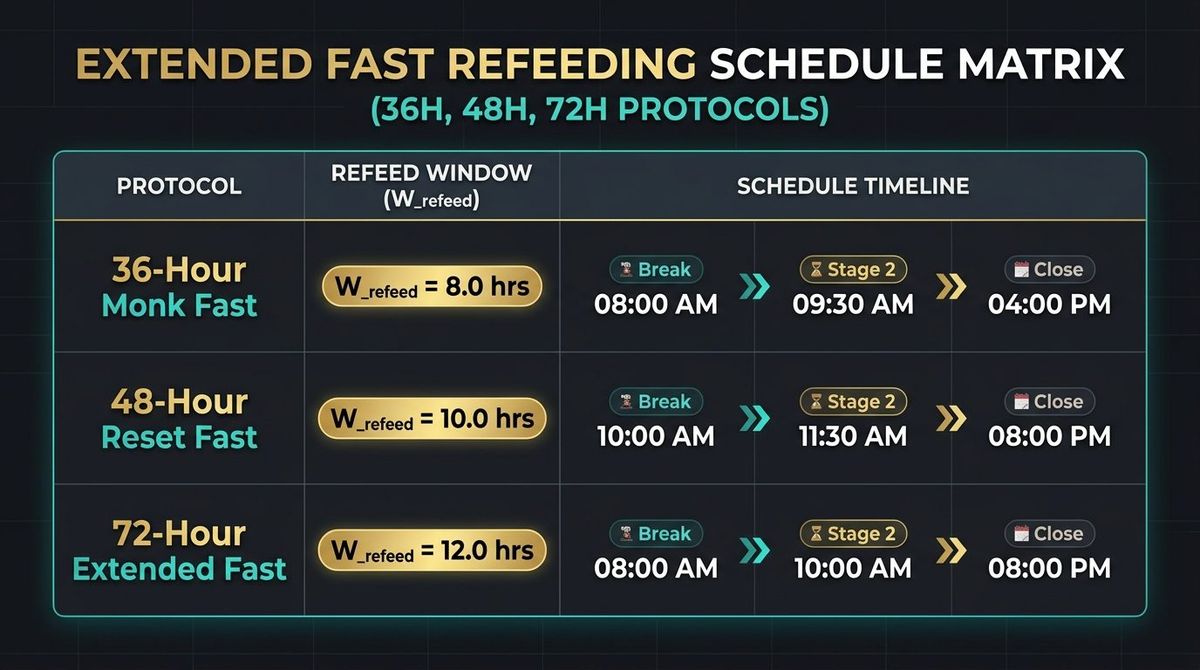
4. Step-by-Step 48-Hour & 72-Hour Transition Clock Walkthrough
Follow this chronological five-checkpoint sequence on the day your extended timer finishes:
- Checkpoint 1 (\( T_{\text{break}} - 60\text{ min} \)): Complete final plain water and schedule check at 13:00 so your kitchen or desk prep is ready before the timer rings.
- Checkpoint 2 (\( T_{\text{break}} = 14:00 \), Stage 1 Opening): Open the window with a small introductory portion and start your \( B_{\text{stage1}} \) countdown timer (45 minutes for 36h, 60 minutes for 48h, or 90 minutes for 72h). Do not schedule back-to-back commuting during this 60-to-90-minute buffer.
- Checkpoint 3 (\( T_{\text{break}} + B_{\text{stage1}} = 15:00\text{ to }15:30 \), Stage 2 Meal): Sit down for your primary mid-afternoon meal at an unhurried 30-to-45-minute pace.
- Checkpoint 4 (19:00 to 20:00, Stage 3 Closing Meal): Conclude your evening meal before 20:00 (8:00 PM) and start your overnight recovery timer.
- Checkpoint 5 (Next Day 12:00 Noon, Baseline 16:8 Lock-In): After a standard 16-hour overnight recovery (\( 20:00 + 16:00 = 12:00\text{ Noon} \)), your schedule is 100% realigned with your regular daily 12:00–20:00 16:8 eating window with zero calendar drift.
5. Frequently Asked Questions (FAQ)
Why is a 42-hour fast often easier to schedule than a strict 48-hour fast?
A 42-hour fast lets you eat a normal 20:00 (8:00 PM) family dinner on Sunday night, skip Monday completely, and break your fast at 14:00 (2:00 PM) on Tuesday afternoon—giving you a natural 6-hour afternoon refeeding window (14:00 to 20:00) without having to stop eating early at 14:00 on Sunday.
How much time should I leave between my Stage 1 opener and my main meal?
Budget 45 minutes after a 36-hour fast, 60 minutes after a 48-hour fast, and 90 minutes after a 72-hour fast before sitting down for your full Stage 2 meal.
Should I jump straight back into another extended fast the very next day?
To keep your weekly calendar sustainable and predictable, most scheduling protocols alternate an extended fast with at least 4 to 5 consecutive days of standard daily 16:8 or 18:6 time-restricted eating before scheduling another multi-day block.
6. Standard Operating Verification & Audit Checklist
Before locking in your final configuration or production parameters for extended fasting refeeding schedule formula, execute this five-point verification protocol across your workspace and accounting records to ensure repeatable field performance:
- Midday Start & Break Timestamp Alignment: Anchor 48-hour and 72-hour fasts at 14:00 (2:00 PM) rather than 20:00 (8:00 PM) so your closing refeeding window unfolds during daytime hours.
- 25% Transition Window Budgeting: Allocate a total staged transition window equal to 25% of elapsed fasting hours (capped at 12 daytime hours) before returning to baseline.
- Stage 1 Introductory Buffer Timer: Set a dedicated 45-minute (36h fast), 60-minute (48h fast), or 90-minute (72h fast) timer between your opening Stage 1 primer and your primary Stage 2 meal.
- 20:00 (8:00 PM) Evening Anchor Close: Conclude your Stage 3 evening meal by 20:00 so a standard 16-hour overnight pause aligns your clock with a 12:00 Noon 16:8 opening the next day.
- Calendar & Commute Conflict Check: Map all three refeeding stages inside the Intermittent Fasting Window Calculator below to ensure Stage 1 and Stage 2 never overlap with transit or back-to-back meetings.
Model Your Exact Parameters & Tolerances
Run your custom numbers through our interactive engineering and financial calculator to verify your setup in real time.