Early Time-Restricted Feeding (eTRF) Window Schedule Formula: 4-Day Chronological Shift Protocol
Compliance & Scope Notice: This guide provides purely chronological, mathematical, and logistical scheduling frameworks for organizing daily meal timing windows and work/commute calendars. It does not provide medical, nutritional, or clinical advice.
Most people practicing a standard 16:8 intermittent fasting schedule default to an afternoon-to-evening eating window (\(12:00\text{ to }20:00\)) simply because skipping breakfast feels logistically easy on busy work mornings. However, shifting that same 8-hour eating block earlier into the daylight hours—a chronological structure known as Early Time-Restricted Feeding (eTRF), typically anchored between \(08:00\text{ and }16:00\) or \(07:00\text{ and }15:00\)—requires precise calendar coordination around wake times, morning commutes, workplace lunch breaks, and evening lights-out targets. Using our early time restricted feeding schedule formula, you can compute your exact opening bell, midpoint meal anchor, closing bell, and a 4-day step-back transition schedule without abrupt calendar friction.
Why do abrupt overnight jumps from a \(12:00\text{–}20:00\) window to an \(08:00\text{–}16:00\) window fail logistically? Because closing your eating window at \(16:00\) on Day 1 when your routine is still anchored to a \(20:00\) dinner creates an unexpected 4-hour afternoon gap in meal prep and workday break scheduling. You can generate a custom printable daily timestamp schedule for any wake time using our Intermittent Fasting Window Calculator & Schedule Planner.
Quick Answer — Early Time-Restricted Feeding (eTRF) Timing Equations:
- Opening Bell Formula (\(T_{\text{open}}\)): \(T_{\text{open}} = T_{\text{wake}} + \Delta t_{\text{morning}}\), where \(\Delta t_{\text{morning}} = 1.0\text{ to }1.5\,\text{hours}\) (\(60\text{–}90\,\text{minutes}\) after waking).
- Closing Bell Formula (\(T_{\text{close}}\)): \(T_{\text{close}} = \left(T_{\text{open}} + W_{\text{eat}}\right) \bmod 24\), where \(W_{\text{eat}} = 8.0\,\text{hours}\) for a 16:8 eTRF protocol.
- Pre-Sleep Evening Buffer (\(\Delta t_{\text{evening}}\)): \(\Delta t_{\text{evening}} = T_{\text{sleep}} - T_{\text{close}} \ge 5.0\,\text{hours}\), ensuring all meal prep and cleanup conclude well before evening wind-down.
- 4-Day Step-Back Transition Rule: Shift both \(T_{\text{open}}\) and \(T_{\text{close}}\) earlier by \(\delta = 1.0\,\text{hour/day}\) over \(4\,\text{consecutive days}\) to move smoothly from \(12:00\text{–}20:00\) to \(08:00\text{–}16:00\).
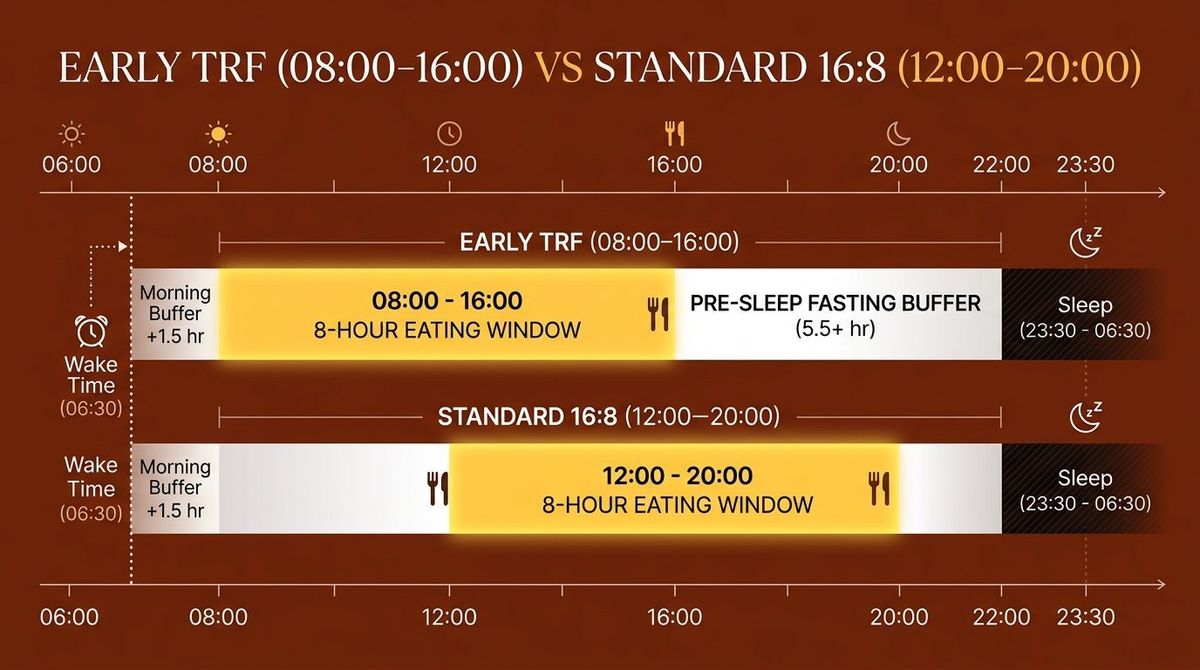
1. The 24-Hour Chronological Anchor Equations for eTRF
Unlike late-day eating windows that work backward from dinner, an Early Time-Restricted Feeding schedule is mathematically anchored to your habitual daily wake timestamp (\(T_{\text{wake}}\)) and lights-out sleep timestamp (\(T_{\text{sleep}}\)). For a 24-hour cycle partitioned into an active sleep block (\(D_{\text{sleep}}\)), a morning post-wake buffer (\(\Delta t_{\text{morning}}\)), an active eating window (\(W_{\text{eat}}\)), and an evening pre-sleep fasting buffer (\(\Delta t_{\text{evening}}\)), conservation of diurnal time requires:
From your wake timestamp \(T_{\text{wake}}\), the three daily meal timestamps (Meal 1 Opening Anchor \(T_{\text{open}}\), Midpoint Meal Anchor \(T_{\text{mid}}\), and Final Meal Closing Cutoff \(T_{\text{close}}\)) are calculated via modular 24-hour clock arithmetic:
Note that \(T_{\text{close}}\) represents the final bite timestamp—meaning your afternoon meal preparation and consumption must begin at \(T_{\text{meal\_start}} = T_{\text{close}} - \Delta t_{\text{prep}}\) (typically \(30\text{ to }45\,\text{minutes}\) prior to \(T_{\text{close}}\), or \(15:15\text{–}15:30\) for a \(16:00\) cutoff).
2. Worked Schedule Derivation (06:30 Wake Time & 22:30 Bedtime)
Suppose your weekday alarm sounds at \(T_{\text{wake}} = 06:30\) (\(6.50\,\text{hr}\)) and your lights-out target is \(T_{\text{sleep}} = 22:30\) (\(22.50\,\text{hr}\), giving an \(8.0\text{-hour}\) sleep block \(D_{\text{sleep}} = 8.0\,\text{hr}\)). You select a 16:8 eTRF structure (\(W_{\text{eat}} = 8.0\,\text{hr}\), \(W_{\text{fast}} = 16.0\,\text{hr}\)) with a \(90\text{-minute}\) (\(\Delta t_{\text{morning}} = 1.50\,\text{hr}\)) morning routine buffer:
- Step 1 — Compute Opening Bell (\(T_{\text{open}}\)): \[ T_{\text{open}} = 6.50 + 1.50 = 8.00 \implies \mathbf{08:00\,\text{AM}} \]
- Step 2 — Compute Midpoint Meal Anchor (\(T_{\text{mid}}\)): \[ T_{\text{mid}} = 8.00 + \frac{8.00}{2} = 12.00 \implies \mathbf{12:00\,\text{PM (Noon)}} \]
- Step 3 — Compute Final Meal Prep Start & Closing Bell (\(T_{\text{close}}\)): \[ T_{\text{meal\_start}} = 16.00 - 0.50 = \mathbf{15:30\,\text{(3:30 PM)}}, \qquad T_{\text{close}} = 8.00 + 8.00 = 16.00 \implies \mathbf{16:00\,\text{(4:00 PM)}} \]
- Step 4 — Verify Evening Pre-Sleep Fasting Buffer (\(\Delta t_{\text{evening}}\)): \[ \Delta t_{\text{evening}} = 22.50 - 16.00 = \mathbf{6.50\,\text{hours}} \quad (\text{1.5 hr morning} + \text{6.5 hr evening} + \text{8.0 hr sleep} = \mathbf{16.0\,\text{hr fast}}) \]
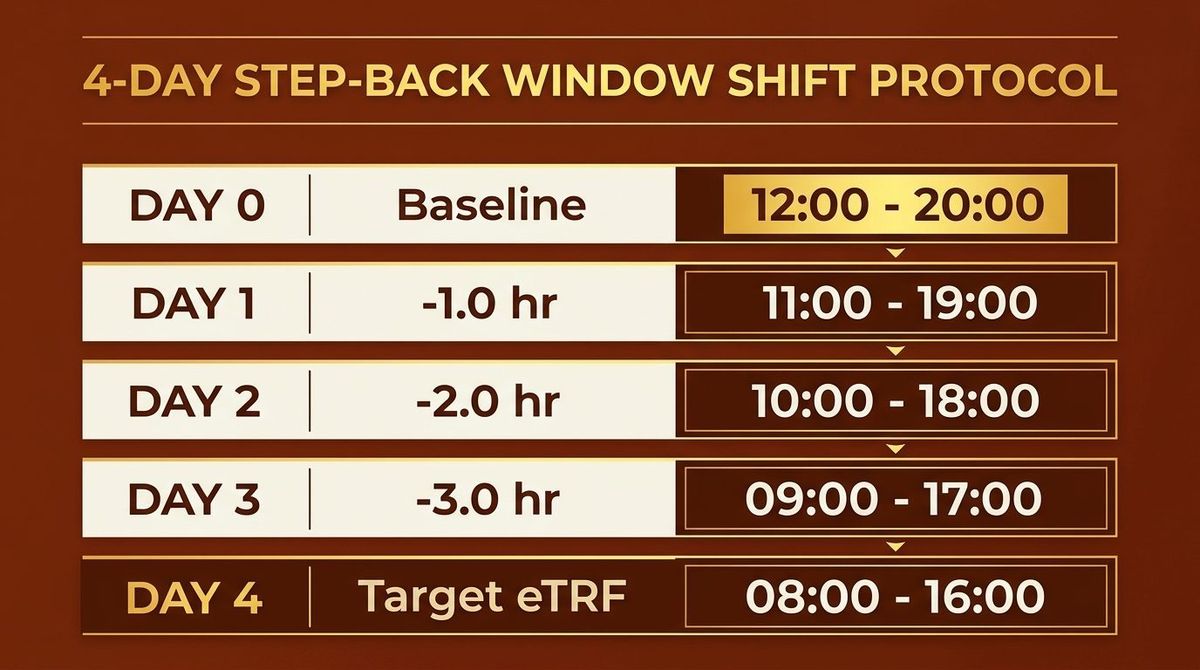
3. The 4-Day Step-Back Transition Formula (12:00–20:00 to 08:00–16:00)
If you currently follow a standard \(12:00\text{–}20:00\) schedule (\(T_{\text{open},0} = 12.00, T_{\text{close},0} = 20.00\)) and want to transition to an \(08:00\text{–}16:00\) eTRF schedule (\(\Delta S_{\text{total}} = -4.0\,\text{hours}\)), use a linear daily step-back increment of \(\delta = 1.0\,\text{hour/day}\) across \(N_{\text{days}} = \frac{|\Delta S_{\text{total}}|}{\delta} = 4\,\text{days}\). On transition day \(d \in \{1, 2, 3, 4\}\), your opening and closing timestamps follow:
Notice that during each step-back transition day \(d\), because your opening bell on day \(d\) occurs \(1.0\,\text{hour}\) earlier than it would have under the previous day's schedule, each transition overnight fast is temporarily \(24.0 - W_{\text{eat}} - \delta = 16.0 - 1.0 = \mathbf{15.0\,\text{hours}}\) during the 4-day adjustment phase, before locking back into a steady-state \(16.0\text{-hour}\) overnight fast on Day 5 once \(T_{\text{open}}\) stabilizes at \(08:00\).
4. Master Wake-Time Lookup Table for eTRF Schedules (16:8 & 18:6)
| Habitual Wake Time (\(T_{\text{wake}}\)) | Morning Buffer (\(\Delta t_{\text{morning}}\)) | 16:8 eTRF Window (\(W_{\text{eat}} = 8\,\text{hr}\)) | 18:6 eTRF Window (\(W_{\text{eat}} = 6\,\text{hr}\)) | Final Meal Prep Start (\(-30\,\text{m}\)) | Evening Buffer (Before \(16\,\text{hr}\) Sleep) |
|---|---|---|---|---|---|
| 05:00 AM | \(+1.5\,\text{hr}\) | 06:30 – 14:30 | 06:30 – 12:30 | 14:00 (16:8) / 12:00 (18:6) | \(6.5\,\text{hr}\) (21:00 Bedtime) |
| 06:00 AM | \(+1.5\,\text{hr}\) | 07:30 – 15:30 | 07:30 – 13:30 | 15:00 (16:8) / 13:00 (18:6) | \(6.5\,\text{hr}\) (22:00 Bedtime) |
| 06:30 AM | \(+1.5\,\text{hr}\) | 08:00 – 16:00 | 08:00 – 14:00 | 15:30 (16:8) / 13:30 (18:6) | \(6.5\,\text{hr}\) (22:30 Bedtime) |
| 07:00 AM | \(+1.5\,\text{hr}\) | 08:30 – 16:30 | 08:30 – 14:30 | 16:00 (16:8) / 14:00 (18:6) | \(6.5\,\text{hr}\) (23:00 Bedtime) |
| 07:30 AM | \(+1.5\,\text{hr}\) | 09:00 – 17:00 | 09:00 – 15:00 | 16:30 (16:8) / 14:30 (18:6) | \(6.5\,\text{hr}\) (23:30 Bedtime) |
| 08:30 AM | \(+1.5\,\text{hr}\) | 10:00 – 18:00 | 10:00 – 16:00 | 17:30 (16:8) / 15:30 (18:6) | \(6.5\,\text{hr}\) (00:30 Bedtime) |
Notice how keeping the morning post-wake buffer fixed at \(\Delta t_{\text{morning}} = +1.5\,\text{hours}\) automatically preserves an identical \(6.5\text{-hour}\) evening pre-sleep buffer across every wake-time row.
5. Workplace & Commute Logistics for the 15:30 Afternoon Meal
- Block a Recurring 25-Minute Calendar Hold at \(T_{\text{close}} - 35\,\text{mins}\): On an \(08:00\text{–}16:00\) schedule, your final meal occurs at \(15:25\text{–}15:55\) while you are still at the office or in afternoon meetings. Place a recurring daily calendar block at \(15:25\) so afternoon calls never push your final meal past \(16:00\).
- Pre-Pack Portable Afternoon Containers Before Leaving Home: Because you will not be in your home kitchen at \(15:30\), pack your afternoon meal alongside your midday lunch in an insulated tote before your morning commute.
- Repurpose the 18:00–20:00 Evening Block: Use the reclaimed evening dinner preparation hour for family walks, gym sessions, or zero-calorie herbal tea rituals so your evening schedule remains structured.
Frequently Asked Questions
What happens if an afternoon work meeting runs until 16:30 on an 08:00–16:00 eTRF schedule?
If an unavoidable meeting shifts your closing meal by \(+30\,\text{minutes}\) to \(16:30\), simply apply a matching \(+30\text{-minute}\) offset to the next morning's opening bell (\(T_{\text{open}} = 08:30\)) to preserve your full \(16.0\text{-hour}\) overnight fast, then compress the window back to \(16:00\) that afternoon.
Can I use a 3-meal vs. 2-meal structure inside an 8-hour eTRF window?
Yes. In an 8-hour window (\(08:00\text{–}16:00\)), a 3-meal cadence spaces meals evenly every \(3.75\,\text{hours}\) (\(08:00, 11:45,\) and \(15:30\)), while a 2-meal cadence anchors a hearty morning meal at \(08:30\) and a late lunch/early dinner at \(15:15\).
How do I handle Friday or Saturday social dinners when following eTRF Monday through Thursday?
Many practitioners run a 5:2 hybrid calendar: anchoring eTRF (\(08:00\text{–}16:00\)) Sunday through Thursday when work routines are predictable, and shifting to a standard \(12:00\text{–}20:00\) window on Friday and Saturday for social dining.
Build Your Custom Early TRF Timestamp Schedule
Want to calculate your exact opening bell, midpoint meal, and 4-day transition schedule for your personal wake time? Enter your daily routine into our free Intermittent Fasting Window Calculator & Schedule Planner.