4-Day Condensed Workweek (4x10-Hour Shifts) & 3-Day Weekend Intermittent Fasting Window Schedule Formula: 5 Clock-Anchor Rules
Working a compressed 4-day, 10-hour-per-day schedule (often called a 4/10 or 4x10 roster) creates a distinct scheduling challenge for time-restricted eating: four long operational workdays with commute buffers followed immediately by a three-day weekend on Friday, Saturday, and Sunday. When you factor in a two-way commute around a (\( 10.0\text{-hour} \) shift, your away-from-home span stretches to \( 11.5\text{ hours} \) or \( 12.0\text{ hours} \)), leaving narrow evening time before sleep. You can map your exact shift blocks and weekend transition hours using our schedule planner at IF Window Calculator.
Executive Formula Summary
Core 4x10-Hour Workweek & 3-Day Weekend Schedule Equations: A sustainable 7-day intermittent fasting plan across a 4x10 roster balances four workday eating windows \( E_{\text{work}} \) against three weekend eating windows \( E_{\text{wknd}} \) while constraining the Friday-to-Monday anchor drift \( \Delta T_{\text{anchor}} \) to at most \( 90\text{ minutes} \) (\( 1.5\text{ hours} \)).
\[ T_{\text{open,work}} = T_{\text{shift,start}} + 0.5 \cdot L_{\text{shift}} \quad \text{and} \quad T_{\text{close,work}} = T_{\text{open,work}} + E_{\text{work}} \] \[ F_{\text{week}} = 4 \cdot \left( 24 - E_{\text{work}} \right) + 3 \cdot \left( 24 - E_{\text{wknd}} \right) = 168 - \left( 4 E_{\text{work}} + 3 E_{\text{wknd}} \right) \]
Rule 1: Anchor Meal 1 to the Mid-Shift Break Using the Half-Shift Offset Formula
The most common scheduling mistake on a \( 10.0\text{-hour} \) shift (such as \( 07:00 \) to \( 17:00 \) or \( 06:00 \) to \( 16:00 \)) is opening the eating window before commuting to work. Opening an \( 8.0\text{-hour} \) eating window at \( 06:00 \) forces your window to close at \( 14:00 \)—leaving three hours of afternoon work, the evening commute, and the entire evening at home with zero scheduled meals. Instead, set your workday window opening timestamp \( T_{\text{open,work}} \) to the midpoint of your shift \( L_{\text{shift}} \):
\[ T_{\text{open,work}} = T_{\text{shift,start}} + 0.5 \cdot L_{\text{shift}} \]For a standard Monday-through-Thursday shift starting at \( T_{\text{shift,start}} = 07:00 \) with \( L_{\text{shift}} = 10.0\text{ hours} \) (ending at \( 17:00 \)), the midpoint offset places your opening meal at \( 12:00 \) noon:
\[ T_{\text{open,work}} = 07:00 + 0.5 \cdot (10.0\text{ hr}) = 12:00 \quad \text{and} \quad T_{\text{close,work}} = 12:00 + 6.5\text{ hr} = 18:30 \]- Morning Unfed Work Block (07:00 to 12:00): You complete the first \( 5.0\text{ hours} \) of your shift using water, plain black coffee, or unsweetened tea before opening your window at the scheduled \( 12:00 \) lunch break.
- Post-Shift Commute Buffer (17:00 to 17:45): Ending the shift at (\( 17:00 \) with a \( 45\text{-minute} \) commute gets you home by \( 17:45 \)), leaving a full \( 45\text{-minute} \) window to finish dinner before the \( 18:30 \) cutoff.
- Pre-Sleep Quiet Buffer (18:30 to 21:30): Closing the window at \( 18:30 \) preserves a full \( 3.0\text{-hour} \) evening buffer before a \( 21:30 \) bedtime ahead of a \( 05:30 \) alarm.
Rule 2: Calculate the Away-From-Home Span and Pre-Packed vs. Home Meal Split
To prevent unplanned drive-thru stops on the commute home, compute your total daily away-from-home span \( S_{\text{away}} \) by adding your morning and evening commute durations \( 2 \cdot C_{\text{commute}} \) to your shift duration \( L_{\text{shift}} \):
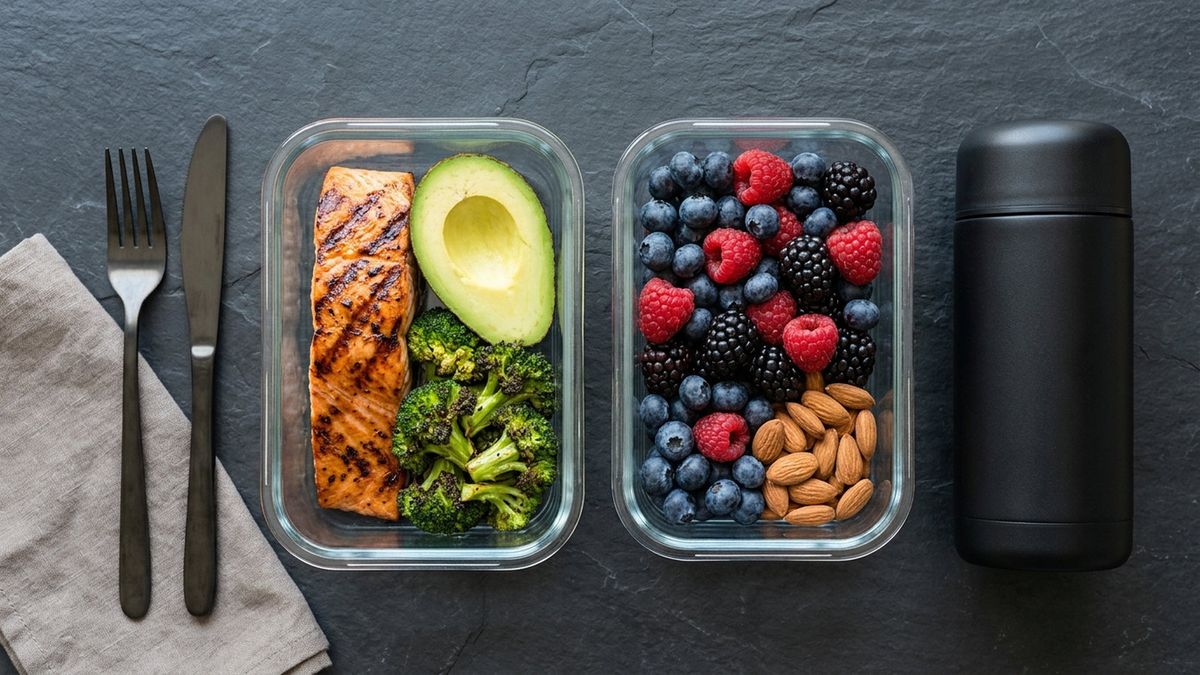
\[ S_{\text{away}} = L_{\text{shift}} + 2 \cdot C_{\text{commute}} \]When \( L_{\text{shift}} = 10.0\text{ hr} \) and \( C_{\text{commute}} = 0.75\text{ hr} \) (\( 45\text{ minutes} \) each way), your total away-from-home span reaches \( S_{\text{away}} = 11.5\text{ hours} \) (\( 06:15 \) departure to \( 17:45 \) return). Because \( 5.0\text{ hours} \) of your active eating window (\( 12:00 \) to \( 17:00 \)) occur on-site at work, a two-meal structure (Meal 1 at \( 12:00 \) on-site and Meal 2 at \( 17:45 \) at home, separated by \( 5.75\text{ hours} \)) eliminates mid-shift snacking while keeping evening prep simple.
Rule 3: Balance Cumulative 168-Hour Weekly Fasting Totals Across the 4:3 Split
A 4-day condensed workweek divides the \( 168\text{-hour} \) calendar week into \( 96\text{ workday hours} \) (Monday through Thursday) and \( 72\text{ weekend hours} \) (Friday, Saturday, and Sunday). This 4:3 asymmetry lets you pair a slightly tighter workday window \( E_{\text{work}} \) (such as \( 17.5:6.5 \) or \( 18:6 \)) with a wider social weekend window \( E_{\text{wknd}} \) (such as \( 16:8 \) or \( 14:10 \)) while still hitting your target weekly cumulative fasting hours \( F_{\text{week}} \):
\[ F_{\text{week}} = 4 \cdot F_{\text{work}} + 3 \cdot F_{\text{wknd}} = 168 - \left( 4 \cdot E_{\text{work}} + 3 \cdot E_{\text{wknd}} \right) \]For example, if your weekly target is (\( F_{\text{week}} = 114.0\text{ fasting hours} \) (an average of \( 16.29\text{ fasting hours/day} \)), running a \( 6.5\text{-hour} \) workday eating window (\( F_{\text{work}} = 17.5\text{ hr} \) Monday–Thursday) accumulates \( 70.0\text{ fasting hours} \) before Friday morning even begins. You only need \( 44.0\text{ fasting hours} \) across Friday, Saturday, and Sunday (\( 14.67\text{ fasting hours/day} \)), or roughly a \( 15:9 \) weekend window) to hit your exact weekly goal.
| 4x10 Roster Protocol Tier | Mon–Thu Workday Window | Fri–Sun Weekend Window | Workday Fasting Sum (4 Days) | Weekend Fasting Sum (3 Days) | Total 7-Day Fasting Hours |
|---|---|---|---|---|---|
| Baseline 16:8 Uniform | 12:00–20:00 (8.0 hr) | 12:00–20:00 (8.0 hr) | 64.0 hr (16.0 hr/day) | 48.0 hr (16.0 hr/day) | 112.0 hr / 168 hr (66.7%) |
| Balanced 17.5:6.5 + 15:9 Flex | 12:00–18:30 (6.5 hr) | 11:00–20:00 (9.0 hr) | 70.0 hr (17.5 hr/day) | 45.0 hr (15.0 hr/day) | 115.0 hr / 168 hr (68.5%) |
| Tight Workday 18:6 + 16:8 Weekend | 12:00–18:00 (6.0 hr) | 12:00–20:00 (8.0 hr) | 72.0 hr (18.0 hr/day) | 48.0 hr (16.0 hr/day) | 120.0 hr / 168 hr (71.4%) |
| 20:4 Workday + 16:8 Weekend | 13:30–17:30 (4.0 hr) | 12:00–20:00 (8.0 hr) | 80.0 hr (20.0 hr/day) | 48.0 hr (16.0 hr/day) | 128.0 hr / 168 hr (76.2%) |
Rule 4: Cap 3-Day Weekend Clock Drift at 90 Minutes Using the Sunday Reset Cutoff
Because a 4x10 schedule provides three consecutive days off (Friday, Saturday, and Sunday), shifting your eating window three or four hours later on Friday and Saturday nights creates "Monday morning clock lag." If you eat until \( 22:30 \) on Sunday night and attempt to hold until \( 12:00 \) noon on Monday, your Sunday-to-Monday interval shrinks to \( 13.5\text{ hours} \) or forces an uncomfortable midday stretch. Enforce the 90-minute maximum anchor drift rule:
\[ \left| T_{\text{open,wknd}} - T_{\text{open,work}} \right| \le 1.5\text{ hr} \quad \text{and} \quad T_{\text{close,Sun}} = T_{\text{open,Mon}} - F_{\text{target}} \]To open Monday's workday eating window cleanly at \( T_{\text{open,Mon}} = 12:00 \) after a full \( F_{\text{target}} = 17.5\text{-hour} \) fast, your Sunday evening cutoff \( T_{\text{close,Sun}} \) must occur at \( 18:30 \) (or \( 19:30 \) for a \( 16.5\text{-hour} \) Sunday-to-Monday bridge). You can test different Friday/Saturday dinner extensions and Sunday reset cutoffs in real time with the IF Window Calculator.

Rule 5: Adapt the Formula for Afternoon/Second-Shift 4x10 Rosters (14:00 to 00:00)
Many manufacturing, logistics, and hospitality teams work an afternoon 4x10 shift from \( 14:00 \) to \( 00:00 \) midnight (Monday through Thursday). Applying a daytime \( 12:00 \) to \( 18:30 \) window to a second-shift schedule works remarkably well because it places Meal 1 at home before work and Meal 2 during the mid-shift dinner break:
\[ T_{\text{open,2nd}} = T_{\text{shift,start}} - 2.0\text{ hr} = 12:00 \quad \text{and} \quad T_{\text{close,2nd}} = 18:30\text{ (or } 19:30\text{)} \]| Day of Week (4x10 Day Shift) | Duty & Shift Hours | Window Open (Meal 1) | Window Close (Meal 2) | Eating Window Width | Overnight Fasting Bridge |
|---|---|---|---|---|---|
| Monday (Shift Day 1) | 07:00–17:00 (10.0 hr) | 12:00 (Mid-Shift Break) | 18:30 (Home Dinner) | 6.5 hr | 17.5 hr (to Tue 12:00) |
| Tuesday (Shift Day 2) | 07:00–17:00 (10.0 hr) | 12:00 (Mid-Shift Break) | 18:30 (Home Dinner) | 6.5 hr | 17.5 hr (to Wed 12:00) |
| Wednesday (Shift Day 3) | 07:00–17:00 (10.0 hr) | 12:00 (Mid-Shift Break) | 18:30 (Home Dinner) | 6.5 hr | 17.5 hr (to Thu 12:00) |
| Thursday (Shift Day 4) | 07:00–17:00 (10.0 hr) | 12:00 (Mid-Shift Break) | 18:30 (Home Dinner) | 6.5 hr | 16.5 hr (to Fri 11:00) |
| Friday (Weekend Day 1) | Off Duty (3-Day Weekend) | 11:00 (Late Brunch) | 20:00 (Social Dinner) | 9.0 hr | 15.0 hr (to Sat 11:00) |
| Saturday (Weekend Day 2) | Off Duty (3-Day Weekend) | 11:00 (Late Brunch) | 20:00 (Social Dinner) | 9.0 hr | 15.0 hr (to Sun 11:00) |
| Sunday (Weekend Reset Day) | Off Duty (Monday Prep) | 11:00 (Late Brunch) | 18:30 (Early Reset Cutoff) | 7.5 hr | 17.5 hr (to Mon 12:00) |
- Pre-Pack Thursday's Meal 2 Before Leaving for Shift 4: End-of-week fatigue peaks on Thursday at (\( 17:00 \)); having Thursday dinner plated in the refrigerator guarantees you close your window on time at \( 18:30 \) before starting your 3-day weekend.
- Keep Friday's Opening Meal Within 60 Minutes of Workday Noon: Opening Friday at \( 11:00 \) instead of \( 08:00 \) preserves a \( 16.5\text{-hour} \) overnight fast after Thursday's shift while still giving you a relaxed Friday brunch.
- Lock In the Sunday 18:30 Cutoff: Pulling Sunday dinner back to \( 18:30 \) restores your exact \( 17.5\text{-hour} \) overnight bridge into Monday's \( 12:00 \) mid-shift break without any Monday morning clock friction.
Frequently Asked Questions
Should I eat before a 10-hour morning shift or wait until my midday break?
Waiting until the midpoint of your shift (such as \( 12:00 \) noon on a \( 07:00 \) to \( 17:00 \) schedule) is logistically much easier for most 4x10 workers. It allows you to eat your second meal at home with your household around \( 17:45 \) to \( 18:30 \) rather than closing your eating window in the middle of the afternoon at work.
Can I use a wider eating window on my 3-day weekend than on my 4 workdays?
Yes. Pairing a \( 6.5\text{-hour} \) eating window across Monday through Thursday (\( 17.5\text{ fasting hours/day} \)) with a \( 9.0\text{-hour} \) window on Friday and Saturday and a \( 7.5\text{-hour} \) reset window on Sunday yields \( 116.5\text{ cumulative fasting hours} \) per week—exceeding a strict 7-day \( 16:8 \) schedule (\( 112.0\text{ hours} \)) with far greater weekend flexibility.
How do I schedule workouts on a 4-day 10-hour shift roster?
With (\( 11.5\text{ hours} \) committed to shifts and commuting Monday through Thursday, schedule three primary training sessions on Friday, Saturday, and Sunday mornings (\( 09:30 \) to \( 10:30 \)), right before your \( 11:00 \) weekend opening meal) and keep Monday-through-Thursday activity to a brisk \( 20\text{-minute} \) walk during your break or after dinner.