22:2 Intermittent Fasting Schedule & 120-Minute Two-Course Refeeding Window Formula: 5 Clock-Spacing Rules Between 20:4 and 23:1 OMAD
Compressing an entire day's nutritional intake into a single \( 60\text{-minute} \) sitting often creates a logistical bottleneck where meal volume exceeds comfortable dining pace, whereas a \( 4\text{-hour} \) evening window can invite unstructured grazing. Applying the 22 2 intermittent fasting 2 hour window schedule formula gives you an exact \( 120\text{-minute} \) two-course clock architecture that bridges the gap between \( 20:4 \) and \( 23:1 \) OMAD. You can generate your exact daily opening and closing timestamps across any work shift using the Intermittent Fasting Window Calculator.

Executive Formula Summary: 24-Hour Clock Modulo and Caloric Pacing Math
The \( 22:2 \) schedule divides the \( 24\text{-hour} \) solar day into a continuous \( 22\text{-hour} \) zero-calorie fasting block and a \( 2\text{-hour} \) (\( 120\text{-minute} \)) refeeding window governed by modulo-24 clock arithmetic and caloric intake rate constraints:
\[ T_{\text{close}} = \left( T_{\text{open}} + 2\text{ hr} \right) \bmod 24, \qquad D_{\text{fast}} = 24\text{ hr} - 2\text{ hr} = 22\text{ hr} \] \[ R_{\text{kcal/min}} = \frac{E_{\text{total daily kcal}}}{W_{\text{active dining minutes}}} \] \[ W_{\text{120 min}} = \Delta t_{\text{Course 1 (20 min)}} + \Delta t_{\text{Buffer (25 min)}} + \Delta t_{\text{Course 2 (60 min)}} + \Delta t_{\text{Closure (15 min)}} \]Instead of forcing \( 2{,}000\text{ kcal} \) into a single \( 50\text{-minute} \) plate at an overwhelming pace of \( 40.0\text{ kcal/min} \) — the \( 120\text{-minute} \) window distributes the same \( 2{,}000\text{ kcal} \) across \( 120\text{ total window minutes} \) (\( 16.67\text{ kcal/min} \) gross window rate, or \( 21.05\text{ kcal/min} \) across \( 95 \) active dining minutes). This purely logistical scheduling adjustment eliminates rushed eating while preserving \( 91.67\% \) of the day in a fasted state.
Rule 1: Apply the 24-Hour Modulo Formula Across Three Circadian Anchors
Selecting a sustainable opening timestamp \( T_{\text{open}} \) requires aligning your \( 120\text{-minute} \) refeeding block with your kitchen availability, commute logistics, and evening wind-down buffer. Because the window spans exactly \( 2\text{ hours} \) — shifting \( T_{\text{open}} \) by even \( 60\text{ minutes} \) alters both your daytime work schedule and your pre-sleep cutoff gap.
\[ T_{\text{next open}} = \left( T_{\text{close}} + 22\text{ hr} \right) \bmod 24 \]- Early Afternoon Anchor (13:00 to 15:00): Opens at \( 13:00 \) and closes at \( 15:00 \) — providing a \( 7\text{-hour} \) evening buffer before a \( 22:00 \) bedtime; ideal for remote workers with full kitchen access at midday.
- Early Evening Anchor (17:00 to 19:00): Opens at \( 17:00 \) with a light starter upon returning from work and finishes the main dinner course by \( 19:00 \) — leaving a clean \( 3\text{-hour} \) pre-sleep buffer before \( 22:00 \) —
- Late Dinner Anchor (19:00 to 21:00): Opens at \( 19:00 \) and closes at \( 21:00 \) to accommodate late commuters or evening family dinners, leaving a minimum \( 2\text{-hour} \) buffer before a \( 23:00 \) sleep schedule.
| Schedule Variant | Window Open (T_open) | Course 1 Primer (Min 0-20) | Pacing Buffer (Min 20-45) | Course 2 Main (Min 45-105) | Closure & Cutoff (Min 105-120) | Next Fast Duration |
|---|---|---|---|---|---|---|
| Early Afternoon Slot | 13:00 | 13:00 - 13:20 | 13:20 - 13:45 | 13:45 - 14:45 | 14:45 - 15:00 (Hard Stop) | 22 hr (15:00 to 13:00) |
| Mid-Afternoon Slot | 15:00 | 15:00 - 15:20 | 15:20 - 15:45 | 15:45 - 16:45 | 16:45 - 17:00 (Hard Stop) | 22 hr (17:00 to 15:00) |
| Early Evening Slot | 17:00 | 17:00 - 17:20 | 17:20 - 17:45 | 17:45 - 18:45 | 18:45 - 19:00 (Hard Stop) | 22 hr (19:00 to 17:00) |
| Standard Dinner Slot | 18:00 | 18:00 - 18:20 | 18:20 - 18:45 | 18:45 - 19:45 | 19:45 - 20:00 (Hard Stop) | 22 hr (20:00 to 18:00) |
| Late Commuter Slot | 19:00 | 19:00 - 19:20 | 19:20 - 19:45 | 19:45 - 20:45 | 20:45 - 21:00 (Hard Stop) | 22 hr (21:00 to 19:00) |
Rule 2: Partition the 120-Minute Window into Four Timed Intervals
Treating a \( 2\text{-hour} \) eating window as an unstructured \( 120\text{-minute} \) snacking marathon defeats the organizational simplicity of time-restricted scheduling. Instead, divide the \( 120\text{ minutes} \) into four clock-locked sub-phases with explicit caloric allocations so every course has a predetermined start and stop minute.
\[ E_{\text{total}} = E_{\text{Phase 1 (20\%)}} + E_{\text{Phase 2 (0\%)}} + E_{\text{Phase 3 (70\%)}} + E_{\text{Phase 4 (10\%)}} \]- Minute 0 to Minute 20 — Course 1 Starter Primer (20% of Daily Intake): Consume \( 350\text{ kcal} \) to \( 450\text{ kcal} \) of light, easily portioned starter items (such as warm broth, two soft eggs, or sliced avocado) over the first \( 20\text{ minutes} \) immediately upon opening the window.
- Minute 20 to Minute 45 — Kitchen Prep & Pacing Buffer (0% Caloric Intake): Step away from eating for exactly \( 25\text{ minutes} \) while finishing main-course oven roasting or table setup; consume only plain water or unflavored sparkling water during this interval.
- Minute 45 to Minute 105 — Course 2 Dense Main Meal (70% of Daily Intake): Sit down for a structured \( 60\text{-minute} \) main meal delivering \( 1{,}300\text{ kcal} \) to \( 1{,}550\text{ kcal} \) of primary protein, complex starches, and cooked vegetables without rushing.
- Minute 105 to Minute 120 — Closure Course & Hard Cutoff (10% of Daily Intake): Use the final \( 15\text{ minutes} \) for a \( 150\text{-kcal} \) to \( 200\text{-kcal} \) closing portion (such as berries, Greek yogurt, or macadamia nuts), brush teeth, and start your \( 22\text{-hour} \) timer at Minute \( 120 \) —

Rule 3: Enforce the 12 to 18 kcal/min Caloric Density Pacing Ceiling
The primary logistical failure of a \( 23:1 \) single-hour window occurs when an individual with a \( 2{,}100\text{-kcal} \) daily target attempts to finish all food within \( 45\text{ to }60\text{ minutes} \) of table time. Dividing total energy intake \( E_{\text{total}} \) by total window length \( W_{\text{min}} \) reveals why the \( 22:2 \) protocol maintains a comfortable \( 12.0\text{ to }18.0\text{ kcal/min} \) gross pacing band.
\[ R_{\text{gross window}} = \frac{E_{\text{daily kcal}}}{120\text{ min}}, \qquad R_{\text{active table}} = \frac{E_{\text{daily kcal}}}{95\text{ active dining min}} \]- Low-Target Schedule (1,500 kcal/day): Produces a gross window pace of \( \frac{1{,}500}{120} = 12.50\text{ kcal/min} \) and an active dining pace of \( \frac{1{,}500}{95} = 15.79\text{ kcal/min} \) — distributed as \( 300\text{ kcal} \) in Course 1, \( 1{,}050\text{ kcal} \) in Course 2, and \( 150\text{ kcal} \) in Closure.
- Moderate-Target Schedule (2,000 kcal/day): Produces a gross window pace of \( \frac{2{,}000}{120} = 16.67\text{ kcal/min} \) and an active dining pace of \( \frac{2{,}000}{95} = 21.05\text{ kcal/min} \) — distributed as \( 400\text{ kcal} \) in Course 1, \( 1{,}400\text{ kcal} \) in Course 2, and \( 200\text{ kcal} \) in Closure.
- High-Target Schedule (2,400 kcal/day): Produces a gross window pace of \( \frac{2{,}400}{120} = 20.00\text{ kcal/min} \) and an active dining pace of \( \frac{2{,}400}{95} = 25.26\text{ kcal/min} \) — versus an extreme \( 40.00\text{ kcal/min} \) pace if compressed into a single \( 60\text{-minute} \) OMAD sitting.
| Fasting Protocol Comparison | Fasting : Eating Ratio | Daily Fasting Hours | Window Duration (Min) | Recommended Course Structure | Gross Pacing at 2,000 kcal | Weekly Fasting Hours (7 Days) |
|---|---|---|---|---|---|---|
| 20:4 Warrior Protocol | 20 hr : 4 hr | 20.0 hr (83.3% of day) | 240 min | 2 meals + 1 snack across 4 hours | 8.33 kcal/min | 140.0 hr/week |
| 22:2 Two-Course Window | 22 hr : 2 hr | 22.0 hr (91.7% of day) | 120 min | 20-min starter + 25-min pause + 60-min main + 15-min close | 16.67 kcal/min | 154.0 hr/week |
| 23:1 Strict OMAD | 23 hr : 1 hr | 23.0 hr (95.8% of day) | 60 min | Single continuous 1-plate sitting | 33.33 kcal/min | 161.0 hr/week |
Comparing the weekly totals shows that stepping from \( 20:4 \) to \( 22:2 \) adds \( 14.0\text{ hours} \) of weekly fasting time (\( 154.0\text{ hr} \) vs. \( 140.0\text{ hr} \)) while cutting the single-sitting caloric pacing burden in half compared to \( 23:1 \) OMAD (\( 16.67\text{ kcal/min} \) vs. \( 33.33\text{ kcal/min} \)). You can compare these three ratios side by side in the Intermittent Fasting Window Calculator.
Rule 4: Calculate Two-Course Protein and Volume Allocation
Trying to consume \( 140\text{ g} \) to \( 180\text{ g} \) of daily protein in a single \( 45\text{-minute} \) sitting often leads to unfinished plates and missed macro targets. Splitting your daily protein target \( P_{\text{daily}} \) across the two distinct courses inside the \( 120\text{-minute} \) window makes hitting full nutritional quotas straightforward.
\[ P_{\text{daily}} = P_{\text{Course 1 (25\%)}} + P_{\text{Course 2 (65\%)}} + P_{\text{Closure (10\%)}} \]- Course 1 Protein Allocation (25%): For a \( 160\text{-g} \) daily target, include \( 40\text{ g} \) of protein in the Minute \( 0\text{–}20 \) starter course (such as \( 150\text{ g} \) of poached white fish or eggs with bone broth).
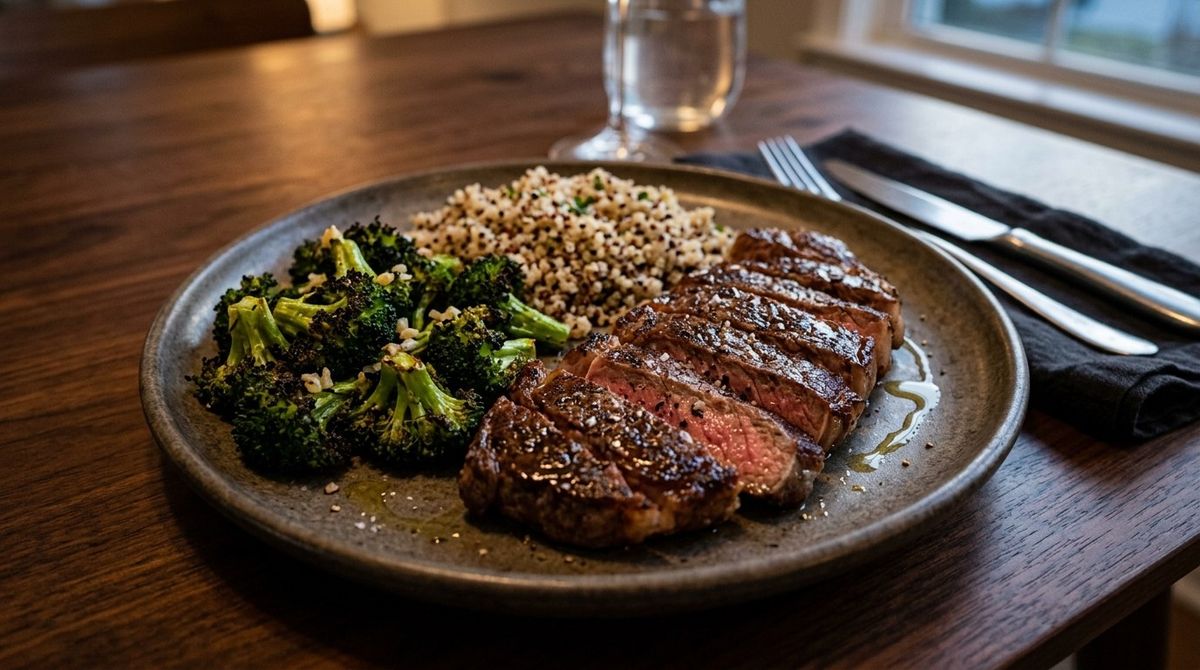
- Course 2 Protein Allocation (65%): Allocate \( 104\text{ g} \) of protein to the Minute \( 45\text{–}105 \) main course (such as \( 350\text{ g} \) cooked weight of ribeye steak, salmon, or poultry alongside roasted tubers and greens).
- Closure Protein Allocation (10%): Finish the final \( 16\text{ g} \) of protein during the Minute \( 105\text{–}120 \) closure window using \( 150\text{ g} \) of strained Greek yogurt or cottage cheese with berries.
Rule 5: Manage Weekend Clock Drift Using the 60-Minute Shift Formula
When a social dinner pushes your Saturday eating window later than your weekday schedule, letting the window expand to \( 4\text{ hours} \) breaks the \( 22:2 \) rhythm. Instead, apply a bounded \( \Delta t_{\text{shift}} \le 60\text{ min} \) adjustment so your fasting duration never drops below \( 21.0\text{ hours} \) on the transition day.
\[ D_{\text{transition fast}} = 22\text{ hr} + \Delta t_{\text{shift}} \]| Transition Day | Target Window Open (T_open) | Target Window Close (T_close) | Clock Shift (Delta t) | Preceding Fast Duration | Eating Window Length |
|---|---|---|---|---|---|
| Thursday (Baseline Weekday) | 17:00 | 19:00 | 0 min | 22.0 hr | 120 min (2.0 hr) |
| Friday (Pre-Weekend Shift) | 18:00 | 20:00 | +60 min later | 23.0 hr (Thu 19:00 to Fri 18:00) | 120 min (2.0 hr) |
| Saturday (Social Dinner Slot) | 19:00 | 21:00 | +60 min later | 23.0 hr (Fri 20:00 to Sat 19:00) | 120 min (2.0 hr) |
| Sunday (Reset Step-Back) | 18:00 | 20:00 | -60 min earlier | 21.0 hr (Sat 21:00 to Sun 18:00) | 120 min (2.0 hr) |
| Monday (Weekday Anchor Restored) | 17:00 | 19:00 | -60 min earlier | 21.0 hr (Sun 20:00 to Mon 17:00) | 120 min (2.0 hr) |
Frequently Asked Questions
What is the practical difference between a 22:2 schedule and 23:1 OMAD?
While both protocols qualify as single-daily-window schedules, \( 23:1 \) OMAD compresses all daily calories into a single \( 60\text{-minute} \) plate (\( 33.33\text{ kcal/min} \) at \( 2{,}000\text{ kcal} \)), whereas \( 22:2 \) provides a \( 120\text{-minute} \) window that accommodates a \( 20\text{-minute} \) starter course, a \( 25\text{-minute} \) pacing break, and a \( 60\text{-minute} \) main meal at half the gross caloric density rate (\( 16.67\text{ kcal/min} \)).
Does the 25-minute pause between Course 1 and Course 2 extend the eating window?
No; the \( 25\text{-minute} \) pause is already accounted for inside the \( 120\text{-minute} \) total duration between \( T_{\text{open}} \) (Minute \( 0 \)) and \( T_{\text{close}} \) (Minute \( 120 \)). The \( 22\text{-hour} \) fast clock begins strictly at Minute \( 120 \) when the closing course ends.
How can I calculate my exact 22:2 window if I work a rotating night shift?
Anchor \( T_{\text{open}} \) to occur \( 5\text{ hours} \) before your scheduled sleep onset so that \( T_{\text{close}} = (T_{\text{open}} + 2\text{ hr}) \bmod 24 \) finishes exactly \( 3\text{ hours} \) before bedtime. Enter your shift start and sleep times into the Intermittent Fasting Window Calculator to generate a custom 24-hour clock table.