16:8 and 18:6 Two-Meal & Bridge-Snack Protein Pacing Interval Schedule Formula: 6 Refractory Spacing & Pre-Sleep Buffer Calculations
Executive Chronological Scheduling Summary: Once you lock in a daily \( 16:8 \) (\( 8.0\text{-hour} \) feeding window) or \( 18:6 \) (\( 6.0\text{-hour} \) feeding window) intermittent fasting schedule, the most common logistical mistake is grazing continuously every \( 60 \text{ to } 90\text{ minutes} \) or cramming three full meals too close together. Continuous grazing eliminates inter-meal digestive rest, while cramming \( 140\text{ g} \text{ to } 180\text{ g} \) of daily protein into a single sitting causes evening fullness and sleep disruption. By applying the Two-Meal + Bridge-Snack (2.5-Pulse) Spacing Formula below, you can structure either \( 2\text{ anchor meals} \) (for \( 18:6 \)) or \( 2\text{ anchor meals} + 1\text{ targeted afternoon bridge pulse} \) (for \( 16:8 \)) separated by an exact \( 3.25\text{-to-}5.25\text{ hour} \) interval while preserving a strict \( 3.0\text{-hour} \) pre-sleep digestion buffer. Map your exact meal timestamps inside the Intermittent Fasting Window Calculator.
1. Calculation 1 & 2: Inter-Meal Spacing Interval Formula (\( \Delta t_{\text{spacing}} \)) Inside 8-Hour & 6-Hour Windows
As practitioners frequently ask in r/intermittentfasting 8-hour meal frequency threads, 16:8 daily clock-time schedule discussions, and eating-window meal-count breakdowns, an eating window of total duration \( W_{\text{eat}} \) (in hours) is bounded by the first bite of Meal 1 at \( T_{\text{open}} \) and the final bite of the last meal at \( T_{\text{close}} = T_{\text{open}} + W_{\text{eat}} \). If your final meal requires \( d_{\text{meal}} = 0.50\text{ hours} \) (\( 30\text{ minutes} \)) to consume before the window closes at \( T_{\text{close}} \), the Active Start-to-Start Span (\( W_{\text{span}} \)) and the Equal-Interval Spacing (\( \Delta t_{\text{spacing}} \)) across \( N_{\text{pulses}} \in \{2, 3\} \) discrete feeding events are:
\[ W_{\text{span}} = W_{\text{eat}} - d_{\text{meal}} \text{ hours}, \qquad \Delta t_{\text{spacing}} = \frac{W_{\text{eat}} - d_{\text{meal}}}{N_{\text{pulses}} - 1} \text{ hours} \]Let's compare the resulting inter-meal intervals across both \( 16:8 \) (\( W_{\text{eat}} = 8.0\text{ h} \)) and \( 18:6 \) (\( W_{\text{eat}} = 6.0\text{ h} \)) schedules assuming a standard \( d_{\text{meal}} = 0.50\text{ h} \) (\( 30\text{-minute} \)) dinner duration:
- \( 16:8 \) with \( N_{\text{pulses}} = 3 \) (
2.5-MealStructure: Meal 1 + Bridge Snack + Meal 2): \( W_{\text{span}} = 8.0 - 0.50 = 7.50\text{ hours} \), yielding an inter-meal spacing of \( \Delta t_{\text{spacing}} = \frac{7.50}{3 - 1} = 3.75\text{ hours} \) (\( 3\text{ hours } 45\text{ minutes} \) between feeding starts)—landing right inside the ideal \( 3.5\text{ to } 4.5\text{ hour} \) digestive clearance window! - \( 16:8 \) with \( N_{\text{pulses}} = 2 \) (Strict Two-Meal Structure): \( \Delta t_{\text{spacing}} = \frac{7.50}{2 - 1} = 7.50\text{ hours} \) between Meal 1 and Meal 2 (ideal for sedentary desk schedules with zero afternoon hunger).
- \( 18:6 \) with \( N_{\text{pulses}} = 2 \) (Strict Two-Meal Structure): \( W_{\text{span}} = 6.0 - 0.50 = 5.50\text{ hours} \), yielding \( \Delta t_{\text{spacing}} = 5.50\text{ hours} \) between Meal 1 and Meal 2. Trying to force \( 3\text{ full meals} \) into an \( 18:6 \) window compresses spacing down to \( \frac{5.50}{2} = 2.75\text{ hours} \), causing overlapping gastric fullness.
| Fasting Protocol & Window | Feeding Structure (\( N_{\text{pulses}} \)) | Meal 1 (Open) Timestamp | Bridge Pulse Timestamp | Final Meal (Start – Close) | Inter-Meal Interval (\( \Delta t_{\text{spacing}} \)) | Protein Distribution (\( 160\text{ g} \) Target) |
|---|---|---|---|---|---|---|
16:8 Standard (12:00–20:00) |
\( 2.5\text{ Meals} \) (2 Meals + Bridge) | 12:00 PM |
3:45 PM |
7:30 PM – 8:00 PM |
\( 3.75\text{ Hours} \) (\( 3\text{h } 45\text{m} \)) | \( 60\text{ g} + 35\text{ g} + 65\text{ g} \) |
16:8 Early (10:00–18:00) |
\( 2.5\text{ Meals} \) (2 Meals + Bridge) | 10:00 AM |
1:45 PM |
5:30 PM – 6:00 PM |
\( 3.75\text{ Hours} \) (\( 3\text{h } 45\text{m} \)) | \( 60\text{ g} + 35\text{ g} + 65\text{ g} \) |
16:8 Strict Two-Meal (12:00–20:00) |
\( 2.0\text{ Meals} \) (No Snack) | 12:00 PM |
None (Clean Bridge) | 7:30 PM – 8:00 PM |
\( 7.50\text{ Hours} \) (\( 7\text{h } 30\text{m} \)) | \( 80\text{ g} + 0\text{ g} + 80\text{ g} \) |
18:6 Standard (13:00–19:00) |
\( 2.0\text{ Meals} \) (Optimal 18:6) | 1:00 PM |
None (Clean Bridge) | 6:30 PM – 7:00 PM |
\( 5.50\text{ Hours} \) (\( 5\text{h } 30\text{m} \)) | \( 75\text{ g} + 0\text{ g} + 85\text{ g} \) |
18:6 High-Output (12:00–18:00) |
\( 2.5\text{ Meals} \) (Compact Mini-Bridge) | 12:00 PM |
2:45 PM (Whey/Yogurt) |
5:30 PM – 6:00 PM |
\( 2.75\text{ Hours} \) (\( 2\text{h } 45\text{m} \)) | \( 65\text{ g} + 30\text{ g} + 65\text{ g} \) |
2. Calculation 3 & 4: The \( 2.5\text{-Meal} \) Protein Pacing Allocation Formula (\( P_1, P_{\text{bridge}}, P_2 \))
For active individuals targeting \( P_{\text{daily}} = 1.6 \text{ to } 2.0\text{ g/kg} \) of lean body mass (for example, \( P_{\text{daily}} = 160\text{ g/day} \) for an \( 82\text{ kg} / 180\text{ lb} \) adult), eating \( 80\text{ g} \) of whole-food protein in two sittings is straightforward, whereas hitting \( P_{\text{daily}} = 190\text{ g/day} \) in two sittings often feels overly heavy. Under the \( 2.5\text{-Meal} \) Partitioning Rule (\( 37.5\% / 22.0\% / 40.5\% \) split), you allocate daily calories \( E_{\text{daily}} \) and protein \( P_{\text{daily}} \) across the three timed pulses so every feeding exceeds the \( 30\text{ g} \) amino-acid threshold without overloading midday digestion:
\[ P_1 = 0.375 \cdot P_{\text{daily}}, \qquad P_{\text{bridge}} = 0.220 \cdot P_{\text{daily}}, \qquad P_2 = 0.405 \cdot P_{\text{daily}} \]For a \( E_{\text{daily}} = 2{,}200\text{ kcal} \), \( P_{\text{daily}} = 160\text{ g} \) daily target on a 12:00 PM – 8:00 PM (\( 16:8 \)) schedule:
- Pulse 1 (
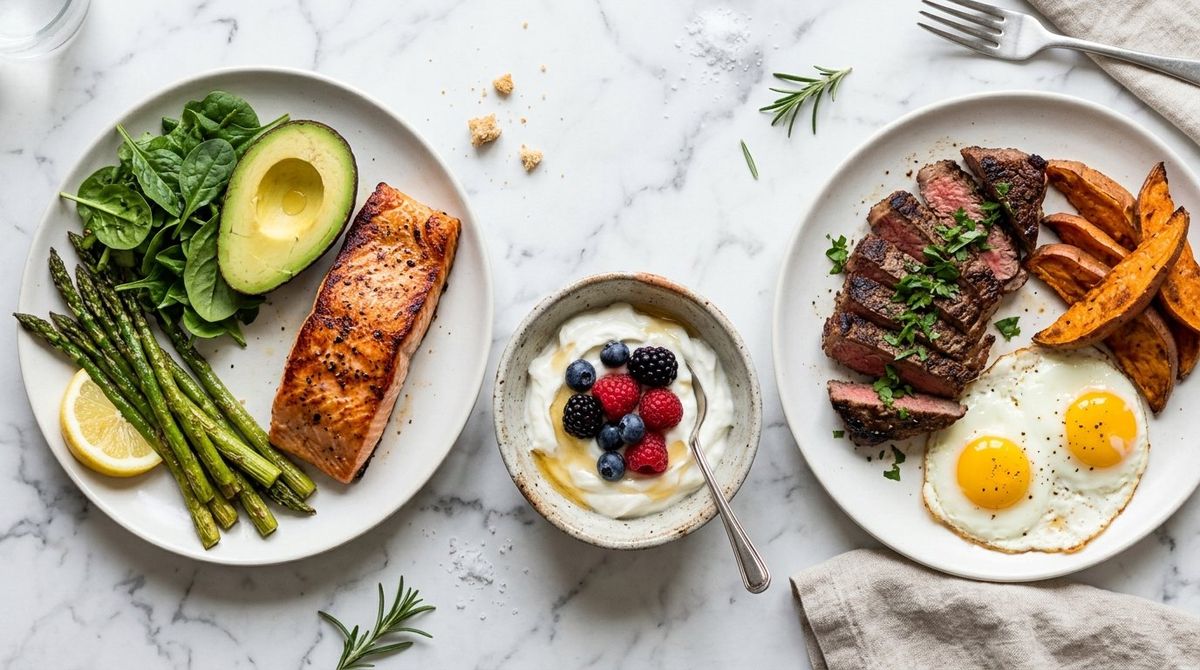
12:00 PM— Window-Opening Anchor Meal): \( 825\text{ kcal} \) / \( 60\text{ g protein} \) (e.g., \( 220\text{ g} \) grilled chicken breast or wild salmon, avocado, greens, and olive oil). - Pulse 2 (
3:45 PM— Targeted Bridge Snack, \( +3.75\text{ h} \) later): \( 485\text{ kcal} \) / \( 35\text{ g protein} \) (e.g., \( 250\text{ g} \) plain Greek skyr/yogurt with berries and pumpkin seeds, or a clean isolate shake + handful of almonds). Because this is a compact, low-volume bridge rather than a heavy starch meal, gastric emptying completes well before dinner. - Pulse 3 (
7:30 PM – 8:00 PM— Window-Closing Dinner, \( +3.75\text{ h} \) later): \( 890\text{ kcal} \) / \( 65\text{ g protein} \) (e.g., \( 200\text{ g} \) grass-fed steak or fish, two pasture-raised eggs, and roasted root vegetables).
3. Calculation 5 & 6: Pre-Sleep Digestion Buffer (\( B_{\text{sleep}} \)) & Morning Hydration Checkpoints
To prevent late-evening heartburn and elevated nocturnal resting heart rate, anchor your evening window closure time \( T_{\text{close}} \) backward from your habitual sleep onset time \( T_{\text{sleep}} \) using a minimum \( B_{\text{sleep}} = 3.0\text{-hour} \) pre-sleep digestion buffer:
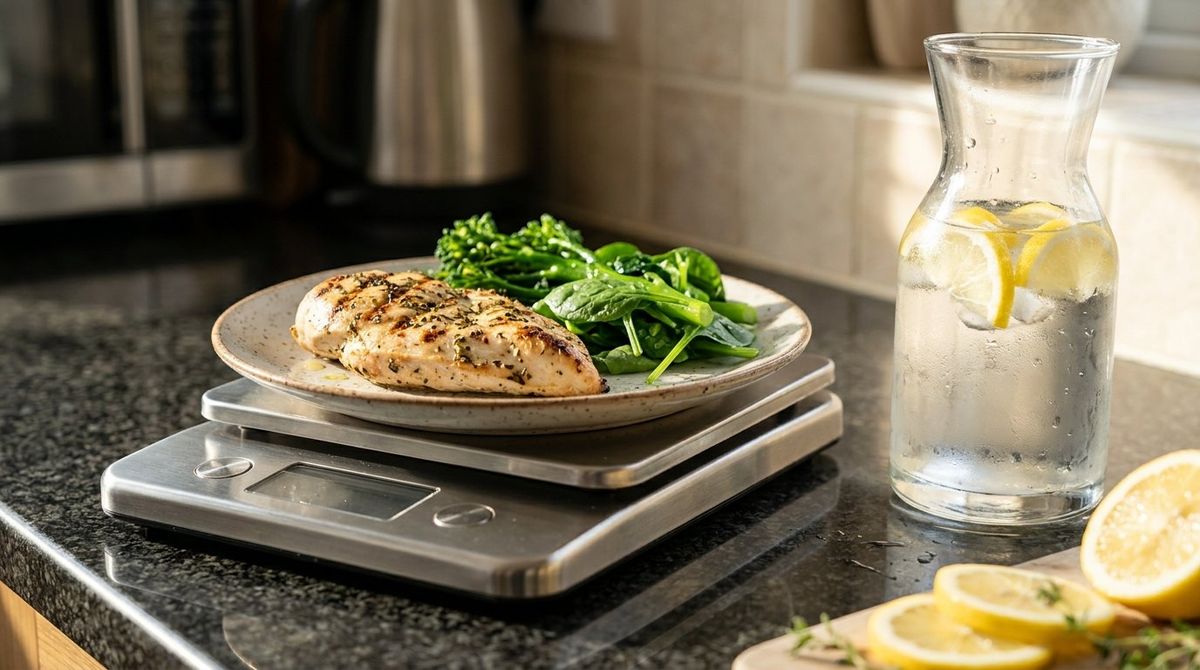
\[ T_{\text{close}} \le T_{\text{sleep}} - B_{\text{sleep}}, \qquad T_{\text{open}} = T_{\text{close}} - W_{\text{eat}} \]For a 11:00 PM (\( 23:00 \)) bedtime with \( B_{\text{sleep}} = 3.0\text{ hours} \), your eating window must close no later than \( T_{\text{close}} = 8:00\text{ PM} \) (\( 20:00 \)), placing your \( 16:8 \) opening bell at \( 12:00\text{ PM} \) or your \( 18:6 \) opening bell at \( 2:00\text{ PM} \). During the morning fasted block (7:00 AM – 12:00 PM), schedule two \( 500\text{ mL} \) plain mineral water + pinch of sea salt checkpoints (7:30 AM and 10:00 AM) so mild morning dehydration is never mistaken for early hunger.
Generate Your Custom 16:8 or 18:6 Meal & Protein Pacing Timetable
Enter your wake-up time, bedtime, and preferred 16:8 or 18:6 protocol to calculate your exact Meal 1, Bridge Snack, and Meal 2 clock timestamps.
Open the IF Window Calculator